
Planning Commission recommends Habitat for Humanity 5‑unit affordable project to City Council, with parking limits
Get AI-powered insights, summaries, and transcripts
Subscribe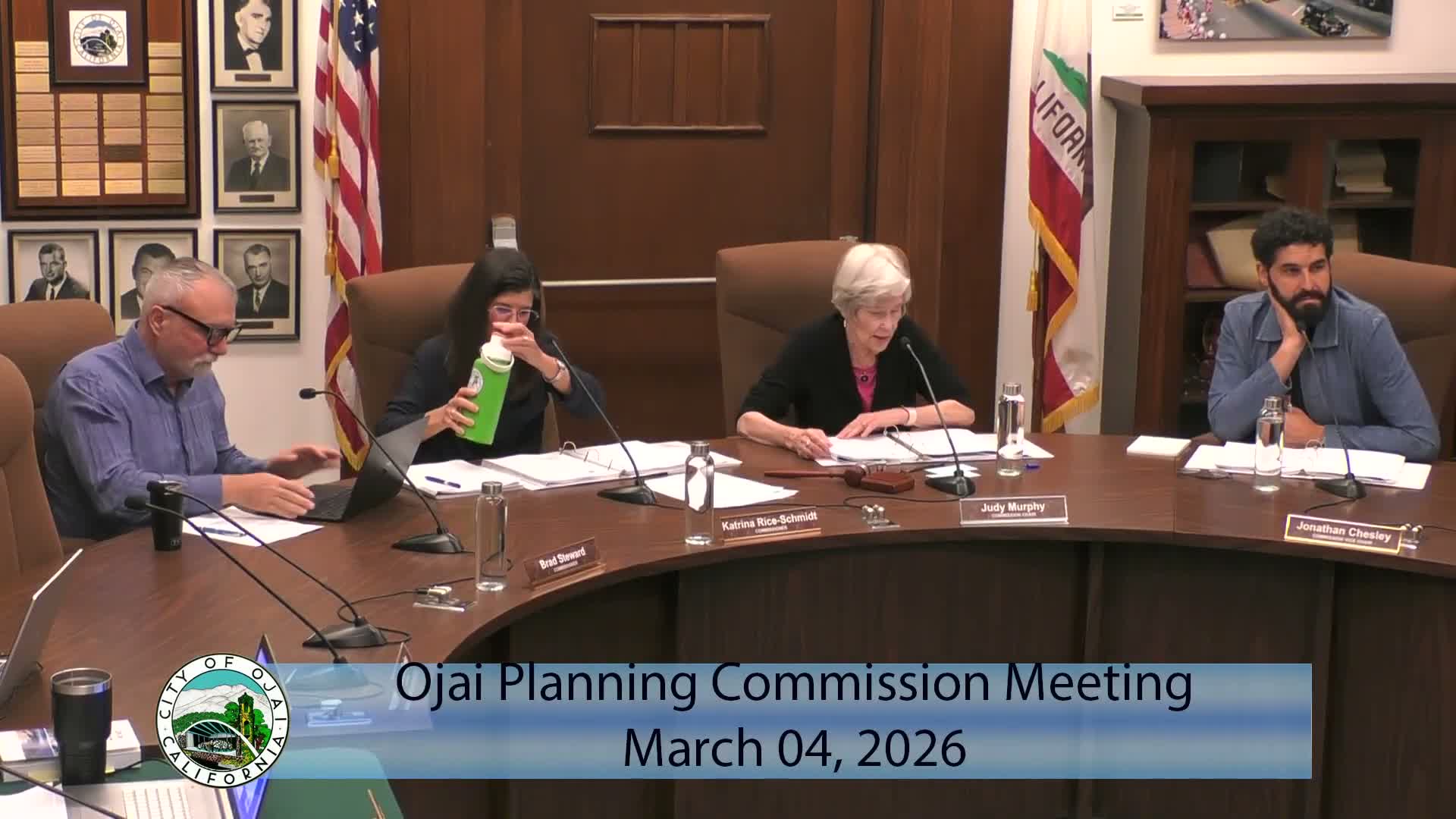
Summary
After a lengthy discussion about parking, maintenance and local preference, the commission unanimously recommended City Council approve a five‑unit, deed‑restricted affordable housing project proposed by Habitat for Humanity, and asked council to adopt parking limits and finalize the land‑lease and maintenance arrangements.
The Ojai Planning Commission voted unanimously on March 4 to recommend that City Council approve a proposed five‑unit, deed‑restricted 100% affordable housing project on North Montgomery Street developed by Habitat for Humanity. Commissioners attached a recommendation limiting parking — one space per tiny home unit and two spaces for the project’s larger two‑bedroom unit — and asked council to finalize land‑lease and maintenance arrangements.
Darcy Taylor, CEO of Habitat for Humanity Ventura County, told commissioners the project is designed to house seniors, veterans and low‑income households who live or work in Ojai and emphasized adaptations to Habitat's usual "sweat equity" model to accommodate elderly applicants. Taylor said the project is the result of a multi‑year partnership with the city to make affordable homeownership opportunities available in Ojai.
Staff explained the project is proposed as a five‑unit development in part to preserve eligibility for housing project incentives tied to a five‑unit baseline; reducing the project to four units could shift the review into a variance process and remove density bonus incentives the project relies on. The commission heard technical presentations on site layout, a tentative tract map, landscaping and wildfire‑resilient plant choices from the project team and from landscape architect Brian Brodersen.
Public commenters generally supported the project but urged refinements. John Trent and other neighbors voiced concerns about parking and traffic on Montgomery and Franklin streets and asked the commission to consider additional red curbing or a three‑way stop at Franklin and Montgomery. Heidi Whitman and Janine Walker supported the project but requested clarity about deed restrictions, long‑term affordability and how maintenance will be handled if the city retains ownership of the land under the proposed leases.
Commissioners discussed alternatives — keeping five units while reconfiguring parking, or moving some units to two stories to accommodate more off‑street parking — and emphasized the need for clear local preference language, deed restrictions, and definitive maintenance obligations. Staff and the applicant explained that because Habitat would not own the land (a lease model), the city and Habitat are negotiating maintenance and long‑term affordability protections, including deed restrictions and resale rules required by the affordable‑housing agreement.
The commission’s motion recommended that City Council approve the five‑unit, single‑story, deed‑restricted affordable housing project and suggested a parking restriction that limits vehicle spaces for the tiny homes to one per unit (and two spaces for the larger unit). The motion passed unanimously on roll call and will be forwarded to City Council, which has final authority over the tract map, land lease and any funding or maintenance commitments.
Next steps include the council review of the tentative tract map and the land‑lease/maintenance agreement; commissioners encouraged the city to consider a three‑way stop at Franklin and Montgomery and to work with public works on curb markings and enforcement.