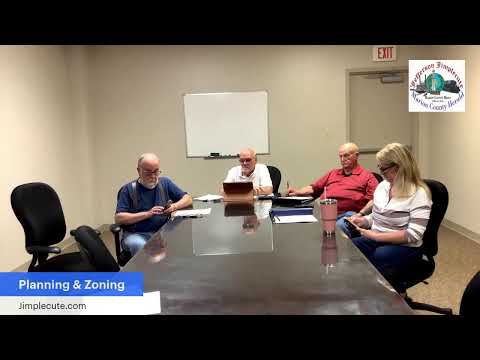
Jefferson Pleasant planning commissioners pause permit reviews while zoning rewrite and enforcement plan progress

City of Jefferson Pleasant Planning and Zoning Commission · March 4, 2026

Get AI-powered insights, summaries, and transcripts

Subscribe
AI-Generated Content: All content on this page was generated by AI to highlight key points from the meeting. For complete details and context, we recommend watching the full video. so we can fix them.

Summary

At a March 3 Planning & Zoning meeting, the commission reviewed a draft zoning ordinance, received legal guidance that National Register listing does not itself allow local property restrictions, discussed manufactured‑home rules and inspection needs, and voted unanimously to pause routine building‑permit reviews until enforcement arrangements and ordinance details are settled.

The City of Jefferson Pleasant Planning & Zoning Commission reviewed the final draft of a proposed zoning ordinance and received legal guidance about how — and when — the city can add enforceable restrictions in its federally recognized historic district.

The commission met at 5 p.m. March 3. Catherine Shamay, an associate attorney with the city attorney’s office, told the panel that listing on the National Register of Historic Places provides designation and grant eligibility but “it doesn't allow you the ability to regulate or encumber” property owners within the district by itself. She said state process under the Local Government Code (chapter 211/211.0165) governs whether the city can impose restrictions, and that enforceable restrictions require property‑owner consent or specific council action under the statute.

That distinction matters because commissioners said the Historic District boundaries, originally defined in 1971 and later ratified by the council, were adopted without property‑owner consent. Commissioners discussed whether to pursue additional local regulations — such as architectural requirements for new construction in the overlay — and whether to follow Department of the Interior standards or craft a local regulatory regime. Shamay offered to provide templates and resources and said the attorney’s office would supply guidance about the state‑law process the city must follow to make restrictions binding.

The meeting also examined how the draft ordinance treats manufactured and mobile homes. The associate attorney noted state code definitions: older manufactured homes (commonly described as pre‑1976 units) can be restricted from new placement, while HUD‑code manufactured homes and modular units are treated differently under state law. Commissioners discussed language that would bar placement of older nonconforming manufactured homes and require replacement with HUD‑code or modular homes when a nonconforming unit is replaced.

Commissioners stressed that an ordinance is only effective if the city can enforce it. The panel discussed past negotiations with a consultant (Willdan was referenced) to provide building‑code official services, inspections and code review. The group agreed the city lacks an in‑house building code official and that a consultant or contracted firm should provide inspection services, code reviews and help set permit‑application requirements. Options discussed included a per‑inspection fee schedule, administrative and reinspection fees charged to contractors or homeowners, and a contract structured as fee‑for‑service or a not‑to‑exceed amount. Staff and the attorney’s office agreed to review a draft scope of work and provide examples from similar municipalities.

The commission also reviewed recent ordinance changes on setbacks and variances, noting the council had limited variances so that side and rear variances would no longer be granted; only front‑yard variances are allowed where structures align with neighboring buildings.

Faced with significant outstanding questions about the ordinance text, enforcement staffing and contract structure, the commission voted to pause its review of building‑permit applications until the zoning ordinance and enforcement mechanisms are further developed. A motion to stop reviewing permits was made, seconded and carried by unanimous voice vote; individual mover and seconder were not recorded in the transcript.

The commission entered the resignation of long‑serving member Hugh Lewis (effective Feb. 27, 2026) into the record and set an expectation that the attorneys would provide feedback on the draft RFP for consultant services before the next meeting, targeted for April 7.

Next steps: staff will circulate the consultant scope of work and the attorneys will provide suggested examples and statutory guidance; the commission will reconvene to consider the attorney feedback and further refine the ordinance and enforcement approach before resuming permit reviews.