Committee hears urgent calls to tighten elevator rules as state weighs code cycle change
Loading...
Summary
State Department of Administrative Services warned the committee that a proposed statewide elevator enforcement scheme would require more staff and funding, while firefighters, police and residents urged stronger oversight and municipal enforcement tools to prevent life‑threatening outages in high‑rise housing.
Lawmakers and first responders pressed for stronger tools to keep elevators in tall residential buildings working after repeated outages that they said have delayed medical care and trapped elderly and disabled residents.
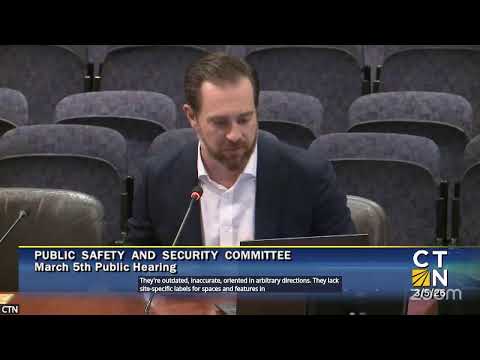
At a March 5 Public Safety and Security Committee hearing, Department of Administrative Services Commissioner Michelle Gilman told legislators that while the department supports the safety goals behind Senate Bill 369 it lacks the staff and systems to carry out some of the centralized enforcement measures the bill would require. Gilman said many of the bill’s goals are being addressed in the 2026 Connecticut State Building Code, scheduled to take effect July 1, 2026, but cautioned that provisions such as relocating tenants or recouping costs from owners could create new administrative and legal workloads for the agency.
Omeris Vasquez, the state building inspector introduced by DAS, explained the state’s existing ‘‘red tag’’ practice: recurring inspections (generally every 18 months) can lead to a red tag when inspectors identify life‑safety violations; red‑tagged elevators are not permitted to be returned to service until repaired and re‑inspected by the state. Vasquez and DAS staff told the committee that the new building code section being developed would explicitly empower local building officials to order abatement, tag equipment out of service and report those actions to DAS so the department can freeze certificates and coordinate follow‑up.
Several committee members and witnesses pushed back on the notion that enforcement should rest solely at the state level. Representative Paolo and others said municipalities and local fire marshals have better situational awareness of chronic problem buildings. DAS agreed the local model could be faster and more efficient for responding to frequent complaints: Vasquez said the department had recorded roughly 5,000 entrapment or complaint calls between 2020 and 2024 that can strain statewide inspection resources.
Public testimony focused on concrete harms. Assistant Chief Shakira Samuel of the New Haven Fire Department described high‑rise housing with thousands of residents, some dependent on oxygen or mobility aids; she called reliable elevators and emergency power generation ‘‘a lifeline’’ for seniors and people with disabilities. Multiple legislators recounted cases in which residents missed critical medical appointments or where emergency responders had to carry equipment many flights of stairs because elevators were inoperable.
Some lawmakers urged a hybrid approach: preserve state oversight on certificate freezes and life‑safety interpretations while delegating day‑to‑day enforcement and penalties to municipalities and building officials, supported by DAS advisories and code interpretations. Representative Paolo and others requested DAS provide the committee the specific code sections and timelines by which municipal officials should act; DAS agreed to deliver those materials.
The committee also debated House Bill 5401, which would extend the code‑adoption cycle from three to six years. Builders and trade groups urged a longer cycle for predictability and lower near‑term costs; DAS and building‑safety advocates warned a multi‑year moratorium could delay adoption of energy, resiliency and life‑safety improvements and produce a regulatory lag between Connecticut and national model codes.
No final action was taken at the hearing. Committee members asked DAS to follow up with the precise code language that will take effect July 1 and to provide estimates of staffing and budget implications for statewide enforcement if DAS were required to take on expanded elevator enforcement duties.