MCPS proposes tiered staffing standards and class‑size ratios; elementary rollout set for FY27

Education & Culture Committee, Montgomery County Council · March 6, 2026

Get AI-powered insights, summaries, and transcripts

Subscribe
AI-Generated Content: All content on this page was generated by AI to highlight key points from the meeting. For complete details and context, we recommend watching the full video. so we can fix them.

Summary

Montgomery County Public Schools presented a working draft of new staffing standards that would set tiered class‑size ratios based on FARMS, school size and enrollment; the plan phases elementary implementation in FY27 and projects a net FY27 staffing impact of about −98 FTEs under current projections.

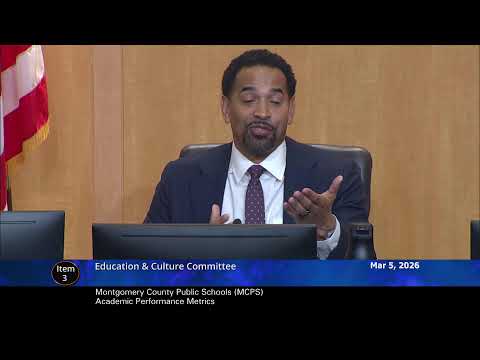
Montgomery County Public Schools told the Education & Culture Committee on March 5 that it is proposing a new, tiered staffing‑standard model to replace loose guidelines and make staffing allocations more transparent and equitable.

MCPS representatives said the standards use three primary inputs — Free & Reduced‑Price Meal (FARMS) participation tiers, school size and enrollment — to allocate staff and set ranges that would cap class sizes by tier. "Having a tiered system for determining staffing support based on FARMS rate allows us to more effectively differentiate additional support where we need it most," MCPS staff said.

Alan Francois, deputy chief of finance leading the project team, presented high‑level goals including consistency, transparent allocations, financial predictability and targeted supports "to make sure that schools and school communities understand how we are allocating resources to schools." The presentation showed examples: for some elementary grades the plan starts from ratios such as 1 teacher to 18 (tier 3/highest need) and 1 to 23 (base tier) as a planning starting point; MCPS said some secondary ratios will be planned but implemented later.

The district described a phased implementation: elementary staffing and selected special‑education ratios would begin in FY27; middle schools would be phased in starting FY28 and high‑school changes later. MCPS also proposed additional special‑education resourcing tied to least‑restrictive‑environment (LRE) categories and a plan for English‑language development supports.

Council staff referenced a projection that, at the high end, 3,383 new FTEs could be needed under full implementation; MCPS staff said enrollment dynamics reduce near‑term needs and that for the FY27 proposal projected a net decrease of about 98 FTEs after reductions and other adjustments. "The highest number would be 3,383 new FTEs... but for the FY27 proposal there's a reduction of 518 FTEs... resulting in a net of a decrease of 98 for FY27," a district presenter said.

Council members sought clarifications about FARMS data quality, whether administrators and students would be included in stakeholder feedback, and how the district would treat schools that previously relied on principals' requests for additional staff. MCPS said the staffing standard remains a working draft and that staff will reconvene work groups with principals, teachers and association representatives to pressure‑test the plan. "This staffing standard is marked as a working draft," MCPS staff said; "we can make tweaks. We can listen to our stakeholders."

Members also raised implementation concerns tied to the budget, including whether discontinuing certain assistant positions (ASAs) or shifting them from 11‑ to 12‑month status would affect school operations. MCPS said some changes are budget‑dependent and that the staffing standards aim to reduce subjective, request‑based allocations.

Next steps identified at the meeting included follow‑up materials requested by council members: a clearer multi‑year projection of staffing impacts, a breakdown of the FY27 FTE changes by school level and additional stakeholder engagement plans. MCPS said it will return with further detail and that checkpoints in the school year (April 15 and May 15) will be used to run school numbers and allocate resources under the new model.