Get Full Government Meeting Transcripts, Videos, & Alerts Forever!
Get email alerts on the Persistent Poverty Connectivity topic
No spam. Unsubscribe anytime.
Commuting data shows persistent-poverty neighborhoods are often economically and socially 'disconnected,' presenter says
Summary
Kennan Fickry, a senior fellow at EIG, told a U.S. Census Bureau webinar that LEHD/LODES commuting and social-connection measures reveal many census tracts labeled persistently poor are isolated from nearby opportunity, and he discussed implications for policy tools such as opportunity zones.
Kennan Fickry, a senior fellow at the Economic Innovation Group (EIG), told a U.S. Census Bureau Local Employment Dynamics webinar in July that commuting and social-network data show many persistently poor census tracts are economically and socially disconnected from surrounding areas, limiting residents’ access to jobs and upward mobility.
Fickry said the analysis uses LEHD/LODES origin-destination commuting matrices and linked social-data measures to identify how strongly people in a tract are tied into broader regional economic flows. “Persistent poverty as places that have registered a poverty rate of at least 20% for at least 3 decades,” he said, and added that tract-level analysis shows a far larger affected population than county-level measures capture.
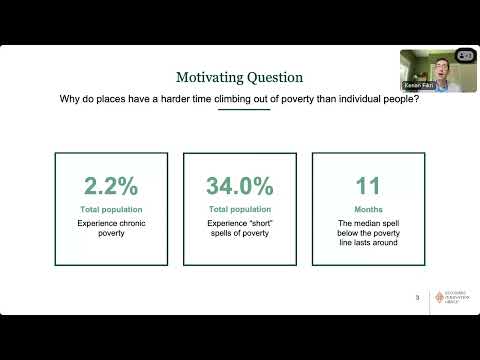
Why it matters: Fickry argued that county-level statistics can hide concentrated neighborhood disadvantage. He cited a Census Bureau longitudinal analysis of 2013–2016 data showing about 2.2% of the U.S. population experienced chronic poverty over that period and said tract-based work shows roughly 34 million Americans live in persistently poor census tracts. Those residents, he said, often lack commuting ties to growing employment centers and have fewer cross-class social ties that foster mobility.
Key findings and methods: The project visualizes tract-to-tract commuter flows and emphasizes pairs with substantial commuter counts to reveal whether persistently poor tracts are integrated into regional employment networks. In Chicago, Fickry showed, many persistently poor tracts sit outside the main north–south commuter flows into the central business district; in Columbus he described a “suburb-to-suburb” mesh that leaves persistently poor tracts with few strong links to core employment hubs. He also noted variation across places: in some Western counties persistent poverty coexists with rapid growth, and downtown census tracts — which sometimes meet low-income criteria because of small resident populations, public housing or student housing — can distort aggregate connectivity summaries.
Data sources and limitations: Fickry said the analysis relies on official poverty measures because the supplemental poverty measure lacks the geographic and longitudinal detail needed for decades-long tract comparisons. He cited Opportunity Insights and linked IRS/Facebook-based measures for social connectedness and emphasized the LEHD/LODES commuting data as the core connectivity metric. He warned that downtown tracts can produce misleading signals and suggested treating downtowns as a separate analytic category when policy decisions (for example, opportunity-zone designations) are at stake.
Policy application and examples: Fickry proposed that governors and planners could use the connectivity method to inform designations and investments. He noted opportunity zones were often designated to include downtown tracts in 2017 and said the reconciliation bill will again require governors to nominate qualifying low‑income tracts; his method could help identify downtowns so policymakers can weigh whether to prioritize them.
Audience questions and clarifications: During Q&A, Fickry confirmed the 2.2% chronic-poverty figure comes from a Census Bureau longitudinal analysis of 2013–2016 data and said pandemic-era stimulus likely altered more recent poverty dynamics. He told attendees the EIG interactive maps and a report (Advancing Economic Development in Persistent Poverty Communities) are available online, and he offered to share shapefiles and data upon request. On tribal lands, he acknowledged unique legal and social contexts and cautioned reconnection strategies must respect tribal identity and governance.
What’s next: The Census LED team will post the recording, slides and supplemental materials on the Census Academy website within 30 business days. Fickry encouraged researchers and local practitioners to collaborate on refining downtown classification and on case studies of places that successfully moved out of persistent-poverty status.
Closing note: The webinar concluded with an announcement of future LED events and a call for further questions and follow-up via email.