
Medicaid director warns CNMI cannot expand nursing-home care without consistent local matching funds
Get AI-powered insights, summaries, and transcripts
Subscribe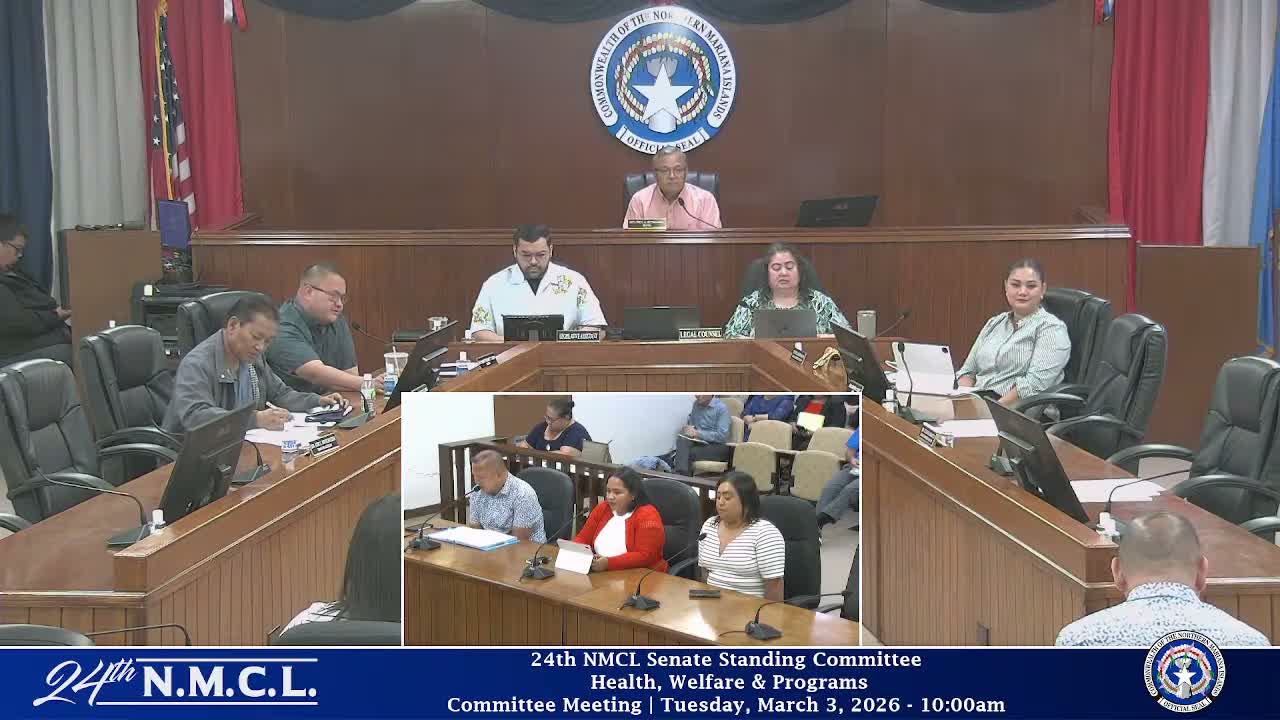
Summary
Senate committee hearing heard advocates and agency officials say the Commonwealth lacks the local match needed to unlock federal Medicaid dollars for long-term care; Medicaid director George Cruz called declining local allocations a practical barrier to nursing homes and home- and community-based services.
Senate Standing Committee members heard urgent testimony that the Commonwealth cannot build or sustain new long-term care services without steady local matching funds.
George Cruz, director of the Commonwealth Medicaid Agency, told the committee that Medicaid long-term care services depend on a local match that unlocks federal participation. "For every 17¢ the Commonwealth spends locally, the federal government contributes 83¢," Cruz said, warning that recent decreases in local allocations have reduced the agency’s capacity to expand services and that the agency has been short of its required match in recent years. He said the CMA paid out roughly $127,000,000 in reimbursements last fiscal year and that the commonwealth missed several million dollars in potential federal drawdown because local matching funds fell short.
The testimony followed accounts from advocates and CHCC staff describing patients who remain hospitalized because no caregiver or placement was available. "These are patients admitted with no caregiver, no place to go," Dr. Chelsea Cabrera, an elder-care advocate, said in public comment, recounting four cases she has raised before the committee. CHCC’s Helena Palacios described the hospital’s constraints and said CMS safe-discharge rules prevent releasing patients without adequate home supports. "We actually cannot just let people go whether or not they have a home," Palacios said, adding that social workers sometimes work with embassies for non-U.S. nationals but that capacity is limited.
Committee members and invited officials flagged policy steps and financing options. Witnesses discussed creating a regulatory framework and licensing oversight for nursing facilities, potential use of existing assets such as converted hotels or alternative-care sites, and the possibility of seeking additional federal help. Jose Chrysostomo, executive officer for Veterans Affairs, said the VA’s caregiver and veteran facility programs offer models worth reviewing.
Cruz laid out the practical limits: state-plan changes or new services require money to be sustained. He said the CMA had been budgeted lower local matching amounts in recent years (he cited multi-year local allocation declines), and estimated that a full local match to maximize federal resources would require between $9 million and $11 million in local funds under current federal shares; he also said a $3.5 million shortfall in a prior year cost the commonwealth tens of millions in unrealized federal reimbursements.
Senators on the panel urged prioritizing local matching funds and exploring targeted revenue earmarks or one-time appropriations to secure federal matches. Several members asked the CMA and CHCC to develop specific cost estimates and a regulatory bill to designate an oversight authority for licensing, inspection and certification of long-term care facilities.
Next steps: committee members agreed to pursue drafting regulatory language for oversight and to continue discussions about funding approaches and federal advocacy; the committee tabled the listed bills for a later meeting and adjourned.