
Committee deadlocks on ordinance to restrict private memorials on public property
Get AI-powered insights, summaries, and transcripts
Subscribe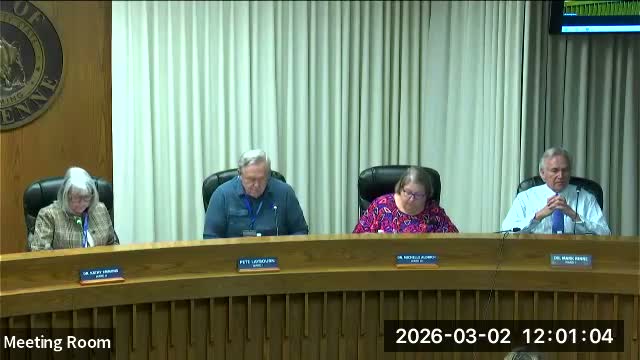
Summary
After public comment and committee debate, the Cheyenne Public Service Committee did not forward a recommendation on a proposed ordinance (chapter 8.72) that would regulate unauthorized private displays on public property; an amendment to reduce the proposed fine failed for lack of a second.
A proposed ordinance that would create chapter 8.72 to regulate private displays on public property failed to win a committee recommendation March 2 after public testimony and council debate.
The ordinance, described briefly by Deputy City Attorney David Hopkinson as creating a new regulatory chapter for private displays on public property, drew several public commenters who urged opposite outcomes. "It is really bad for culture when we criticize how other people mourn and when we remove opportunities that allow them to mourn," said Chelsea McCourt (Ward 1). She and others urged the council not to criminalize roadside memorials.
Supporters of the ordinance, including some council members, framed the measure as a response to constituent complaints and a means of setting consistent parameters for memorials. Hopkinson said the statutory maximum penalty for an ordinance violation can be a misdemeanor: "...you're looking at a misdemeanor, 6 months in jail, $750 fine," though he and members noted that $750 is a statutory maximum that courts rarely invoke.
Councilwoman Aldridge moved to approve the ordinance on third and final reading; Councilman Layborn seconded. Aldridge then proposed an amendment to reduce the maximum fine in section (c) from $750 to $50, but the amendment "died for lack of a second," and the committee returned to consideration of the ordinance as drafted.
After further discussion about the ordinance’s origins and enforcement, the committee called the vote. With ayes and nos recorded, the chair stated "there will be no recommendation based on the failure of the vote," meaning the committee did not forward a recommendation on the ordinance to the full governing body.
Why it matters: the ordinance seeks to balance public‑property management and roadway safety concerns with residents’ desire to memorialize loved ones in visible public locations. Public commenters framed the issue as both cultural and practical; council members cited constituent complaints and the need for consistent parameters.
Next steps: Because the committee did not make a recommendation, the item will not be forwarded with a committee endorsement at this time; any future action will depend on how the governing body chooses to proceed or whether the item returns to a committee for reconsideration.