
CDTA outlines Transit Development Plan, warns of funding shortfall and plans service rebalancing
Get AI-powered insights, summaries, and transcripts
Subscribe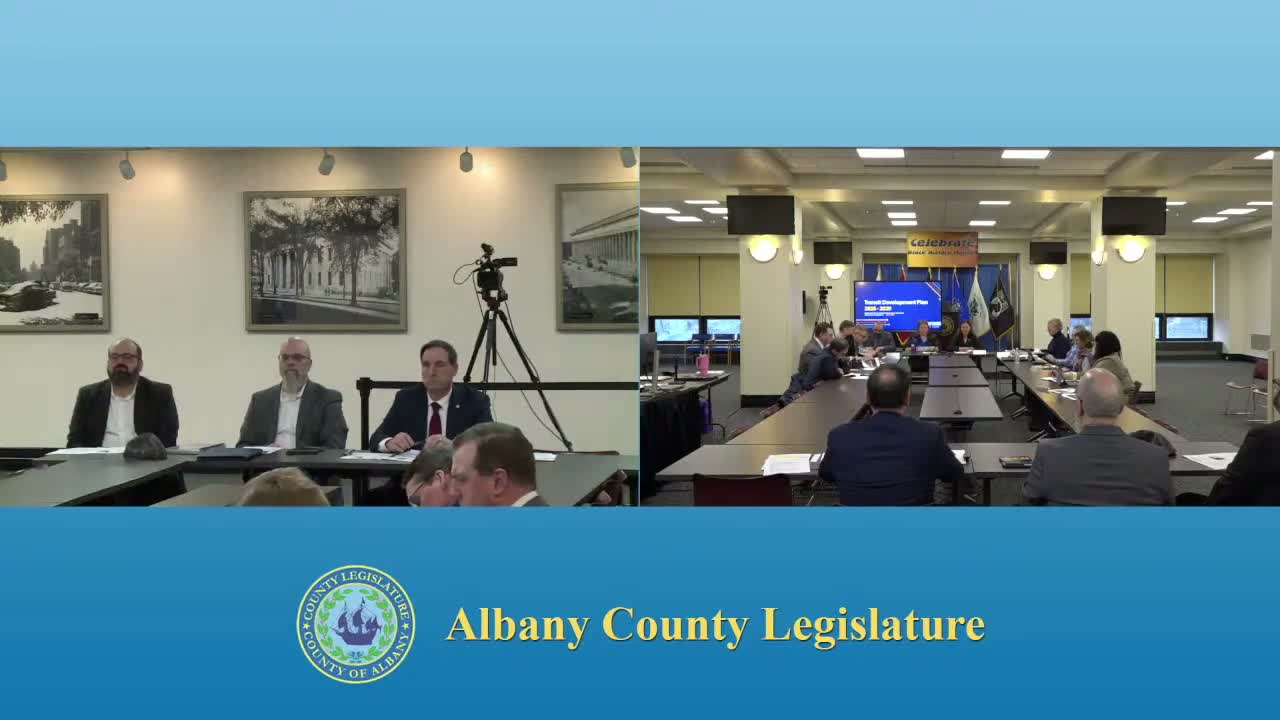
Summary
CDTA presented a 342‑page Transit Development Plan and said it will rebalance service to align with post‑COVID ridership, expand targeted on‑demand services and press for more stable state funding; legislators pressed the agency on a discontinued courthouse stop, shelter safety and paratransit access.
Frank Anacaro, chief executive officer of the Capital District Transportation Authority, told the Multimodal Transit and Pedestrian Access Committee that CDTA is executing a multi‑phase Transit Development Plan and rebalancing service to match current ridership and fiscal constraints.
Anacaro said the plan — described during the meeting as a 342‑page roadmap the agency’s board approved in September — recommends concentrating service on high‑ridership corridors, eliminating costly route deviations, splitting overly long routes and expanding lower‑cost flex and point‑to‑point services in low‑density “transit‑desert” areas. “We’re focusing our effort on ensuring that our service matches today’s real world demand,” Anacaro said. “That means improving reliability, eliminating redundancy and aligning service levels with actual ridership.”
Why it matters: CDTA officials said COVID reserve funds have largely been spent and the authority lacks the dedicated revenue streams available to larger systems, complicating long‑range planning. Anacaro urged stable state funding as a priority: “Unlike the MTA, we do not have many dedicated revenues. Very few,” he said, adding CDTA is lobbying during the legislative session for steadier operating support.
Plan highlights and tradeoffs: The TDP cites past investments — including about 40 miles of bus rapid transit lines and expanded micromobility pilots — and recommends continued investment in mobility hubs, shelters and real‑time information on high‑ridership corridors. CDTA plans to extend its cycle (bike‑share) season where feasible, explore discounted access for priority riders and lean more heavily on flex on‑demand vehicles in lower‑demand areas to preserve trunk service.
CDTA officials stressed tradeoffs. Agency staff said eliminating deviations and cutting low‑use segments will save operating costs and improve reliability for most riders but will reduce service in some neighborhoods. “We had to make tough decisions in eliminating deviations,” Anacaro said, noting some route deviations added time and significant cost to system operations.
Local issues raised: Legislators asked CDTA for follow‑up on constituent problems. A committee member said a courthouse stop on Old Wolf Road was removed and cited poor lighting and lack of sidewalks; CDTA said it would confer with court staff and the county planning department and bring back options. On Stuyvesant Plaza, CDTA officials said providing the deviation cost roughly $300,000 and that planners had studied crossings and pedestrian infrastructure before recommending the routing change. Agency staff also described outreach to affected businesses about universal access agreements — contracts that provide riders free trips funded by employers or institutions — as one path to preserve limited service.
Paratransit and fares: CDTA said ACCESS (general‑purpose rides) currently shows no waiting list but requires eligibility; STAR paratransit requires medical qualification or inability to use fixed routes and has experienced month‑over‑month ridership growth that outpaces fixed‑route increases. On fares, officials said the base cash fare remains $1.50 (navigator card $1.30) and that three taps on the navigator card allow free rides for the remainder of the day. Open, contactless payment is a stated goal but faces technical and coverage obstacles.
Shelters and safety: Committee members asked about heated shelters. Agency staff said heated shelters and other amenities are technically possible, but prior trials showed tradeoffs, including misuse and safety concerns; CDTA described stepped‑up cleaning, QR codes for customer reporting, a new ambassador rider program and potential cost‑sharing with DOT or local businesses as interim steps before broader shelter heating programs.
Public comment: A speaker representing students at Albany High School said drivers sometimes pass groups of students waiting at stops, apparently because drivers assume students will not have fare; CDTA asked for specific locations to investigate and noted universal access agreements with schools exist to prevent such problems.
Meeting actions: The committee approved the minutes from its prior meeting by voice vote and later adjourned on a motion and second, both approved by voice vote.
What’s next: CDTA asked legislators to forward constituent complaints and siting suggestions to the agency’s mobility and communications teams for follow‑up; agency officials said they will return with more detailed data and proposals as the TDP moves from plan to implementation.