Get Full Government Meeting Transcripts, Videos, & Alerts Forever!
Get email alerts on the Land Use topic
No spam. Unsubscribe anytime.
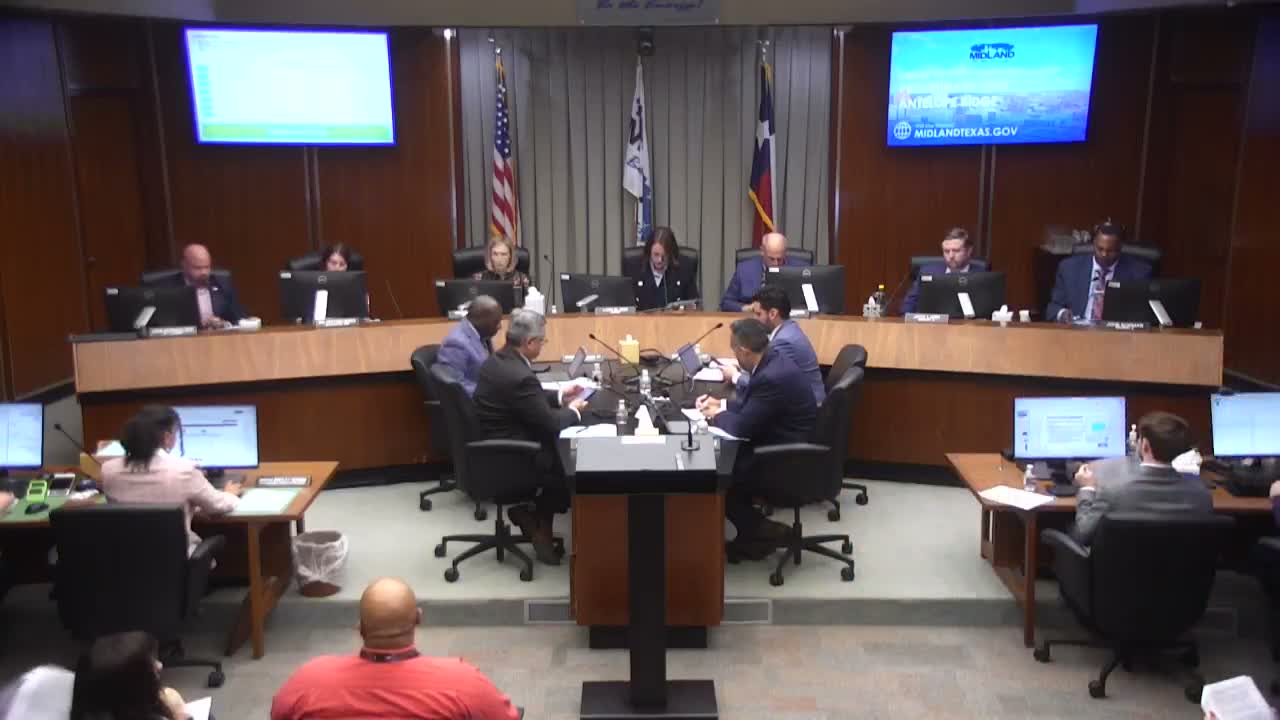
Midland council debates Antelope Ridge preliminary plat as members press water-supply and annexation limits
Summary
Council members raised persistent concerns about approving a 225-acre Antelope Ridge preliminary plat in the city's extraterritorial jurisdiction, saying state rules limit the city's ability to require municipal water; staff said certification by a licensed professional controls approval and inaction triggers approval by operation of law.
A proposed 225.28‑acre preliminary plat called Antelope Ridge prompted an extended council discussion about groundwater reliability, municipal authority in the extraterritorial jurisdiction and the limits of local review.
Landon, the staff presenter, said the proposal — requested by Talback Development — would create about 65 residential lots of roughly two to three acres each. He reported two letters of objection, including a petition signed by 34 people associated with 28 nearby businesses raising land‑use and traffic concerns. The planning and zoning commission recommended approval on Feb. 2.
Several council members pressed staff about water. “Some of the biggest concerns with these large developments have been traffic, but the biggest thing for me is the water situation,” one council member said, citing earlier instances when wells failed to meet expectations. Staff answered that the state requires a certification (a GAC) signed by a registered professional — a geoscientist or professional engineer — attesting to sufficient groundwater, and that the city’s review authority is limited to verifying that the state-required certification is present and properly completed.
City legal counsel explained the consequences: if staff and legal review find no statutory basis to deny the plat, the city’s options are to approve it or not act — and not acting results in approval by operation of law. That legal framework, council members said, constrains their capacity to protect future buyers if groundwater availability changes. Council members noted ongoing conversations with state legislators about whether the law should be amended to give municipalities greater discretion.
Public commenter Xavier Fernandez said he was representing about 25 companies and opposed the plat, saying the area is principally industrial and asking the council to consider incompatibility with existing uses. Several council members asked whether annexation was possible; staff said there had been no annexation discussions and annexation is typically voluntary. Staff also said the specific GAC for this plat was returned multiple times before it met state requirements.
Why it matters: The discussion highlights a recurring municipal dilemma in West Texas: local councils weighing growth and developer proposals face legal limits when parcels in the ETJ certify groundwater via state‑accepted engineers or geoscientists. That structure can transfer risk to future lot owners and provoke calls for legislative change.
What’s next: The council did not take further action during the meeting; staff noted that if the council does not act, the plat would be approved by operation of law unless a specific legal basis for denial is identified.