Get Full Government Meeting Transcripts, Videos, & Alerts Forever!
Get email alerts on the Animal Adoption Center topic
No spam. Unsubscribe anytime.
Coweta County weighs higher cost for planned adoption center; staff to return with funding options
Summary
Designers recommended an efficient floor plan and durable finishes for a new Coweta County adoption center; county staff and commissioners agreed staff should return with funding alternatives after learning projected costs exceeded the SPLOST allocation.
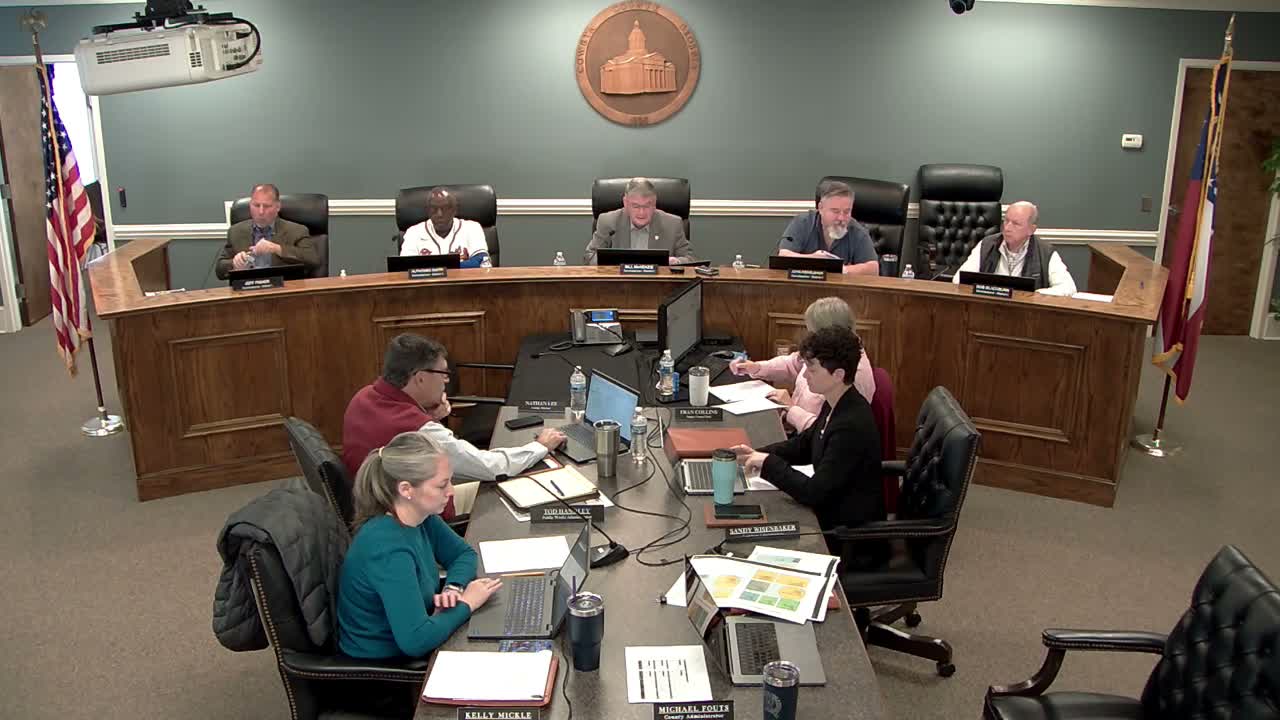
Coweta County commissioners on Feb. 12 reviewed designs and cost estimates for a proposed animal adoption center and directed staff to return with detailed funding options after learning current SPLOST dollars fall short of the latest project estimates.
Staff said the county previously allocated SPLOST 2025–2030 funds for a level‑2 adoption center but that earlier rough estimates (about $3.7 million) did not reflect current shelter construction costs. "We likely used normal construction estimates and as you heard Heather say, construction costs for a shelter are much different," Mister Fouts said during the presentation.
Design consultant Heather Lewis (member of the shelter‑design team introduced to the board) summarized a capacity study and recommended design features aligned with industry best practices, including double‑compartment dog kennels and durable, low‑maintenance materials. Lewis told the board the proposed facility should include no fewer than about 30 dog kennels (designed as double compartments to reduce stress and improve outcomes) and that an alternate, more linear floor plan saved roughly 2,000 square feet compared with an initial square plan.
On costs, the designers and contractors provided benchmark figures: industry post‑pandemic averages of about $750–$800 per square foot for animal shelters and a project pricing estimate presented to the board at roughly $667 per square foot with contingencies. Staff and the design team noted that site development, drainage and durable finishes drive much of the cost. "Animal shelters are expensive buildings ... they're designed for sanitation and healthy air, lighting and power, and most importantly, durability," Lewis said.
Facing a funding gap, staff outlined possible cost‑reduction and financing strategies: using county forces for site work, partnering with the Department of Corrections mobile construction crew, asking municipal partners for additional contributions under existing intergovernmental agreements, seeking corporate or private sponsorships for kennels, forming a nonprofit friends group to solicit donations, or using certificates of participation (COPS) or other debt instruments. Staff estimated that combining alternate construction methods and in‑house resources could reduce the project toward a working figure near $6.8 million, but cautioned that more detailed costing is needed.
Commissioners pressed staff on operational details and the facility’s policy framework. Staff confirmed an existing threshold guideline (about 90% capacity) that triggers outreach and mitigation steps; they stated the shelter has not had to euthanize healthy animals under that policy in the past two years. On staffing and operations, commissioners directed staff to prepare an organizational plan: a separate animal‑services department with a director and an adoption‑center coordinator included in future budget cycles.
Staff will return with refined cost estimates, a menu of funding options and a proposed staffing plan for the new adoption center.