Get Full Government Meeting Transcripts, Videos, & Alerts Forever!
Get email alerts on the School Safety topic
No spam. Unsubscribe anytime.
Sumner County officials outline threat assessments, SRO roles and safety tools after closed session
Summary
Sumner County Schools officials and sheriff's office representatives updated the board on prevention measures, SRO training, a threat‑assessment model and the Safer Sumner tip app after a closed-door school‑safety session; officials also described a recent incident at Station Camp Middle School and plans to implement state-required firearm‑safety education.
Sumner County Schools officials and a sheriff’s office representative briefed the school board on safety measures and threat‑assessment procedures during a short public update following a closed-door session on school safety.
Dr. Lankford, a school district official who led the presentation, said the district focuses on prevention and preparation for the “space between” — the period after an incident begins and before first responders arrive — and emphasized close collaboration with first responders across the county. “This is a strong protective factor for our schools,” he said, noting regular cross‑agency training.
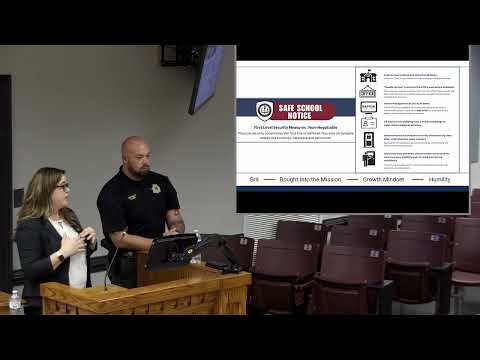
Dr. Lankford described classroom “safer space” signs placed in coordination with building administrators and SROs so students and staff know where to shelter. He said the district uses an annual, 232‑question site assessment developed with the Department of Homeland Security to identify building vulnerabilities and inform improvements such as two‑door visitor management, locked exterior doors, visitor badges and closed classroom doors to support emergency response.
“Safer Sumner” — an app the district has installed on iPads and that is available in app stores — routes anonymous tips to appropriate staff and law enforcement depending on the nature of the report. “In fact, I would say 98% of the things that we are able to address are because they were reported to us by a student,” Dr. Lankford said.
On threat assessments, Dr. Lankford said the district follows a formal model (citing Dewey Cornell) that evaluates a student’s intent, capability and other factors to determine whether a threat is credible. He stressed that the school and law‑enforcement investigations proceed in parallel and that professional authorities lead formal investigations, not school staff alone.
Lieutenant Vines of the sheriff’s office described the Sheriff’s Special Investigations Unit and school‑resource‑officer program. “Every single school has an SRO,” he said, adding that SROs are full‑time, certified officers rather than security guards and that the office maintains a rotating pool to cover absences. He also explained the after‑hours capabilities of the SIU and that the sheriff’s office conducts its own investigations alongside school teams.
Dr. Lankford described a recent incident at Station Camp Middle School in which a child brought a weapon onto campus. “There was a weapon on campus at Station Camp Middle School,” he said, and added that, based on the investigation discussed in the closed session, there was no indication of intent to harm. He said the presence of a weapon and ammunition nonetheless requires policy and procedural responses.
Officials noted a new state requirement (the transcript referred to the TCA) that mandates firearm‑safety education; the district is developing age‑appropriate materials and parent communications and already uses the Eddie Eagle program for younger students. The transcript indicates staff are “walking through” how to implement the new requirement so parents are partnered in those conversations.
A board member summarized the closed session and praised district staff and the SRO program, noting state minimum training requirements and the district’s additional training. The transcript records that state law requires at least eight hours of training, and the board member said SROs had completed “20” since August; the transcript did not specify whether that figure refers to hours or another unit.
No formal motion or vote was recorded during the public update. Chair (speaker 1) closed the public briefing, thanked staff for the information and adjourned the meeting; staff remained available for follow‑up questions.