Joint minerals committee collects interim topic requests on energy, industrial siting and economic development
Get AI-powered insights, summaries, and transcripts
SubscribeSummary
The Joint Minerals Committee heard public and member testimony on proposed interim topics including energy‑dominance regulatory barriers, industrial siting exemptions and bonding, produced‑water reuse, Wyoming Business Council governance and economic impacts of possible Colorado River curtailment; members were asked to submit their top five priorities by tomorrow.
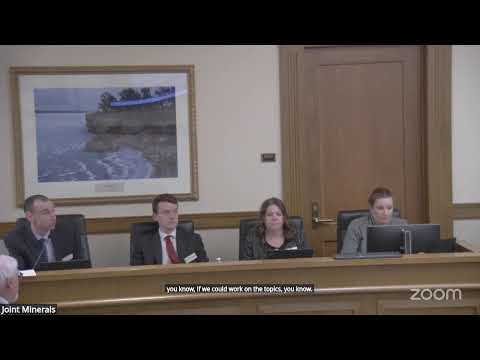
The Joint Minerals Committee met to solicit and prioritize interim topic requests, hearing a steady stream of testimony from industry groups, state agencies and local economic developers about topics the committee could study this summer. Chair opened the meeting, a clerk called roll and members confirmed a quorum.
Travis Ditai of the Mining Association urged the committee to consider a follow‑up review of the Energy Dominance Fund bill and “look at the barriers” — regulatory, bonding and permitting — that industry says slow project development, and suggested a task‑force approach similar to a prior regulatory reduction effort. Rusty Bell, CEO of Energy Capital Economic Development in Gillette, told members that an industrial‑siting exemption for mineral activities on coal‑mine property could help Powder River Basin projects such as rare‑earth or uranium‑conversion proposals, while noting any exemption should account for local socioeconomic concerns.
Representatives of local governments and emergency services pressed the committee to address timing and bonding for industrial siting. Representative Lien described a Natrona County example in which local fire services bought equipment required by a permitted solar project before the project was complete, calling for options such as advance bonds or front‑loaded impact payments so municipalities can recover costs for early impacts.
A presenter working on House Bill 120 asked the committee to consider including coal‑bed methane in proposed energy sovereign zones, arguing coal‑bed methane can support the same value‑added manufacturing envisioned in the bill but that current statutes create constraints that prevented inclusion in this session’s text.
In a lighter but still economic development–oriented exchange, a senator and Joanne True of the Wyoming Geologic Survey highlighted three Wyoming granites with mineralogy similar to traditional curling‑stone sources and asked the committee to work with the geologic survey to identify potential quarry sites and downstream uses for dimension stone.
Multiple witnesses asked the committee to examine Wyoming Business Council governance and structure. The chair proposed a joint deep dive with the Joint Appropriations Committee in August; local economic development groups (Wyoming Association of Municipalities, Wyoming Economic Development Association) and community economic developers urged broad outreach, use of performance metrics and attention to accountability and overlaps with newer state entities.
Blue Cross Blue Shield’s Raymond Redd proposed a draft bill to add a resident preference for goods and services procurement under Title 9, analogous to a existing 5% preference in Title 16 for certain public‑works procurement, while recognizing exemptions for federal funding and capacity limits of in‑state firms.
Other topics raised included wholesaling of real estate and consumer‑protection concerns, a request for an eight‑hour joint session on potential Colorado River curtailment and its economic impacts (agriculture, mining, municipalities), updates to the Unclaimed Property Act to define digital assets and streamline small‑claims procedures, and a request from the Oil & Gas Conservation Commission to study authority to permit centralized produced‑water reuse infrastructure even when cost recovery between operators might appear commercial under current statutes; the commission clarified it is not seeking to permit commercial disposal or to supplant the state engineer’s permitting of beneficial uses.
The chair asked committee members to identify their top five interim topics and submit them by tomorrow so he and co‑chair Anderson can agree on a prioritized list to submit to legislative staff. No formal votes were taken; the management council will work to avoid duplicating topics across committees. The committee adjourned after confirming next steps.