Get Full Government Meeting Transcripts, Videos, & Alerts Forever!
Get email alerts on the Land Use Rezoning topic
No spam. Unsubscribe anytime.
Chesapeake Planning Commission denies Viridian Reserve North rezoning amid wetlands and school-capacity concerns
Summary
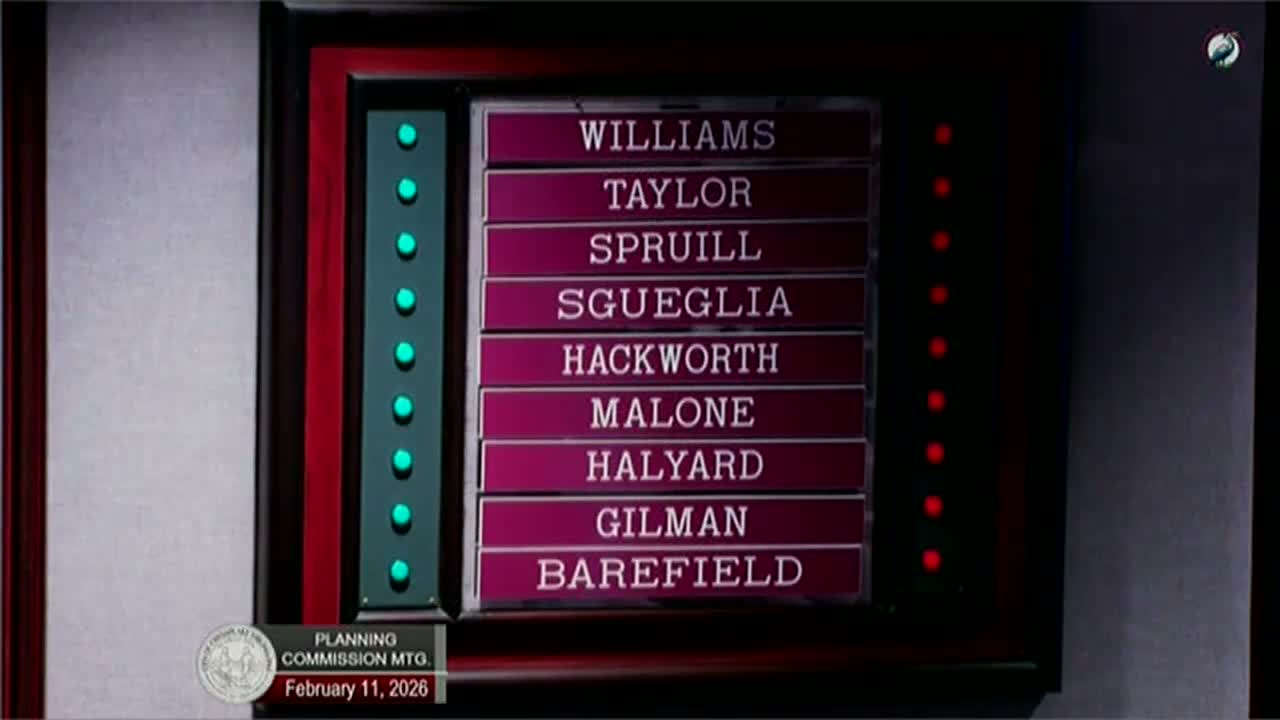
After extended public comment and questions about wetlands, stormwater and school overcrowding, the Chesapeake City Planning Commission voted 7–2 to deny a rezoning request for the 25.3-acre Viridian Reserve North project (PLN‑REZ‑2025‑059).
The Chesapeake City Planning Commission voted 7–2 on Feb. 11 to deny a rezoning request for Viridian Reserve North, a proposed conditional rezoning of roughly 25.3 acres from Agricultural to R‑8 Residential. Commissioners cited potential loss of forested wetlands, ongoing stormwater and flood concerns, and continued overcrowding at Southeastern Elementary School as the basis for the denial.
The project team, represented by attorney Tyler Rose of Williams Mullen, told the commission the development would provide neighborhood connectivity, a three‑acre public park and a stormwater pond sized to a higher-than‑typical standard. Rose said the applicant proffered to restrict certificates of occupancy until either completion of the Southeastern Elementary expansion or an outside date of July 1, 2027, and stood by plans to preserve buffers and limit clearing where possible.
Opponents — many residents of the adjacent Viridian Reserve neighborhood — told the commission the site is largely forested and includes wetlands and habitat for wildlife. “This forest behind Viridian Reserve is not just an empty land waiting to be cleared,” said Rachel Beth Johnson, a nearby homeowner, who urged the commission to preserve trees and wildlife and warned of increased flooding and school overcrowding. Other residents raised similar concerns about traffic, safety for children and the affordability claims of the project.
Staff and the applicant answered detailed questions about wetlands impacts, stormwater mitigation and traffic. The developer’s engineer described sizing a wet pond at 15% of the development area for additional runoff control and said preliminary culvert and roadway crossings were sized to avoid downstream impacts. Transportation staff explained that a traffic study showed a narrow difference between a D and an E level of service in peak hours and that signal‑timing adjustments could restore acceptable operation.
Commission discussion focused on the tension between the city’s long‑range transportation plan, which shows the proposed connector, and the project’s near‑term impacts on schools and environmentally sensitive lands. Commissioner Lee Halyard moved to deny PLN‑REZ‑2025‑059; the motion was seconded and carried by a 7–2 vote. The commission’s denial will be transmitted to City Council in accordance with established procedures.
What happens next: the developer may refine the proposal and pursue a new application, or the applicant could request reconsideration before the council. The Planning Department also will include the commission’s discussion of wetlands, drainage and school impacts in the public record for any future review.