
Committee rejects bill to bar local deputization for federal immigration enforcement after hours of testimony
Get AI-powered insights, summaries, and transcripts
Subscribe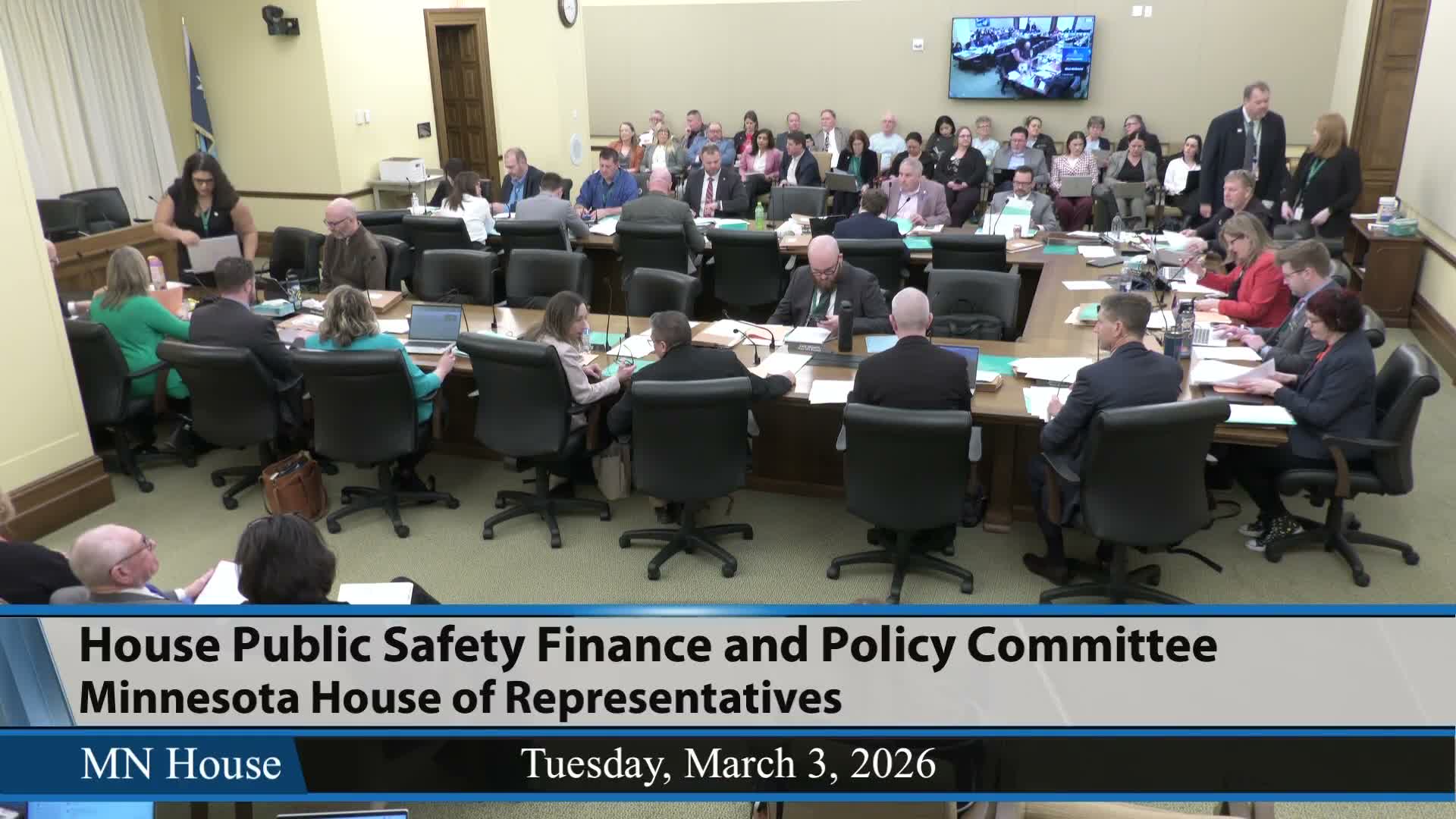
Summary
House File 3413, which would prohibit local governments from entering deputization agreements with federal immigration authorities (287(g) agreements), drew competing testimony from civil-rights advocates, county officials and sheriffs; committee roll call was 10-9 and the motion did not prevail.
House File 3413, introduced by Representative Hollins, would prohibit state and local governments from entering intergovernmental agreements that deputize local officers to enforce federal civil immigration law (commonly referred to as 287(g) agreements). The Public Safety Finance and Policy Committee considered the bill and several amendments on March 1, 2026; after testimony and debate the committee voted 10-9 and did not advance the measure.
Representative Hollins said the bill was aimed at protecting civil liberties and community trust, arguing the program "incentivizes racial profiling and unlawful detainment" and increases litigation risk and community distrust of local police. She described the measure as focused on immigration-enforcement agreements and emphasized that it does not prevent federal officers from operating in the state.
Supporters offered several witnesses. Noreen Shah, director of immigration policy for the National ACLU, urged passage and said the bill would create statewide uniformity and avoid pressure on local departments to join federal initiatives that undermine community trust. Hallie Pond, a Pine River resident, described local impacts she attributed to ICE operations and urged a yes vote. Dr. Bebe Neumann, testifying for an immigrant-led interfaith civic group in Saint Anthony/New Brighton, said HF3413 draws an important structural line and cited federal statutory references offered in the bill text.
Local officials and law enforcement leaders urged caution. Bruce Meslet, Sherburne County administrator, said the bill as introduced cast a "very wide net" that could affect longstanding intergovernmental service agreements and jail contracts with multiple federal agencies; he asked for clearer drafting about whether the bill would affect detention agreements and intergovernmental service agreements beyond immigration enforcement. Sheriff Eric Tolleson, representing the Minnesota Sheriffs Association and speaking as an elected sheriff, opposed the bill on the grounds it would remove local discretion and immediately terminate existing agreements.
The committee considered and adopted an A2 amendment intended to narrow the bill to immigration-enforcement agreements and rejected other amendments, including an A3 amendment that would have required federal reimbursement studies before authorizing reimbursement in certain subdivisions. Members split largely along differing views about state uniformity versus local discretion. Representative Curran and other supporters said statewide clarity is needed to preserve public trust; Representative Duran and other skeptics argued some cooperation with federal partners can be operationally helpful.
A roll call recorded 10 ayes and 9 nays. The chair announced that the motion did not prevail and the bill did not pass out of committee.
What happens next: Sponsors said they will continue advocacy and seek clarifying language; opponents urged further vetting with counties and local stakeholders.
Sources: Committee testimony and roll-call recorded March 1, 2026.