
Committee lays over Met Council bills that expand tribal grant access, streamline programs
Get AI-powered insights, summaries, and transcripts
Subscribe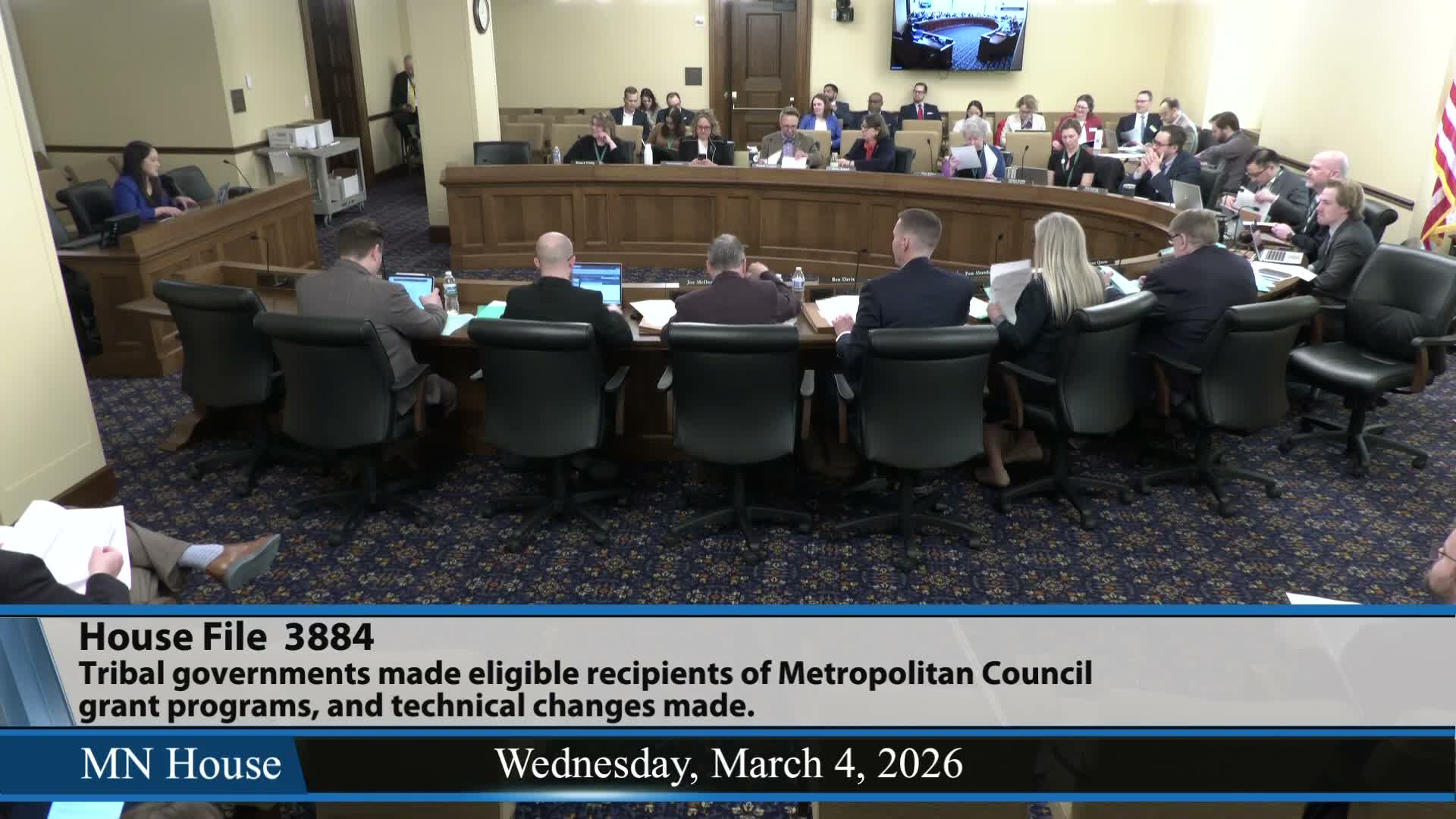
Summary
The House committee laid over four Metropolitan Council agency bills March 4, 2026, after testimony from Met Council staff. Proposals would let tribal governments apply directly for certain grants, align tree-planting grants with DNR, extend small-business procurement authority and simplify administrative reporting and reviews.
The House Elections, Finance and Government Operations Committee on March 4 laid over a package of Metropolitan Council agency bills after staff from the regional authority described changes intended to simplify program administration and expand eligibility for tribal governments.
The measures include House File 3884, which would let the Met Council award Livable Communities Act and community tree-planting grants directly to tribal governments and tribal development entities; House File 3881, which would align Met Council procurement rules with state small-business contracting authorities; and House File 3882, which makes a series of administrative clarifications for Met Council programs.
Met Council witnesses told the committee the bills aim to reduce duplication, improve clarity and remove statutory barriers. "This bill would allow the Met Council to have the same authorities as state agencies already have to contract with small businesses," said Ashanti Payne, director of the Office of Civil Rights and Small Business Programs at the Metropolitan Council. Lisa Beth Barajas, executive director of community development at the Metropolitan Council, said HF 3884 would "simplify the process" by treating tribal governments similarly to port authorities and housing and redevelopment agencies when their projects are located within a participating city in the seven-county metro.
House File 3882 would also change several technical timelines and reporting rules. Barajas said the proposal would change the Metropolitan Significance rule-review cycle from every two years to every ten years and shift park operations reimbursements to audited financial statements to provide more reliable numbers and additional time for agency review.
Committee members generally voiced support for administrative streamlining during brief discussion. Each Met Council bill was moved to be "laid over for possible inclusion," a procedural step that keeps the bills under consideration for inclusion in an omnibus package later in the session.
What happens next: The bills were laid over for possible inclusion; no final passage or votes on the underlying policies occurred at this meeting. The Met Council witnesses remained available for follow-up questions at subsequent committee stops.