
Public and board members push RSU 73 to restore science teacher as $200,000 cuts debated
Get AI-powered insights, summaries, and transcripts
Subscribe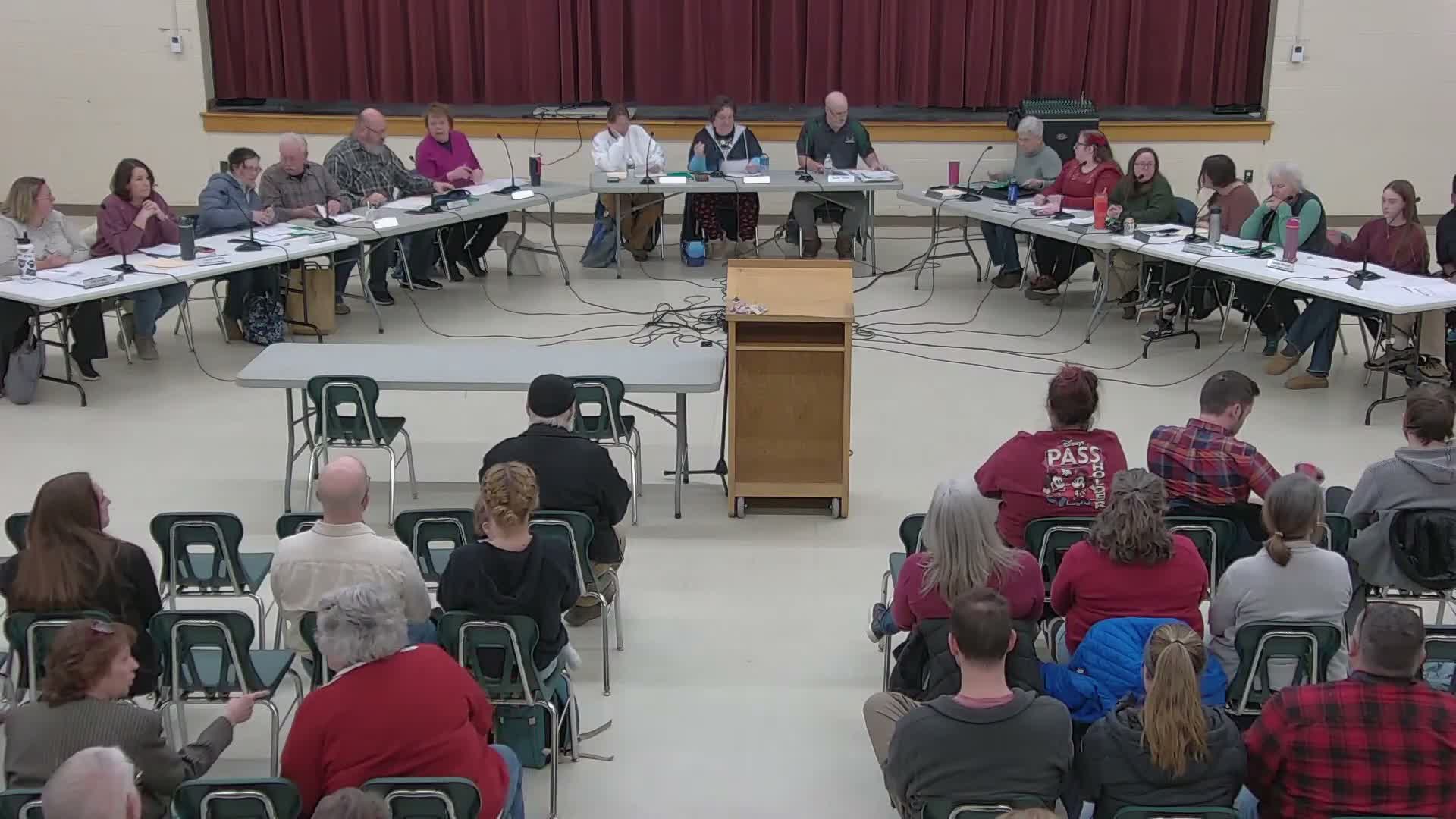
Summary
Public commenters and board members urged RSU 73 to avoid additional $200,000 cuts that would eliminate a high-school science position and shrink electives; after line-item adjustments and discussion about staffing and certification, the board moved to reinstate the science position and sent final numbers to lawyers to prepare warrants.
Rob Taylor, a science teacher at Spruce Mountain High School, told the RSU 73 school board that he learned the board was “seeking to cut an additional $200,000” and warned that leaving a retiring high-school chemistry position unfilled would shrink the science department by about 20% and eliminate early-college courses and electives the department currently offers.
Taylor outlined the department’s offerings — University of Maine early-college courses in environmental science and physics, electives such as mycology and forensics, an intensive anatomy and physiology program, and hands-on outdoor projects — and said losing a staff position “threatens” those programs. “A chain is only as strong as its weakest link and our department is well forged,” he said, arguing a 20% reduction would force the school to provide only the basics.
Dozens of public commenters echoed Taylor’s concerns. Chris Baldwin, a longtime district resident, said RSU 73 ranks in the bottom third of Maine districts for per-pupil spending and that an extra $200,000 cut would keep the budget increase at roughly 2.4%, below regional inflation. Student-athlete Kylie Marcotte warned cuts to athletics and extracurricular funding would increase pressure on boosters and could imperil senior scholarships; Emma Towers, a recent graduate, described extracurriculars as critical to student engagement and belonging.
District staffer Scott reviewed the specific line-item changes staff proposed to reach roughly $226,500 in reductions (an initial number that reflected a previously approved bus purchase). He described modest transportation savings (including a new propane bus), small corrections in special-education allocations, and programmatic cuts such as rotating professional stipends. Scott identified two bookkeeping corrections — $5,640 and $3,600 — and noted a half-year reduction for an out-of-district special-education placement ($36,089), totaling $45,329 in corrections.
Scott also said the specific staff reduction under consideration was tied to the retirement of a chemistry teacher. Board members and teachers raised certification and scheduling concerns: about two of the remaining science teachers are certified for chemistry instruction, and moving courses around could limit elective offerings. Rob Taylor and other speakers said that, even with creative scheduling, losing a position will reduce course variety and hands-on opportunities.
During board discussion a member moved to restore the board’s original proposed budget and to account for the discovered corrections; the motion’s practical effect was to preserve the high-school science position while keeping many of the other cuts under consideration. After debate about trade-offs (including whether to add one season of esports and which transportation and special-education adjustments to keep), the board approved the motion and instructed administrators to send the approved numbers to lawyers to be placed into warrants for distribution to the towns.
Scott said the finalized warrants will be available next week and that the board will vote on individual warrants at its next regular meeting on March 12 at 6:00 p.m. The meeting adjourned after the chair called the vote and members approved adjournment.
Why it matters: RSU 73’s discussion highlights common local-budget trade-offs: the financial pressure of reduced revenues and low per-pupil spending versus programmatic impacts on science education, extracurriculars and small-class supports such as RTI. Parents, educators and students argued the marginal tax impact on households is small compared with the potential loss of educational opportunities; board members responded by balancing fiscal constraints, accounting corrections and preserving key instructional capacity.