Officials urge faster, flexible buyouts and floodplain restoration after December floods
Loading...
Summary
After December 2025 storms, Partnership speakers and county and tribal representatives told the Leadership Council that prior buyouts and floodplain reconnections reduced damage but that faster, more flexible acquisition funds, better hazard mapping, and tribal inclusion are needed to scale relief across Puget Sound.
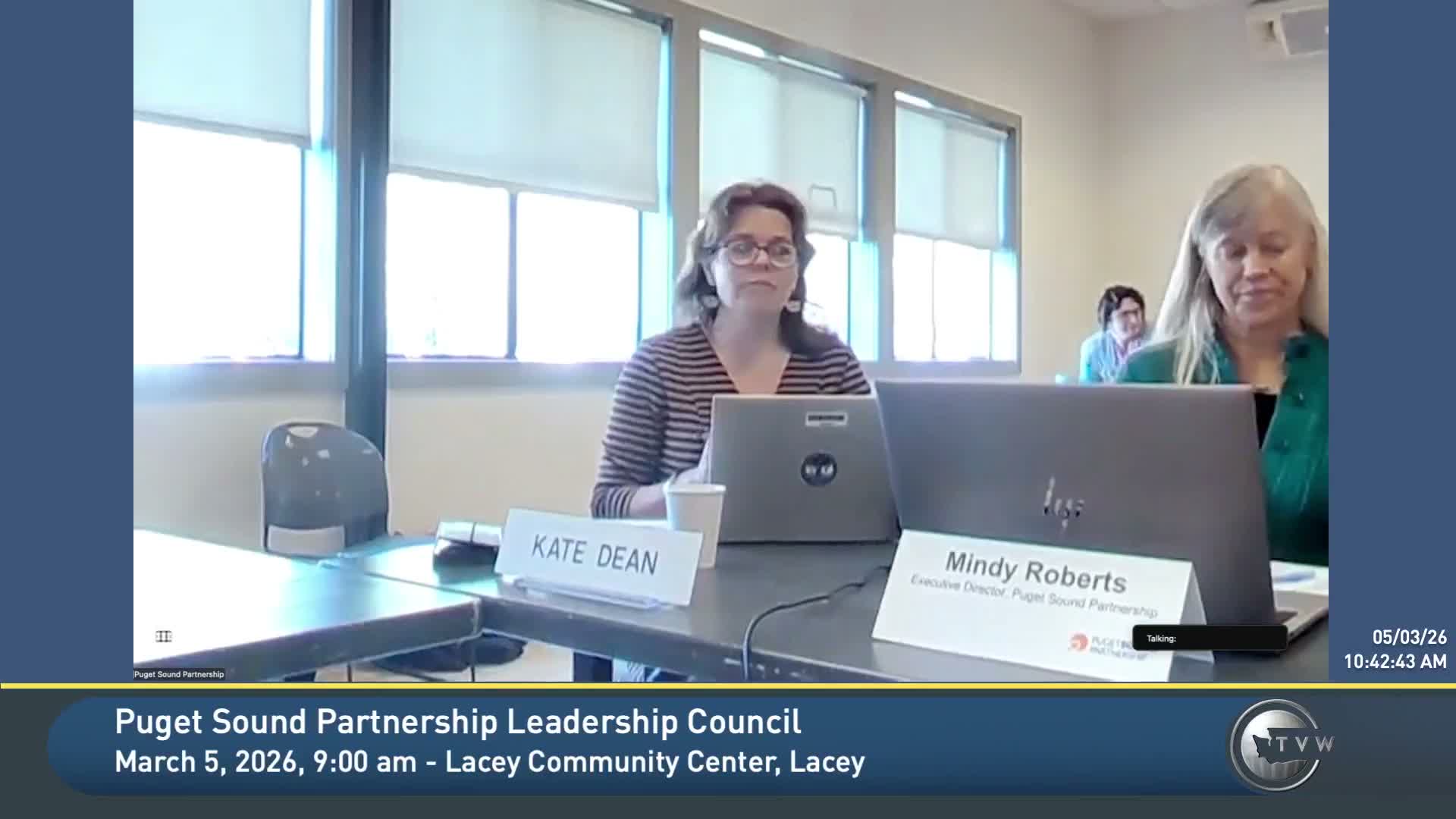
Mindy Roberts, the partnership’s newly introduced executive director, and agency staff on March 5 heard a multi‑hour briefing showing how decades of buyouts, levee setbacks and restoration projects limited damage in the December 2025 atmospheric‑river floods — and why leaders say state, federal and philanthropic money needs to move faster.
The presentations focused on how “room‑for‑the‑river” projects reduced velocity and spread floodwaters into restored floodplains, protecting homes, roads and fisheries. "Public investments are paying off," said the Floodplains by Design lead (Bonneville Environmental Foundation), noting an estimated $182,000,000-plus in recovery needs from the December storms and a growing pipeline of ready projects.
Speakers argued that scaling those results requires three changes: nimble, voluntary acquisition funds to seize willing sellers; improved flood and channel‑migration mapping; and stronger engagement and resources for tribal and local governments. Kathleen Berger of Pierce County described projects in the Puyallup watershed where prior buyouts and levee setbacks meant properties and infrastructure fared much better. "We purchased this home shortly after coming across this posting on Redfin," Berger said of one buyout project, adding that the resident received a full relocation package and the home was demolished to remove hazard exposure.
Hydrologist Steve Winter (Natural Systems Design) connected the restoration work to salmon outcomes, showing modeling from South Prairie Creek: reconnecting floodplain area diffused peak flow energy and created more diverse low‑velocity refuges for eggs and juveniles. "When big events happen, you see much less juvenile salmon production," Winter said, describing how high peak flows scour redds and wash juveniles downstream in confined channels.
Trevor Delgado, the Nooksack tribal historic preservation officer, urged stronger attention to cultural resources, access, and food security: "There's a strong need for immediate actions," he said, urging that restored floodplain work respect tribal sites and treaty rights while improving community resilience.
Panelists and council members flagged practical hurdles. Staff said some buyout programs rely on opportunistic funding and long permitting timelines; leaders called for a short‑term voluntary acquisition pot and for streamlining permitting and staffing so federal and state grants translate quickly into on‑the‑ground work. Council discussion also stressed the human side: many households relocated through buyouts are economically vulnerable, and speakers urged sensitive, potentially anonymized, follow‑up with relocated households to learn whether relocation improved long‑term housing stability and livelihoods.
Partnership staff said the coalition has identified roughly $680 million in "ready" capital projects for flood resilience and recovery, but that converting that demand into contracts and construction needs faster federal and state administration of funds and local permitting capacity. The council heard that a November convening on floodplains by design will work to translate local success stories into scalable practices and messaging for policymakers.
The council agreed to continue the conversation, emphasizing model ordinances, public education to reduce risky development, and tribal‑led engagement. The meeting closed with staff pointing to immediate next steps: assemble a prioritized list of acquisition opportunities, work with counties on regulatory alignment, and brief the council on legislative asks tied to nimble acquisition and permitting capacity.