Get Full Government Meeting Transcripts, Videos, & Alerts Forever!
Get email alerts on the Budget Tax Rate topic
No spam. Unsubscribe anytime.
Arlington council sets ceiling for proposed tax rate, reviews budget options and road needs
Summary
At a council work session, Arlington officials set a ceiling for the proposed tax-rate hearing and debated cuts, fee adjustments and long‑term options for road maintenance while staff highlighted bond ratings and a planned early payoff on AT&T‑related debt.
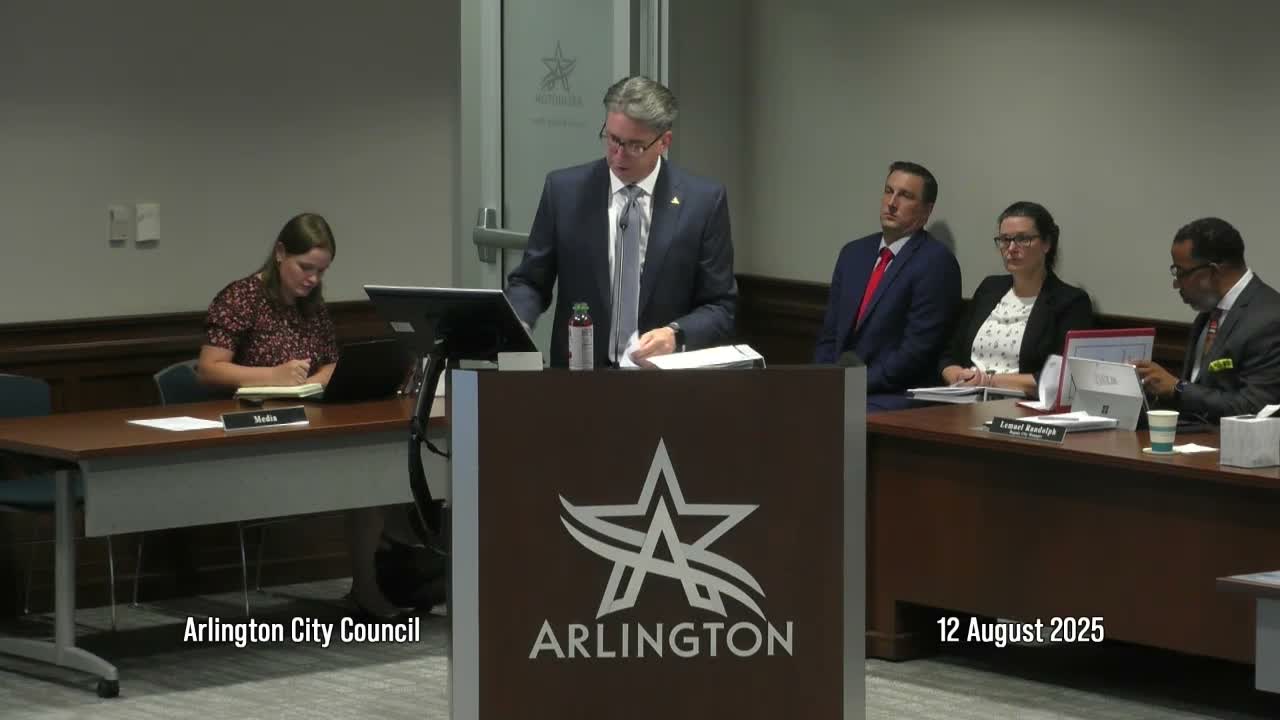
Arlington City Council set a ceiling for the proposed tax‑rate hearing and spent a work session weighing options to close a multiyear budget gap, debating staff‑recommended cuts, fee adjustments and long‑term fixes for the city’s street network.
Trey, a city staff member leading the budget presentation, told the council that national ratings agencies had reaffirmed Arlington’s credit: “Standard and Poor’s … reflected a stable outlook with strong economic growth and robust liquidity” and Moody’s rated the city Aa1 for strong financial management. He said the city will also “pay off our obligation regarding AT and T debt” a decade early, which staff estimate saves roughly $150,000,000 compared with original projections and requires a final payment “of around $22,000,000 on Friday.”
The discussion centered on how to close the remaining budget gap. Staff laid out a pyramid of actions that includes reauthorizing $51,000,000 in existing tax relief, about $8,000,000 in fee increases, elimination of 42 vacant positions and program changes totaling roughly $7,700,000. Trey said FY24 street spending (maintenance plus bond money) was about $66,000,000 and touched 114 lane miles, or roughly 3.8% of the city’s lane‑mile network, and that the city is approximately $30,000,000 short of the annual investment public works estimates would require to sustain the network.
Councilmember Lemuel Bridal urged more aggressive cutting and proposed pausing the tax‑credit review process to 2027 to reduce staff time and related costs: “I’m going to suggest that we pause it to 2027.” Bridal also asked staff to explore shifting some inspections to third‑party providers so property owners would pay inspection costs directly.
Councilmember Odom Westley pushed for more frequent citizen feedback, arguing the city should use existing digital tools alongside the biennial omnibus survey: “My favorite part of the whole budget is the business plan,” Odom Westley said, and recommended leveraging the Ask Arlington app and targeted departmental surveys instead of an expensive annual citywide study.
On fees, staff said multifamily inspection fees are near full cost recovery and noted statutory constraints that municipal fees generally must be cost‑recovery rather than revenue sources. Trey described fee adjustments and position reductions as levers council could use to lower the proposed tax‑rate ceiling.
Procedurally, staff asked the council to set a ceiling for the tax hearing (staff proposed a rate equivalent of $62.98) and outlined town halls and public hearings scheduled to follow. April Nixon, the city CFO, presented the formal resolutions required to publish the proposed tax rate and to call the FY2026 budget hearing; the council moved and the motions passed on both items during the meeting record (transcript records “the motion passes” but does not include detailed vote tallies).
The council also instructed staff to produce more detailed ‘‘what if’’ analyses on street funding — projecting costs to “catch up” versus continuing deferred maintenance — and was reminded the street‑maintenance sales tax will expire next year, requiring a potential voter renewal.
The meeting closed with staff plans to return with refined analyses and with scheduled budget town halls for further public input.