Get Full Government Meeting Transcripts, Videos, & Alerts Forever!
Get email alerts on the Anti Discrimination Ordinance topic
No spam. Unsubscribe anytime.
Arlington council advances controversial revision to anti-discrimination code after hours of public comment
Summary
The Arlington City Council approved a first-reading ordinance amending its anti-discrimination chapter and passed a companion resolution after hours of public testimony. Opponents said the changes remove local enforcement; supporters called the package a compromise to avoid leaving the city with no statement opposing discrimination.
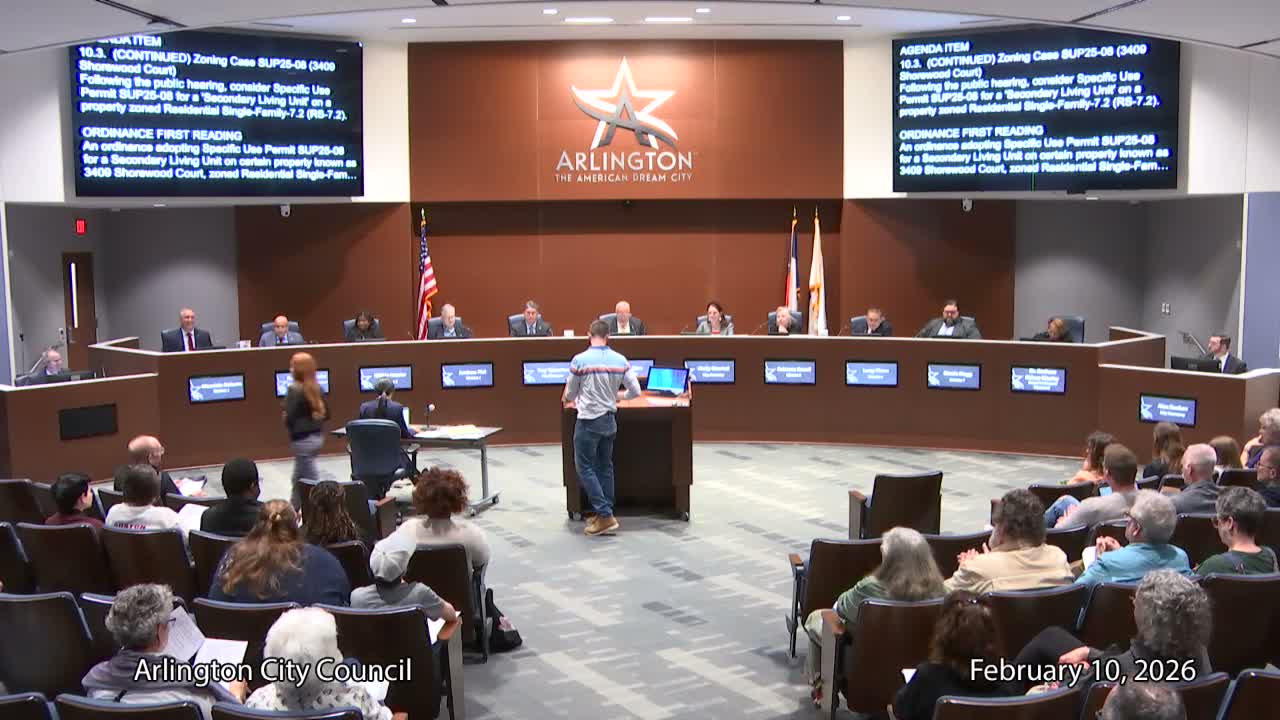
The Arlington City Council on Feb. 10 approved a first-reading ordinance to rescind the temporary suspension of the city's anti-discrimination chapter and to amend the chapter, following several hours of public comment and a separate resolution condemning discrimination.
City staff presented the ordinance as an update to align the city's code with federal and state discrimination law and to streamline administration; Elizabeth Kaylor, the staff presenter, said the amendments "provide an opportunity for the city's administrator to connect individuals who believe they have experienced unlawful discrimination" and include provisions for parts of the chapter that might be preempted by higher law.
Opponents packed the public-comment period and contended the ordinance strips local protections. DJ Johannessen, CEO of the Help Center for LGBT Health, said the draft "removes Arlington's local civil rights protections and replaces them with education and referrals," arguing the city would "not investigate, not advocate, not take sides" and that the change would leave some residents without an effective remedy. Clayton Waters, an Arlington District 2 resident, said the proposal "does not stop discrimination. It stops the city from responding to it."
Supporters and several council members, including Mayor Ross, framed the ordinance as a pragmatic move to avoid leaving the city with no formal statement opposing discrimination. Mayor Ross said the ordinance and a companion resolution were intended as a compromise that "reestablishes a clear standard that discrimination has no place in Arlington" while reflecting council members' legal concerns.
Council discussion focused heavily on whether the city's earlier ordinance (passed in 2021 and since suspended) contained meaningful enforcement. Members and speakers disagreed: Johannessen and others described an administrative process that could generate written reports and compel participation in conciliation, while several council members argued the prior ordinance lacked enforceable remedies and that a resolution could better reflect values without exposing the city to legal risk.
After debate, Mayor Ross called the motion (mover: Council member Odom Wesley; seconder: Council member Pham) and the council voted to advance the ordinance (first reading). The council also adopted a separate resolution condemning discrimination.
What this means: The council advanced a compromise package intended to reaffirm the city's position against discrimination while narrowing the statutory approach. Opponents said the change effectively removes local investigatory and enforcement mechanisms and urged the council to restore or draft stronger, enforceable protections. Supporters said the package avoids leaving Arlington without any official anti-discrimination language.
Next steps: The ordinance moved forward on first reading; the transcript records the vote as passing but does not list individual roll-call votes in the public record. The council also adopted a companion resolution condemning discrimination at the same meeting.
Sources and context: The reporting above is based solely on the council meeting transcript for Feb. 10, 2026, including staff presentations and public testimony from community members and organizational representatives.