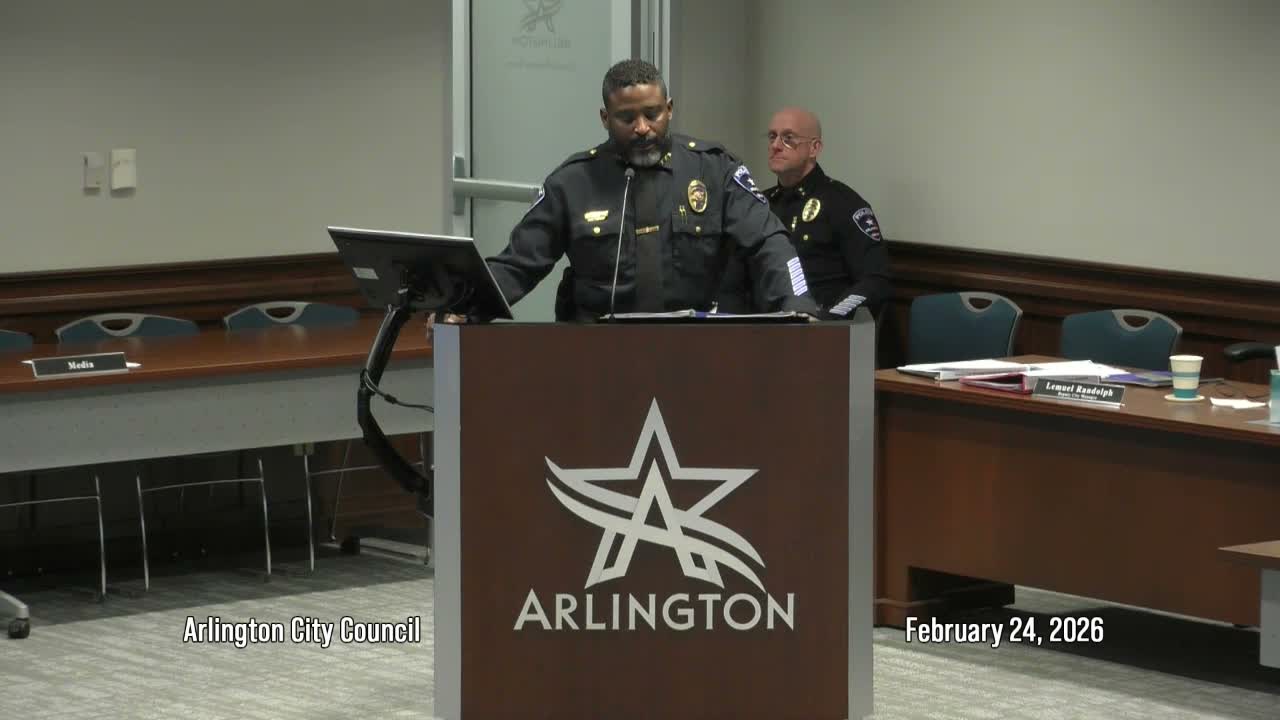
APD says 2025 analysis found 11 profiling complaints out of 103,000 stops; contraband hit rate cited as key measure
Loading...
Summary
Assistant Chief Leland Strickland presented APD's 2025 racial-profiling analysis to the Arlington City Council, reporting roughly 103,000 traffic stops, 11 citizen allegations (all investigated and recorded as unsustained), and a contraband hit rate near 49% that the department and its independent auditor say supports lawful searches.
Assistant Chief Leland Strickland presented the Arlington Police Department's 2025 racial-profiling analysis to the City Council on Feb. 24, saying the department conducted over 103,000 traffic stops last year and received 11 allegations of racial profiling, all of which were investigated by Internal Affairs and recorded as unsustained.
"Of the over 103,000 traffic stops that were conducted last year, only 11 allegations of racial profiling were received," said Leland Strickland, assistant chief over the patrol bureau. "All of which were fully investigated by the department's investigative body, the internal affairs section, including full review of all available video."
Strickland described APD's data collection as comprehensive: officers record race, gender, whether the driver is an Arlington resident or visitor, reason for the stop, and outcomes including verbal warnings, citations, arrests and searches. He said officers reported the driver's race was unknown prior to the stop in about 98% of incidents and that the department provides each stopped driver with the officer's name and contact information.
City officials and APD's independent auditor framed the contraband hit rate (the percentage of searches that produce contraband) as an important measure when assessing whether searches and subsequent arrests were supported by evidence rather than bias. Dr. Alex Del Carmen, the department's contracted auditor who participated remotely, said the contraband hit rate for the group cited in the report is "almost 50%, 49%." He added that the national benchmark often cited by analysts is roughly 30% and said Arlington's results indicate searches are yielding evidence at above-expected rates.
"When you look at the at the searches that are conducted ... about 50% of the time contraband is going to be found," Strickland said. "That ratio of 49% is maintained across all the racial groups." He added that 3.4% of traffic stops included a vehicle search in 2025, and about 83% of searches that found contraband led to arrests, figures the department said are similar across major racial groups.
Several council members raised questions about the raw counts of stops and searches. Council member Galante noted Census comparisons showing differences between the city population makeup and stop totals and pressed for an explanation of why Black drivers appeared in larger absolute numbers in stop and citation counts. Strickland, joined by Dr. Del Carmen, said Arlington's traffic on corridors like I-20 comprises many nonresidents and that comparisons to the city's residential census are not a direct baseline for enforcement activity.
"I do believe that in Arlington ... even though a larger number of minority drivers are being stopped when compared to the actual census data ... what would be concerning is if the contraband hit rate on minority drivers would not match the number of stops," Dr. Del Carmen said. "Because then what that shows us ... is that there is bias on behalf of police officers that are stopping individuals and searching them for no probable cause reason." He said, by contrast, Arlington's hit-rate parity is consistent with legitimate law-enforcement outcomes.
Council members also asked for additional demographic data about the force. Chief Al Jones said APD is "about 24% African American" and that the department tries to recruit classes that better mirror the community's demographics.
Strickland and Chief Jones said the department will provide materials and the full report online; copies were available on the City Council and APD websites. No formal council action was taken during the presentation; council members praised the department's transparency and asked staff to follow up on specific data requests.
The council moved on to other agenda items after roughly an hour of presentation and questioning.