Get Full Government Meeting Transcripts, Videos, & Alerts Forever!
Get email alerts on the Bcyf Legislation topic
No spam. Unsubscribe anytime.
Committee advances amendment to Baltimore Children and Youth Fund ordinance after debate over rapid-response grants
Summary
The Baltimore City CouncilEducation, Youth and Older Adults Committee voted to advance a consolidated amendment to Council Bill 25-0100 after hearing a Comptroller estimate for a BCYF audit, BCYF leadersurging clarity on unexecuted rules, and debate over whether the law should allow narrowly defined invitation-only or emergency grants.
The Education, Youth and Older Adults Committee on Friday advanced a consolidated amendment to the Baltimore Children and Youth Fund ordinance and agreed to return in two weeks for a full vote.
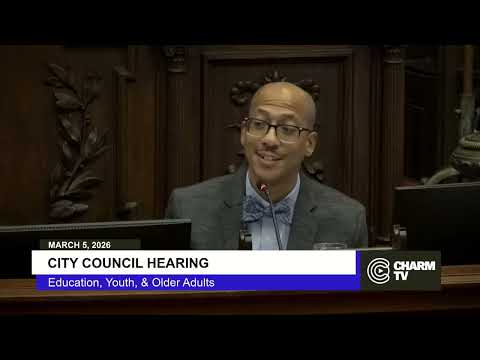
Chair Councilman John Bullock opened the session at 12:36 p.m. and said the hearing would focus on updates to the cityfund that distributes grants for youth programming.
Comptroller Henry told the committee his office had estimated the cost of a performance audit of BCYF at about "$153,000," including salary and fringe, and said it would require "about 2,220 hours of work" from a five-person team. He also said the office would request that two existing frozen PINs (10144 and 10148) be unfrozen to provide capacity for additional audits and offered to provide detailed memos or individual briefings for council members.
The hearing centered on a "clean replacement" amendment described by Vice Chair Councilman Mark Parker that consolidates months of drafting and stakeholder input. Parker highlighted several substantive changes: removal of language that would have excluded organizations that are not tax-exempt (or that rely on fiscal sponsors) from receiving capacity-building support; retention of a 5 percent allocation for public engagement rather than splitting that amount; and simplification of reporting language so the ordinance requires quarterly fiscal reports while allowing more frequent reporting in practice.
Alicia Lee, president and CEO of the Baltimore Children and Youth Fund, told the committee the fund's rules-and-regulations document required by the 2020 memorandum of understanding remains "not executed," and she urged the council to help finalize the document so the board and staff can compare reporting expectations with the ordinance. "This is my fourth year as president and that document is still not executed," Lee said.
Much of the discussion focused on whether the ordinance should allow narrowly tailored "invitation-only" grants or other mechanisms to deploy funds quickly in time-sensitive situations. Lee described a response after a shooting in Brooklyn when BCYF deployed one grantee for 30 days to provide on-the-ground programming and healing services and said that without a tailored mechanism the fund could not have acted as quickly. "We funded those activities for 30 days," she said, describing community beautification and on-site services.
Councilmember Zach Blanchard raised concerns that invitation-only processes can be used to direct money to political allies and asked what safeguards BCYF would use. Lee said the BCYF board approves grant decisions, that programmatic and fiscal reporting would remain public, and that the board follows strict reporting and vetting practices. "The board of directors still needs to approve these decisions," she said, noting that the fund budgets a pool for rapid response.
A law department representative, Jeff, advised that any deviation from a broadly open application process should be explicitly spelled out in the ordinance, including criteria, dollar or time limits, and oversight mechanisms. "Any deviation from the general application process would need to be clearly spelled out, like the criteria under which that happens, and the fact that there's still oversight," he said.
After discussion, Parker moved to advance the compiled amendment to Council Bill 25-0100; Blanchard seconded. The motion was recorded as passing with the present members voting yes. Chair Bullock said the full bill would be considered in two weeks when more committee members could be present and noted the move as productive.
The committee did not adopt final ordinance language on invitation-only grants at the hearing; members asked for clearer bill language and additional law department guidance to define the scope, eligibility and guardrails for any rapid-response or invitation-only funding mechanism. The Comptroller's audit-cost estimate, the unexecuted rules-and-regulations document, and the request that the bill author present to the BCYF board were flagged as items for follow-up.
The committee adjourned following the recorded vote.