
Regional monitoring programs report new funding, coordination needs and data gaps
Get AI-powered insights, summaries, and transcripts
Subscribe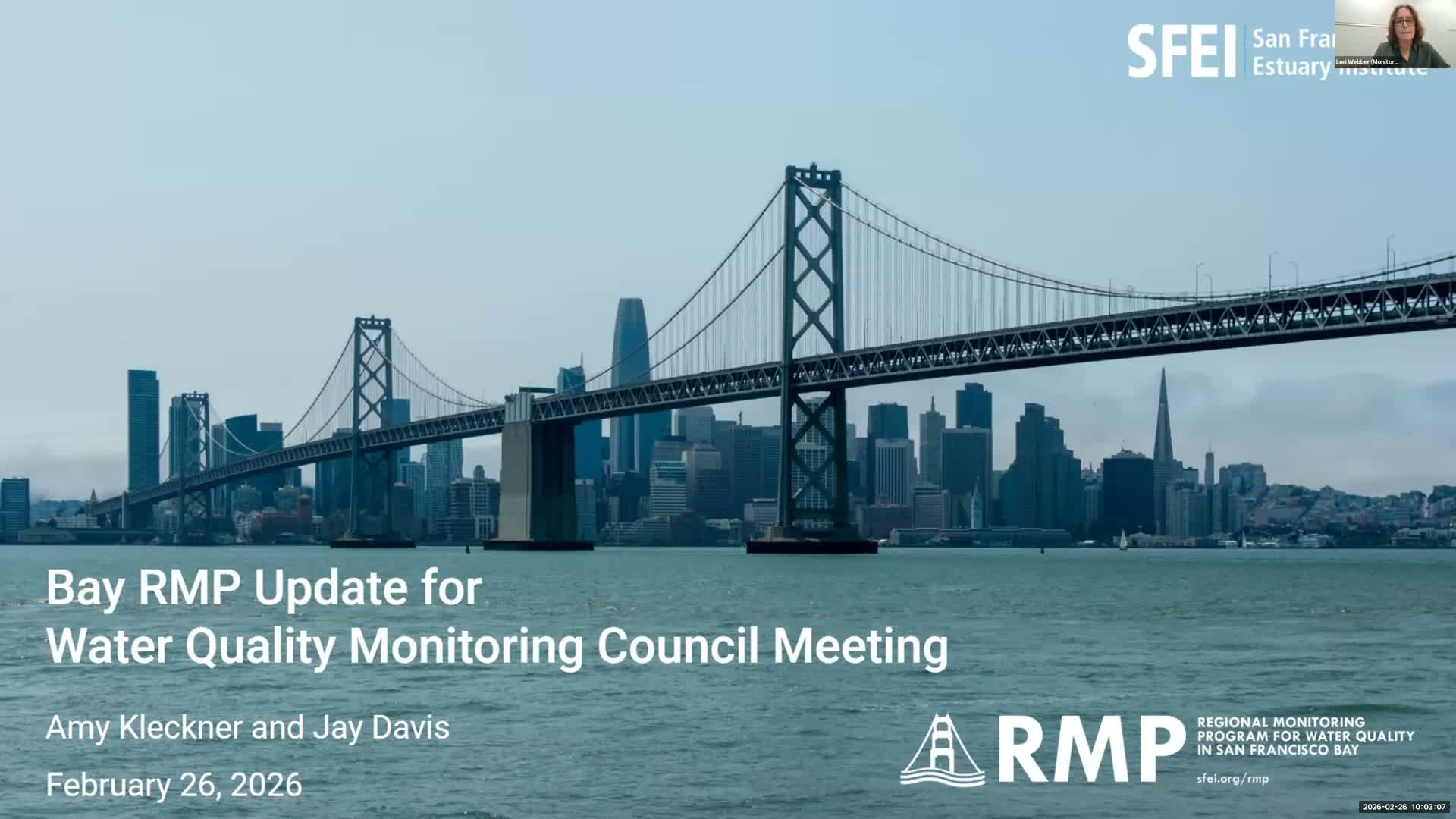
Summary
Regional monitoring programs told the council that recent federal grants and long‑running monitoring designs are expanding capacity, but fragmentation, limited funding and data‑management gaps — especially for continuous telemetry and standardized public access — remain urgent needs across the state.
Multiple regional monitoring programs briefed the California Water Quality Monitoring Council on long‑running monitoring designs, new funding and the data‑management and coordination gaps they still face.
San Francisco Bay RMP: Amy Kleckner and Jay Davis described the San Francisco Estuary Institute‑administered RMP, which received notice of a roughly $23.5 million non‑competitive grant from the U.S. Environmental Protection Agency to support the program’s work over the next five to seven years. Program staff said the RMP budget has expanded from about $5 million in 2024 to more than $9 million in 2026, enabling expanded monitoring of legacy pollutants and contaminants of emerging concern (CECs), new modeling and communications work, and planned hiring to support data services and QA/QC.
Russian River RMP: Speakers from the North Coast described the Russian River regional monitoring program’s transition from planning to implementation. Presenters outlined governance (steering committee and technical advisory groups), selection of priority indicators (22 narrowed to 11 priority metrics), and a joint cost‑share work group that is investigating fee‑based frameworks to stabilize long‑term funding. They emphasized alignment with statewide frameworks (RAMP/CRAM and EPA Healthy Watersheds) and FAIR data principles.
Klamath Basin: Randy Turner summarized the Klamath Basin monitoring program’s voluntary, stakeholder‑led model and the basin’s unusual nutrient and eutrophication challenges (including harmful algal blooms in Upper Klamath Lake). He described coordination obstacles — large volumes of locally collected data, variable QA/QC, tribal data sovereignty issues and inconsistent public posting — and said KBMP’s greatest need is stable funding for staff and centralized services.
Delta RMP: Melissa Turner reviewed the Delta Regional Monitoring Program’s governance transition to a nonprofit funded largely by dischargers, its staggered multiyear monitoring cycles (nutrients, pesticides, contaminants of emerging concern, mercury, HABs), and its 2023 data‑management plan requiring documented data life‑cycle processes and public posting to CEDEN where feasible.
Southern California: Albina Mejinto described the Southern California Bight (BIGHT) regional monitoring program and the Stormwater Monitoring Coalition. The BIGHT program operates on a five‑year stratified probabilistic design and requires intercalibration among dozens of participating agencies to ensure comparable data across many labs and samplers. Recent cycles have expanded bioaccumulation monitoring and added emerging contaminants (PFAS, microplastics) and seasonal sampling.
Common themes: presenters repeatedly asked for better integration of continuous telemetry datasets and clearer, resourced pathways to bring real‑time sensor data into statewide systems; they urged improved centralized access or a web hub for data visualizations; and they highlighted persistent funding shortfalls for sustaining program staff, centralized QA/QC and long‑term data services. Council members suggested the monitoring council could pilot a continuous‑data proof of concept and use the council website as a hub linking regional visualization tools.
What comes next: presenters said they will continue to work with council staff and OIMA on alignment to CEDEN/SEDEN 2, pursue funding models, and refine multiyear study plans. The council director proposed developing the website hub and exploring a limited pilot to stream selected continuous telemetry data into SEDEN 2 for further evaluation.