
State water board announces 2030 data solicitation and outlines SEDEN 2 rollout
Get AI-powered insights, summaries, and transcripts
Subscribe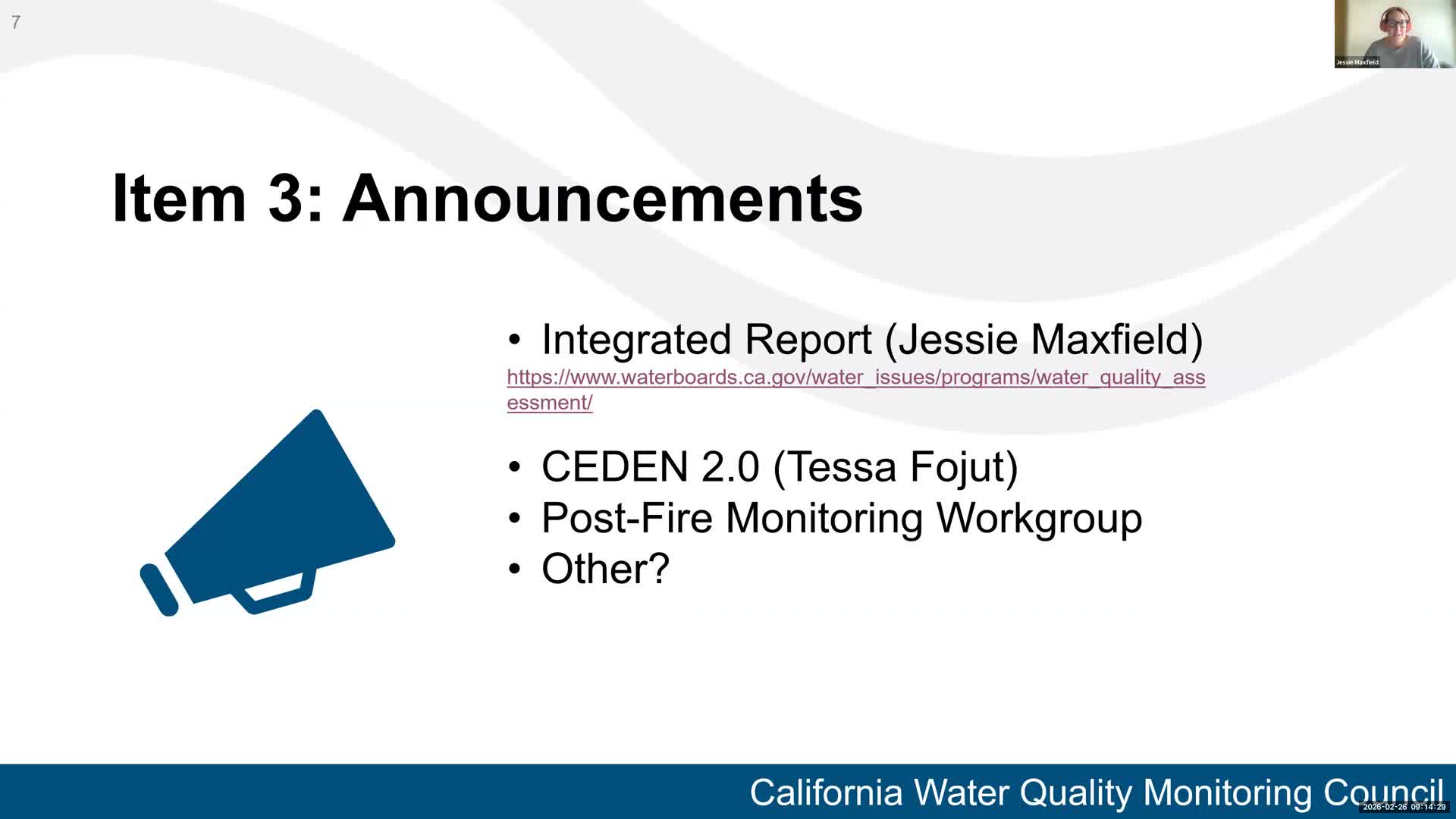
Summary
State water quality staff said data solicitation for the 2030 Integrated Report will open by late March or early April and urged immediate submission of monitoring data; a separate presentation described a phased SEDEN 2 upgrade that will add user accounts, automated QA/QC checks, and a chemistry module for public users this summer.
The California Water Quality Monitoring Council heard two state data updates that could reshape how monitoring data are collected and used for the next Integrated Report.
Jesse Maxfield, supervisor of the tools and support unit for water quality assessment, said the council’s integrated report combines the 305(b) surface‑water assessment and the 303(d) list of impaired waters and that the data solicitation for the 2030 cycle is expected by the end of this month or in early April. Maxfield said the solicitation period will likely last roughly four months and that the regions on cycle for 2030 include the San Francisco Bay, Los Angeles, Santa Ana and the Sacramento River Subbasin. He urged data providers to enter monitoring results into CEDEN (the California Environmental Data Exchange Network) as soon as possible so those datasets can be used in the 2030 assessment rather than waiting for the formal solicitation window.
“We are encouraging folks to start putting data into CEDEN as it becomes available,” Maxfield said. He added that the board is simultaneously managing multiple reporting cycles (2026, 2028, 2030) and that early submission facilitates assessment.
Shortly afterward, Tessa Foggit of the Office of Information Management and Analysis outlined plans for a modernized CEDEN data system she called ‘CEDEN 2’ (SEDEN 2). Foggit said the state is working with a vendor to adapt an EarthSoft ECWIS platform and that the 2026 development phase focuses on chemistry and field‑module data. She described three features she said were priorities: per‑user logins and secure API connections for regional data centers; built‑in QA/QC verification checks and flags (for batch QC, holding times, precision and spike recovery); and an interactive submission interface that highlights errors so submitters can correct files before final upload.
Foggit said the chemistry module and a refreshed website are planned to roll out over the summer of 2026 and that the state will publish templates and submission guidance in advance. She invited organizations with persistent submission errors to send sample files to the SEDEN inbox for troubleshooting.
Council members raised questions about public access and whether continuous telemetry data could be integrated; Foggit and other staff said existing public query tools will continue to provide access but that SEDEN 2 will improve incoming data quality and the submission experience. The council’s director said the board will follow up on pilot ideas for streaming telemetry into SEDEN 2 on a provisional basis.
What comes next: the board is expected to publish the official 2030 data solicitation and supporting guidance; SEDEN 2 materials and the chemistry module are scheduled to be available to users during summer 2026.