Lawmakers hear testimony on bill to extend ECO exemption for large data centers
Loading...
Summary
The House Energy Finance and Policy Committee heard testimony on HF3296, which would extend to data centers an existing exemption from counting large electricity sales toward municipal utilities’ ECO conservation targets; testimony focused on how single large customers can multiply small utilities’ load and make annual savings goals unattainable.
Representative Gilman introduced House File 3296 on March 5, saying the bill would extend to data centers the limited exemption already used for some crypto-mining operations so that a single large customer that increases a municipal utility’s base load by 40% or more would not inflate that utility’s annual ECO (conservation) target.
The author told the committee the measure responds to cases like Glencoe, where a constituent and local utility manager raised the concern. "Glencoe is home to one of, if not the first, crypto-based data mining operations in the state," Representative Gilman said, and the bill aims to ensure utilities are not penalized when a single new load skews their conservation obligations.
David Meyer, general manager of Glencoe Light and Power, testified the scale of some new facilities can make the 1.5% ECO savings goal effectively unattainable. "With that 80,000,000 [kilowatt hours] that means each year we need to show savings of 1,200,000 kilowatt hours," Meyer said, adding that the facility he described would use 146,000,000 kilowatt-hours and push Glencoe’s obligation to about 3,100,000 kWh. He told lawmakers his utility has used revenue from large customers to buy down a monthly power-cost adjustment and pass savings to other customers, but said the conservation requirement becomes very hard to meet when a single customer operates around the clock.
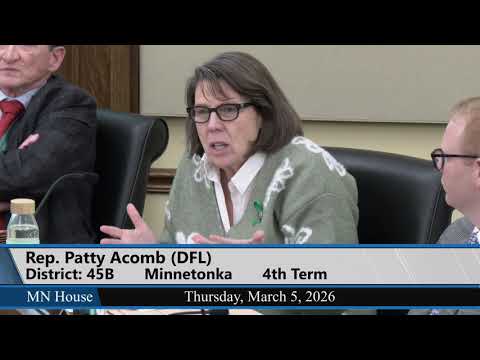
Not all testimony supported an across-the-board exemption. Sarah Wolf of Minnesota Interfaith Power & Light urged continued focus on energy-efficiency measures that save consumers money and help create grid capacity. Representative Sherry Acum cautioned that the committee should balance relief for new large loads against statewide efficiency goals and pointed to existing exemptions for very large users (about 20 MW) that may already provide some relief.
Committee members questioned how much additional efficiency could be found at modern data facilities, the length of typical contracts with large customers and the mechanics by which utilities record and verify ECO savings. Meyer said many large facilities are built to be highly energy efficient from the start and that the utility’s contracts have included three-year terms with extensions and off-ramps.
The committee laid HF3296 over for further work, giving members additional time to reconcile concerns about maintaining state energy-efficiency objectives while addressing the operational challenges small municipal utilities face when a single customer substantially increases load.