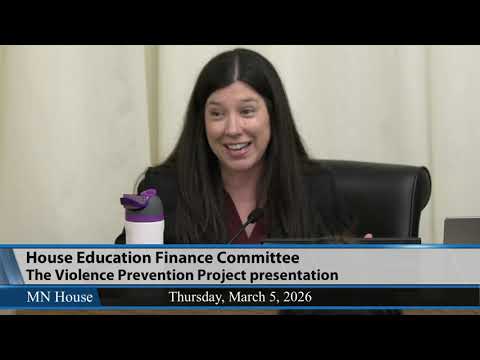
Minnesota committee hears bills to boost safe‑school funding; debate centers on charter and nonpublic inclusion
Loading...
Summary
Representative Green moved bills to raise the safe‑school levy to $44 per pupil and to provide direct aid to cooperatives/charters; the committee adopted an A1 amendment and laid the bills over after testifiers (districts, charters, nonpublic and cooperative leaders) debated charter eligibility and objections from nonpublic schools.
The Minnesota House Education Finance Committee on Wednesday considered two related bills to increase and expand safe‑school funding, and adopted an amendment clarifying direct‑aid eligibility for cooperatives.
Representative Green moved House File 3653 for possible inclusion and offered an A1 amendment clarifying that cooperative (co‑op) funds are for co‑ops that provide direct services to students; the committee adopted the A1 amendment by voice vote.
Representative Green described two proposals: one (HF 2717) would raise local safe‑school levy authority from $36 to $44 per pupil, and the other (HF 3653) would provide direct aid targeted to public school entities, including cooperatives and certain charter public schools, as direct aid of roughly $100 per student for eligible entities. "Safe school funding gives districts flexibility to determine what their schools and what their students need," Green said, arguing the measures support mental‑health staff, facilities, cybersecurity and prevention programs.
A broad set of testifiers supported the proposals but urged clarifications. Marcy Dowd, superintendent of an intermediate district, said safe‑school revenue had enabled physical upgrades, including "installations of weapon detection systems," and that intermediates rely on flexible aid to serve high‑need students. Benson superintendent Dennis Slama said safe‑school funding has not increased since 2013 while costs (for example, school resource officer costs) have risen more than 37% since 2015.
Charter advocates urged direct aid and eligibility. Joey Chenyan, executive director of the Minnesota Association of Charter Public Schools, noted charter schools serve about 70,000 students in Minnesota and are currently excluded from levy revenue because charters cannot levy; he asked that the committee include charter public schools among eligible recipients. "All Minnesota public school students, including the 70,000 who attend charter public schools, deserve equal resources for safe school environments," Chenyan said.
Leaders representing nonpublic schools asked the committee to extend aid beyond public entities. Megan Forget (Archdiocese of St. Paul & Minneapolis) and Tim Benz (independent nonpublic schools) cited the August shooting at Annunciation Catholic Church/School and urged equitable treatment for nonpublic schools. Benz said HF 3653 and HF 2717 “exclude nonpublic school students” and urged the legislature to take broader action to ensure every child receives safe‑school resources.
Several members pushed for further work on transparency and accountability if nonpublic schools are to be included. Representative Green said the bills are structured as public‑school funding and that expanding to nonpublic schools raises additional questions about public accountability and reporting.
The committee laid HF 3653 (as amended) and HF 2717 over for possible inclusion; no final policy vote was taken. Chair noted the bills and testimony will be considered further in subsequent committee action.