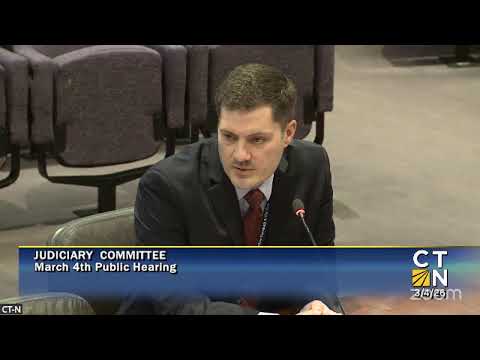
Supporters urge Judiciary Committee to codify PREA standards into Connecticut law
Loading...
Summary
Survivors, advocates and the Office of the Correctional Ombuds urged the Judiciary Committee to pass SB 89, which would codify federal PREA standards in state statute, mandate reporting and oversight, and create clearer paths to accountability for abuse in custody.
Survivors, advocates and state oversight officials told the Judiciary Committee on March 4 that Senate Bill 89 should be enacted to make federal Prison Rape Elimination Act standards enforceable in Connecticut.
"The Alliance strongly supports SB 89 and an act updating prison **** elimination standards," Beth Hamilton, executive director of the Connecticut Alliance to End ****** Violence, told the panel. Hamilton said the bill would require state and local agencies that detain adults or juveniles to meet PREA standards, require annual certification of compliance, mandate public reporting on training and investigations, and ensure survivors access confidential advocates, medical care, forensic exams and mental-health support.
Alex Brown, an MSW student who described having experienced abuse while incarcerated and whose case is documented in a Disability Rights Connecticut investigation, urged lawmakers to strengthen the bill to address structural conditions that allow abuse. "We deserve laws that actually protect people in custody," Brown said, recommending person-first language and limits on cross-gender supervision and stripping practices in intimate spaces.
Matt Mitchell of the Office of the Correctional Ombuds backed codification, telling the committee, "Governor's bill 89 takes an important step by codifying PREA standards in the Connecticut statute." Mitchell noted federal implementation supports have weakened, citing the Department of Justice's recent termination of funding for the National PREA Resource Center and related federal grants, and argued state law must therefore guarantee protections remain durable.
Mitchell also recommended that, where there is a verified PREA complaint or a substantiated Department of Correction investigation, survivors should be able to proceed directly to superior court through a narrowly tailored statutory cause of action. He referenced an ongoing independent review related to an allegation involving Lashonda Gregory and declined to comment on findings while the investigation continues.
Committee members asked witnesses whether the bill should strictly reference current federal PREA language or instead embed standards into state law; witnesses urged codification that preserves enforceable protections while allowing the state to hold agencies accountable even if federal guidance shifts.
The hearing produced no formal votes. Committee members praised the public testimony and asked the Office of the Correctional Ombuds to follow up on specific drafting questions about how PREA standards and bill language will be incorporated.