Get AI Briefings, Transcripts & Alerts on Local & National Government Meetings — Forever.
Court hears arguments over whether mandatory-reporting immunity shields Seattle Children's from negligent-training suit
Loading...
Summary
At oral argument in Farah v. Seattle Children's Hospital, attorneys debated whether Washington's child-abuse reporting statute bars a negligent training and supervision claim against the hospital after an employee's mandatory report led to the plaintiff's arrest and later dismissal of criminal charges.
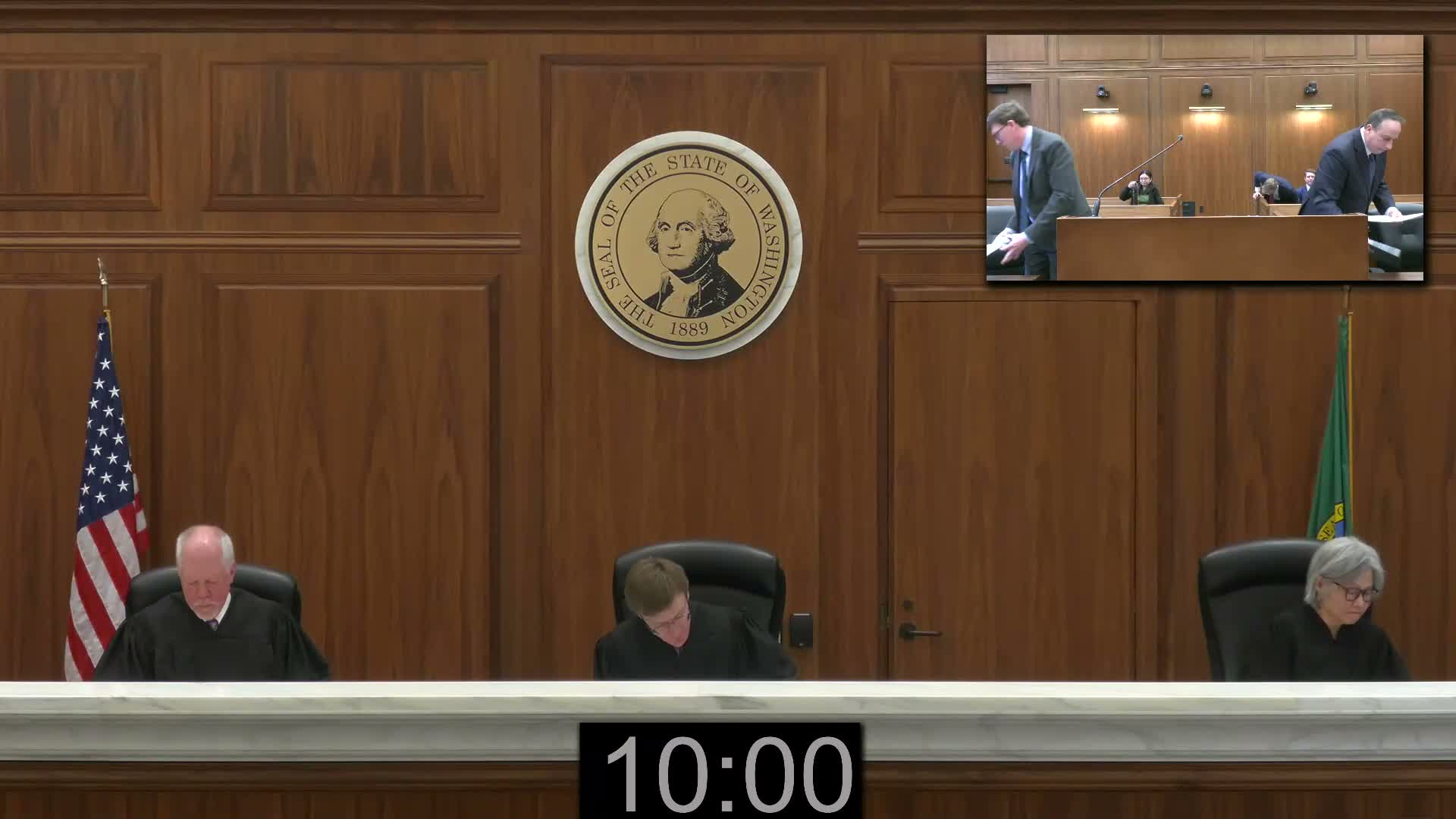
At oral argument in Farah v. Seattle Children's Hospital, counsel for both sides asked the court to resolve whether Washington's mandatory child-abuse reporting statute precludes a negligent training and supervision claim against a hospital when an employee made a good-faith report that led to the plaintiff's arrest.
Brennan Johnson, arguing for Seattle Children's Hospital, told the court that an employee, Amy Tainter, entered an exam room in February 2022 and “observed the plaintiff, Mr. Abdulazir Farah, touching and making motions in the unclothed vaginal area of his 8 disabled 8 year old daughter.” Johnson said Tainter reported the observation to the hospital's Safe Child and Adolescent Network Team (SCAN), which promptly made a mandatory report to CPS; law enforcement arrested the plaintiff and the criminal charges were later dropped after investigators interviewed Tainter.
Johnson argued that Washington's statutory immunity for good-faith reports of suspected child abuse extends to the employer and therefore forecloses Farah's negligent-supervision and negligent-training claims. He cited decisions the defense relied on (discussed as Ewell, Miles, and Anderson in argument) and emphasized that allowing employer liability would undercut the legislative purpose of encouraging reports to protect children. "Nobody attempted to make any sort of dispute or assertion that this immunity would not extend to the employer," Johnson said in argument, urging the court to treat the statutory immunity as dispositive.
Plaintiff's counsel Daniel Whitmore responded that the statutory language does not clearly eliminate an employer's independent duty to exercise reasonable care in training and supervising employees whose conduct creates foreseeable risk. "The report is evidence of the breach," Whitmore said. "The breach is behavior that happened historically before the breach and involves the hospital's failure to provide reasonable ... training and supervision." He told the court that prior cases did not squarely address whether immunity for reporting extinguishes a separate employer duty, and he described proximate-cause issues as factual matters for trial rather than legal questions to be resolved categorically at the pleading stage.
The presiding judge pressed Whitmore on the limits of that theory, questioning whether a causation position that a properly trained employee would not have reported could undermine the immunity statute's purpose of bringing suspicions to law enforcement. Whitmore replied that protecting reporting is different from converting the protected report into a superseding cause that erases antecedent employer negligence; he urged the court to decline to expand statutory immunity beyond the text the legislature provided.
In rebuttal, Johnson reiterated that investigation and verification are functions assigned to the state and that the reporting duty is personal to the mandatory reporter under a layperson standard—citing the RCW provisions discussed during argument—and that the immunity's civil-liability language covers civil claims arising out of making a report.
The court took the arguments under advisement, moved the argument calendar and recessed; no ruling was announced from the bench at the conclusion of oral argument.
The main issue before the court is statutory interpretation: whether RCW 26.44.060 (the mandatory abuse-reporting statute) and related precedent permit a direct negligence claim against an employer based on training and supervision where an employee made a good-faith report that led to law-enforcement action. The court's decision will determine whether an employer can be sued for an employee's mandatory child-abuse report when the report itself is otherwise protected.