Get Full Government Meeting Transcripts, Videos, & Alerts Forever!
Get email alerts on the Local Government Priorities topic
No spam. Unsubscribe anytime.
Sedona City Council workshop narrows 18 priorities to community and housing, sets measurable goals
Summary
At a facilitated visioning workshop, the Sedona City Council consolidated an 18‑item list into two top priorities — community (engagement/communications) and housing/land use — and directed staff to return with measurable objectives, four short‑term joint projects and housing scenarios for a March study session.
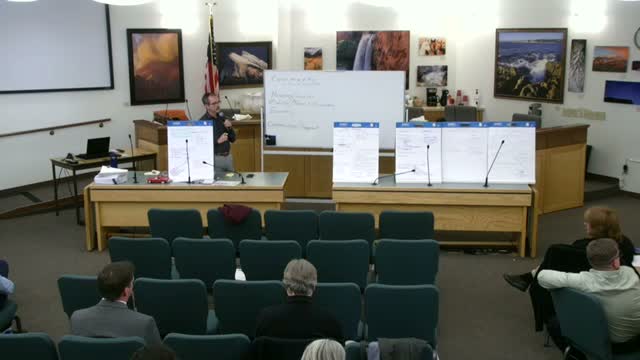
Mayor Ploog opened a full‑day, facilitated visioning session on March 6 in which council members, staff and community participants worked through models and table presentations to identify near‑term priorities for 2026. Facilitator Jonathan King led an exercise aimed at forcing trade‑offs so the council could focus on a small number of achievable goals.
The council coalesced quickly around two standing priorities: community — framed as communication and engagement practices the city should adopt as values — and housing/land use. King summarized the outcome as a cut from 18 items to two clear priorities and urged staff to deliver concrete, measurable objectives so the city can track progress.
Among the specific objectives the council asked staff to pursue for community were using an existing satisfaction survey as a benchmark (a triennial national survey in August 2026 was cited as an available instrument), tracking active engagement with event attendance and volunteer metrics, and piloting a series of short‑term joint projects that pair city staff, local businesses and citizen groups. Council members and staff agreed on a stretch goal of four short‑term joint projects in 2026 — roughly one per quarter — to create visible ‘wins’ while longer‑term work continues.
"If you can trust me, then we'll... get things done," Jonathan King said, urging the council to accept imperfect models and use time as a discipline to focus. King also recommended staff bring back scenario options and draft objectives so council debates are informed by comparable choices rather than open‑ended discussion.
On housing and land use, council members asked staff to return with a concise set of scenarios — broadly described as maintain, grow and do‑nothing — that outline how many units of what type the city should encourage (workforce, missing middle, senior/assisted living), implications for the local school district, financing and regulatory tools, and likely partners. Staff agreed to scope those scenarios and to aim for a study session in March to review them.
Council members emphasized the need to pair objectives with clear measurements and staff accountability. "We need short‑term wins and measurable objectives so staff can go and act," one council member said during the plenary. Members also asked that communication and engagement be integrated into staff work on each priority rather than left as an afterthought.
Next steps: staff will prepare and return with proposed objectives, an implementation timeline with responsible divisions and four candidate short‑term joint projects for 2026; the housing scenarios requested will be presented at a March study session. The facilitator closed by urging the council to adopt the metrics and follow the schedule so the workshop produces concrete action rather than a new list of goals.
The workshop recessed for the night with the council and staff committed to a set of measurable deliverables and a March timeline for the first set of follow‑up materials.