Get Full Government Meeting Transcripts, Videos, & Alerts Forever!
Get email alerts on the Education Accountability topic
No spam. Unsubscribe anytime.
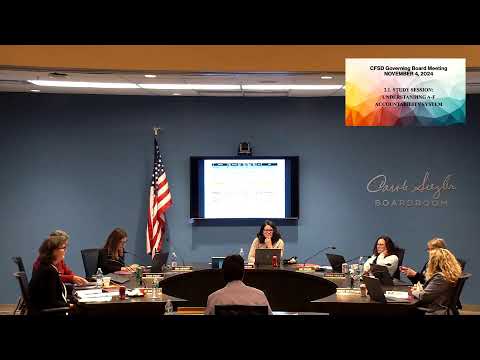
CFSD study session: new coordinator breaks down Arizona's A'F accountability formula; all seven sites earn A grades
Summary
Justin Robinson, the district's coordinator of student data, walked the Catalina Foothills Unified School District board through how Arizona calculates A'F letter grades, explaining proficiency, growth, EL and bonus indicators and highlighting that robust testing and improved data tracking pushed all seven CFSD schools into the A range this year.
Justin Robinson, the district's new coordinator of student data assessment and accountability, briefed the Catalina Foothills Unified School District board in a study session on how Arizona's A'F accountability system converts assessment and outcome measures into letter grades.
Robinson told board members the system combines multiple indicators — proficiency, growth, English-learner performance, acceleration-readiness and, for high schools, graduation and college-and-career readiness — each with its own scoring rules and weights. "The state of Arizona has an A through F accountability system," Robinson said, and the detailed calculations are laid out in statewide business rules he summarized for the board.
Why it matters: the formula can magnify small procedural differences. Robinson emphasized two practical levers: test participation and precise student tracking. Schools that test at least 95% of eligible students avoid a penalty and testing closer to 100% can boost a school's proficiency component; Robinson showed that district sites tested roughly 99% this year and benefited from the percent-tested multiplier. He said the district's high participation "gives you a boost to your proficiency score," a factor he said translated into measurable point gains.
How the main indicators work: for proficiency, student achievement on the state ELA and math assessments is converted into point values and averaged; K'8 schools can optionally use a "stability model" that weights students who have been at the same site for multiple years if that method yields a higher score. For growth, students receive a student-growth percentile by comparing this year's results with state peers who had similar prior-year scores; growth points are awarded based on combinations of prior proficiency and growth. Robinson noted any student can contribute to high-growth points, including previously highly proficient students.
English learners are scored separately on the AzELLA assessment. Robinson said a school must have at least 11 EL students tested to be eligible for points in that subindicator; Ventana Vista and CanyonView were not eligible this year because they did not meet that threshold. Acceleration-readiness (K'8) and several subgroup-improvement measures provide additional opportunities but are often capped, he said.
High-school measures: Robinson explained that the graduation component uses cohort graduation rates (4' to 7'year rates) that are typically a year behind and must be carefully tracked. "Proper tracking of where these students are going is critical," he said, noting that students who move out of state and are not documented with acceptable withdraw codes remain counted in the cohort and can depress a reported graduation rate. Board members discussed differences between the ADE cohort rates and the district's own annual graduation calculations and asked staff to consider how both figures should be presented publicly.
College and career readiness (CCRI) is based on an end'of'year, student-level "brag sheet" of accomplishments (meeting Regents' program-of-study requirements, ACT/SAT/AP results, CTE completion, FAFSA completion, diploma seals and similar items); Robinson said accurate longitudinal record keeping from freshman year onward is essential for students and schools to receive full credit.
Bonus points and outcomes: Robinson described bonus-point opportunities (special-education enrollment comparisons, science proficiency tests, and postsecondary follow-up percentages) and reported the district earned full science bonus points this year. Aggregating base indicators and bonus points, Robinson showed that all seven CFSD sites scored in the A range under the state cutoffs (K'8 A = 84%+, 9'12 A = 82%+), and he highlighted Sunrise Drive Elementary's top result.
Board response and next steps: trustees thanked Robinson for the overview and raised follow-up items: clarifying whether the district should publish ADE cohort rates, district annual rates, or both (with explanation), and continuing work to tighten student-mobility tracking and end'of'year data collection so CCRI and graduation rates accurately reflect student outcomes. Chair (speaker 1) praised the presentation and the board paused for a short break before the regular meeting.
Sources and attributions: quotations and explanations above are drawn from Robinson's presentation and board discussion during the CFSD study session; attributions in the article use the names and role-language explicitly provided in the transcript (Justin Robinson; Chair and committee members as labeled).