
Texas Supreme Court hears dispute over telecom easement fees, standing and state gift-clause claims
Get AI-powered insights, summaries, and transcripts
Subscribe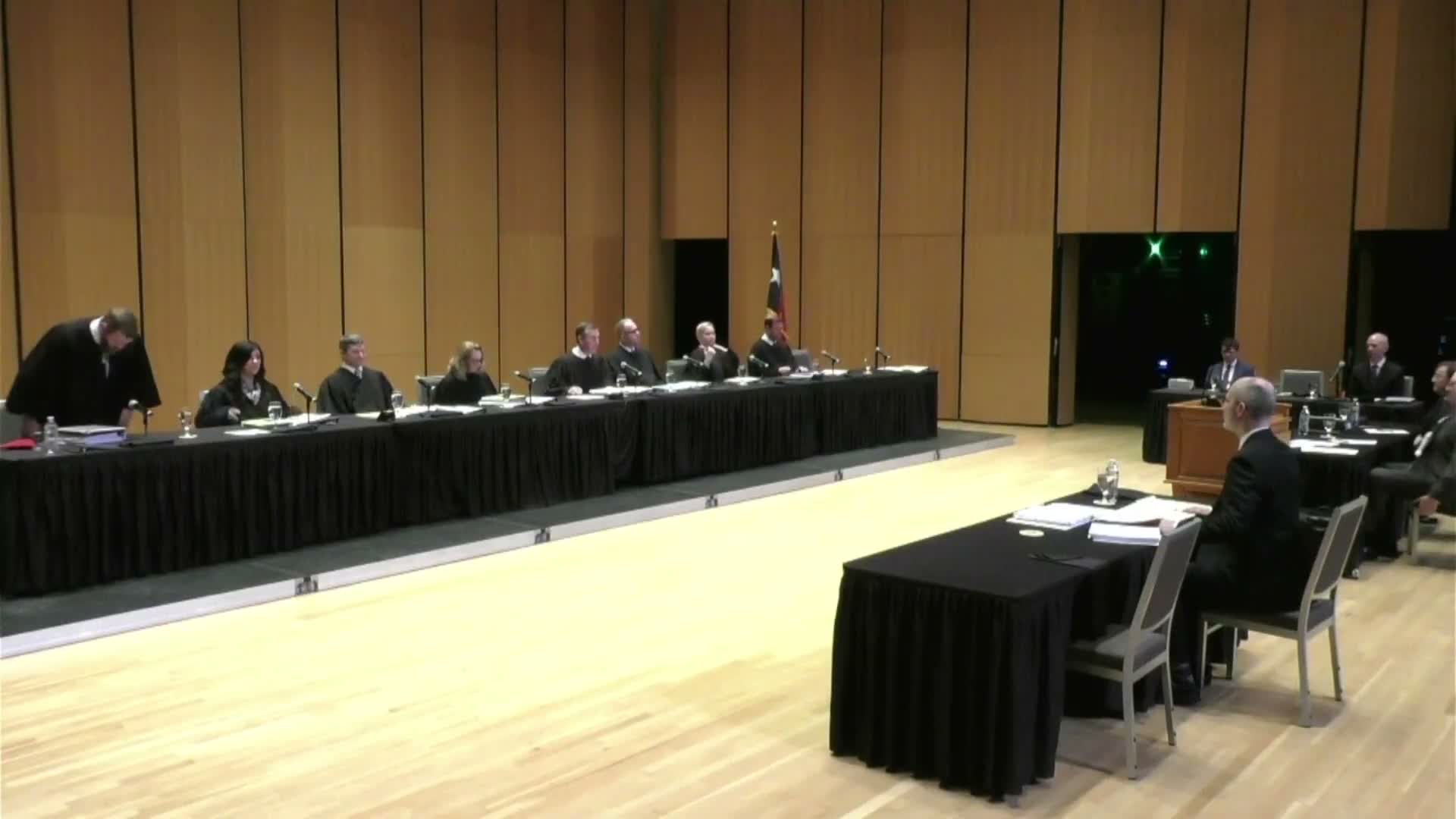
Summary
At oral argument in State of Texas v. City of McAllen and others, petitioners urged dismissal for lack of standing; respondents said the challenged statutes let cities grant a 'thing of value' in possible violation of the state gift clauses and asked the Court to reach the merits.
At oral argument before the Supreme Court of Texas, counsel for the petitioning cities urged the court to dispose of the case on standing grounds, saying the State — the only named defendant — does not itself enforce Senate Bill 1004 or Senate Bill 1152 and therefore the cities lack the traceability and redressability required to bring the suit. "Standing is the most straightforward way to resolve this appeal," petitioner counsel Mister Peterson told the justices.
Mister Peterson, arguing for the petitioners, said that because the public rights-of-way at issue are owned by the state, any grant or donation at issue would be made by the State rather than by the cities, and that the statutes therefore do not violate the state gift clauses. He said the statutes satisfy the Borgelt and Texas Municipal League test because the access is exchanged for consideration, serves a public purpose in providing telecommunications infrastructure, and the State retains control over rights-of-way.
Responding for the State, Mister Heath told the court the two statutes being challenged — Senate Bill 1004 and Senate Bill 1152 — "do exactly that," meaning they permit local action that, in the State's view, amounts to a grant or transfer of value subject to the gift-clause constraints. Heath emphasized precedent holding that a local government required to implement an allegedly unconstitutional law has a cognizable injury for standing and cited the court's Nootsi-related decisions as support for municipal standing.
Justices pressed both sides on how standing should be analyzed here. The court questioned whether naming the State alone as a defendant denies the trial court the ability to render a declaratory judgment that would redress the cities' alleged injury, and whether adding the Public Utilities Commission (PUC) as a defendant would fix any standing problem. Petitioner's counsel acknowledged the PUC probably has enforcement authority over some utility-code charges (citing Local Government Code ch. 283 and chapter 66 of the utilities code) but said he did not see how the PUC could cure standing for SB 1004 (chapter 284), which he said lacks PUC enforcement authority.
The justices also debated valuation and whether the statutory per-line cap in one bill removes the possibility of a gift. The parties and the court discussed an evidentiary record that a right-of-way access easement could have market value between $1,500 and $2,500, while one statutory cap referenced during argument was $250 per year. Counsel acknowledged that proof on value would require expert testimony and econometric evidence in the trial court.
On the merits, respondents urged the court to apply the Borgelt test and asked the justices to scrutinize whether the statutory text requires a predominant public purpose and limits private benefit. Petitioner's counsel responded that even if the State can repeal or amend the statutes, the Court should look to ownership and control of the rights-of-way and the presence of consideration to avoid a gift-clause violation.
The court took no announced decision at the argument. Counsel completed remarks and rebuttal time, the bench thanked counsel and adjourned for a short recess before a private conference. The justices will issue an opinion in due course.