
Snohomish County Council adopts four ordinances updating permit fees and streamlining townhouse permitting
Get AI-powered insights, summaries, and transcripts
Subscribe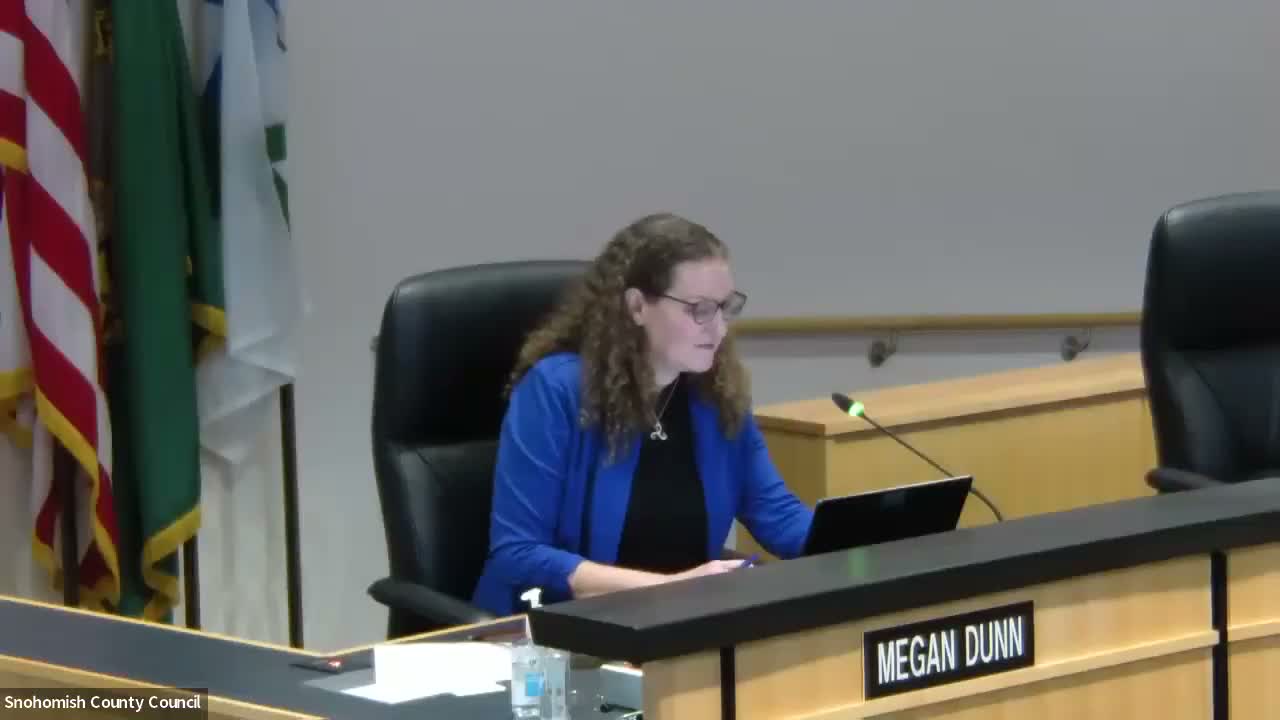
Summary
On Feb. 25, 2026, the Snohomish County Council unanimously adopted four ordinances that update commercial and transportation-related permit fees and streamline townhouse permitting by consolidating separate mechanical and plumbing permits into a single residential building permit to improve efficiency and reduce costs.
Snohomish County Council met in the Jackson Boardroom and remotely on Feb. 25, 2026, and voted unanimously, 5-0, to adopt four ordinances amending county code on commercial and industrial uses, transportation review fees, miscellaneous permit fees and townhouse permitting.
Deb Bell, council staff, summarized the package of ordinances, saying the measures are largely housekeeping updates intended to "streamline current permitting processes and eliminate outdated procedural requirements in commercial and industrial zones" and to improve consistency across zones. She told the council some fee items in the transportation review schedule had not been updated since 1991 and that the proposed changes were calculated in accordance with RCW 82.02.002 to improve cost recovery, equity and predictability.
The most substantial discussion focused on Ordinance 26-005, which would amend Snohomish County Code (Title 30.86) for townhouse permits. Council members asked why townhomes had been treated more like commercial properties and whether the change would affect costs. Mike McCrae, a Planning and Development Services (PDS) staff member, said the proposal "put[s] that all into 1 permit," explaining that townhomes historically required separate building, plumbing and mechanical permits and separate fees. McCrae said consolidating those permits "is more efficient and it actually ultimately ends up in a less cost."
Michael Cepinaro, also with PDS, offered a technical clarification earlier in the meeting on parking standards for mini-storage, noting a ratio of "2 spaces per 75 mini storage units." He and other PDS staff were available to answer Council questions during the hearings.
Natalie Reber, representing the Master Builders Association of King and Snohomish counties, provided the only recorded public comment, expressing organizational support: "we're very happy that PDS is taking this very important measure up that helps provide more predictable housing." No other speakers provided testimony on the other ordinances.
Votes at a glance: Ordinance 26-002 (growth management: uses in commercial/industrial zones) — moved and seconded; amendments 1A and 2 approved; amended ordinance adopted, 5-0. Ordinance 26-003 (development permit fees for transportation review) — adopted, 5-0. Ordinance 26-004 (miscellaneous permit fee updates, additions to Title 30) — adopted, 5-0. Ordinance 26-005 (townhouse permit fee/process changes to consolidate permits) — adopted, 5-0.
The council completed the four-item agenda and adjourned. Several staff members with PDS remained available to follow up on technical questions and implementation details following adoption.