Get Full Government Meeting Transcripts, Videos, & Alerts Forever!
Get email alerts on the School Safety topic
No spam. Unsubscribe anytime.
Sumner County study session spotlights layered school-safety strategy, anonymous tip line and security upgrades
Summary
At a Nov. 12 Sumner County Board of Education study session, district staff and the sheriff's office outlined prevention programs, mental-health supports, an anonymous tip line and physical upgrades including cameras and vape detectors; the board moved to executive session after questions. Presenters said multi-layered efforts aim to reduce threats and improve response, and noted early data on the tip line and detectors.
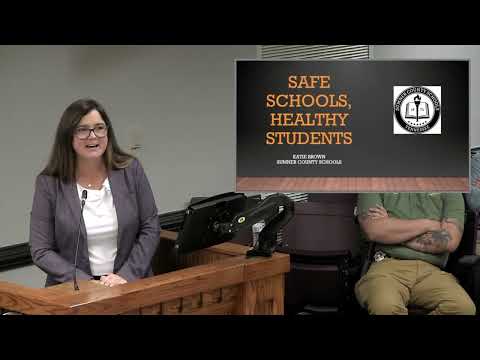
Katie Brown, who led the Safe Schools presentation for Sumner County Schools, told the Board of Education at its Nov. 12 study session that the district's approach to safety combines prevention, preparedness, response and recovery.
Brown said prevention work ranges from peer mediation and leadership-development programs to care teams that give small groups of students short-term support with an adult. "There's no magic bullet," she said, arguing that multiple layers of supports are necessary to prevent escalation and to help students cope with stress.
Brown described the Family Resource Center as a growing resource for students and families, saying 370 students attended a recent back-to-school event and that the center has served 209 more students than it had at the same point last year. She said the district has identified 307 McKinney-Vento students who need additional supports and noted that private donations are used only for direct student aid.
On family education and out-of-school-time services, Brown said Unity Learning Centers and extended-day programs have been funded by grants for 25 years and have brought in more than $21,000,000; she reported 736 students were enrolled in grant-funded after-school programs across 15 elementary and middle schools and said district-funded childcare operates at 16 schools.
Brown described the district's mental-health staffing and outside partners: eight crisis social workers with specialized training and partnerships with Volunteer Behavioral Health, STARS and Centerstone that provide in-school counselors and groups with parental consent.
The district has launched a state-linked "Handle With Care" notification so schools receive a short alert when law enforcement responds to an incident at a student's home; Brown said the alert provides no details but signals staff to show compassion and check in when appropriate.
Brown also introduced "Safer Sumner," an anonymous tip line and app that allows the public to report non-emergency school concerns. The district has received four tips so far, she said, and cited a distribution system that routes reports to school teams or law enforcement for life-safety events. "If it's an emergency, call 911," Brown added, noting the tip line is for issues that need a school-level response rather than immediate emergency action.
Lieutenant Chris Vines of the Sumner County Sheriff's Office told the board that SROs are Tennessee POST-certified police officers who are expected to focus first on safety, second on education through brief classroom instruction, and third as mentors to students. Vines said the county's SRO program was recognized nationally in 2023 and emphasized joint drills that include police, fire, EMS and emergency management.
Vines reviewed campus-level security "must-haves" agreed with district leadership: exterior doors closed and locked except when actively supervised, visitor management via the Raptor system and a double-buzzer entry process, classroom doors locked during class time, a visible district-issued badge policy for adults in buildings and multi-agency site assessments to keep plans current.
Presenters described recent physical-security upgrades: the district added 5,452 feet of campus fencing, expanded camera coverage (Brown said 888 cameras were added in the past year), upgraded door hardware and started a window-lamination program. The district also digitized building maps and floor plans to support emergency operations and life-flight planning.
Brown said the first-phase rollout of vape detectors in middle schools has correlated with fewer hits over time (123 detections in the first month and 45 in the second), and noted the detectors are tied to hallway cameras to help narrow follow-up. She described other programs such as TCIS classroom strategies and Champ Camp for middle-school students as part of prevention and relationship-building.
After a period for questions, the board chair moved the meeting into executive session and the public portion of the study session ended without further open-business votes or motions.