
Committee advances bill to require recording of child interviews by Department of Child Safety
Get AI-powered insights, summaries, and transcripts
Subscribe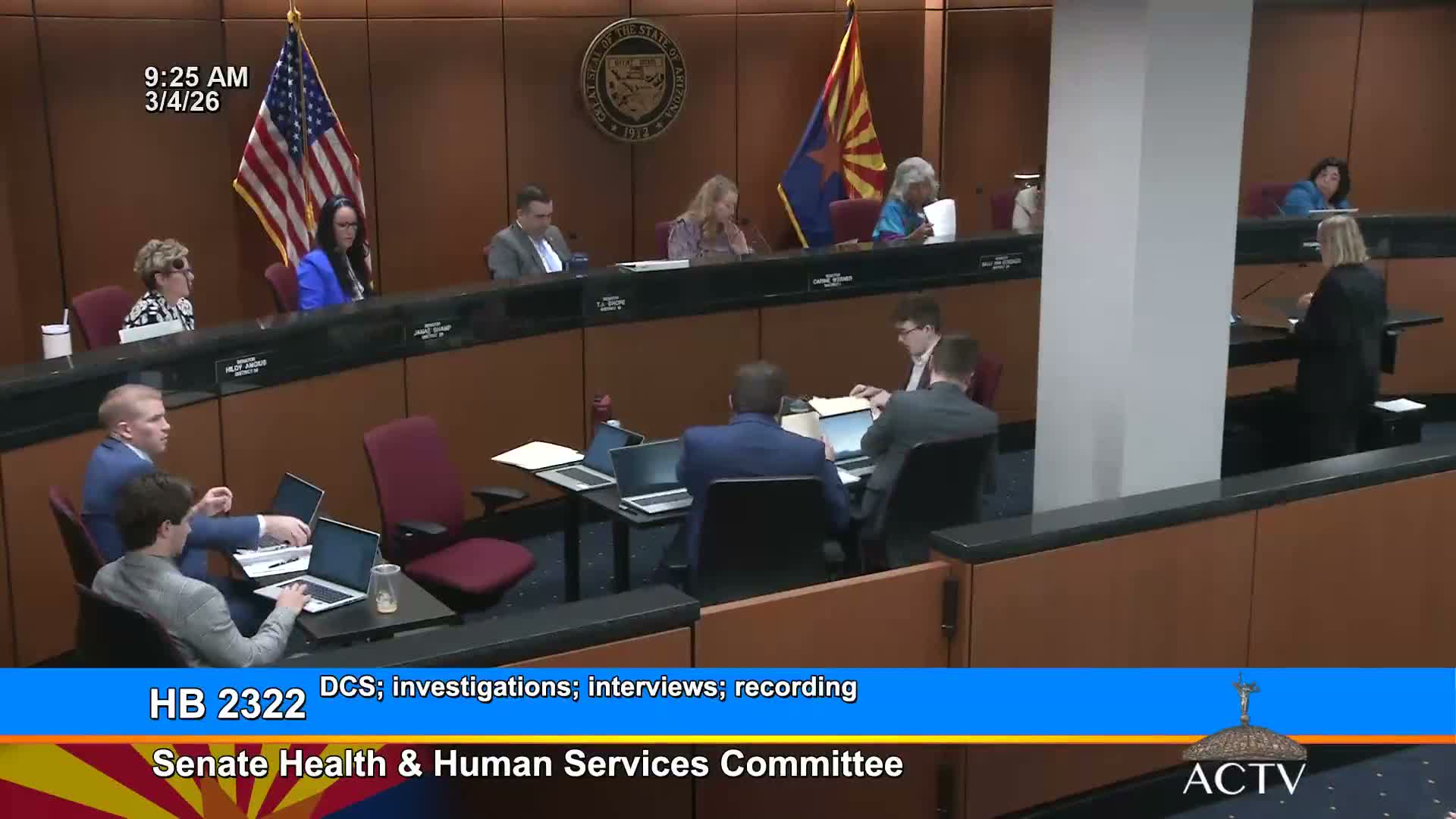
Summary
House Bill 2322 would require DCS to audio or video record interviews with children who are subjects of investigations, with narrow exceptions and a conditional enactment tied to federal grant authority; the committee moved the bill forward by a 7–0 vote after survivor and caregiver testimony.
The House Health and Human Services Committee advanced House Bill 2322, a bill that would require the Department of Child Safety to audio- or video-record interviews with children who are the subject of investigations except when equipment malfunctions or DCS lacks access to recording equipment due to unforeseeable circumstances.
The presenter told the committee the bill specifies that failure to record an interview is not grounds to exclude otherwise admissible statements in criminal or dependency proceedings and that the director of DCS must apply annually for federal grants to support recording if such grants become available. The bill contains a conditional enactment tied to federal grant legislation and sets a conditional date of Jan. 1, 2037 for that grant-based trigger.
Survivors and child-welfare advocates told the committee the recordings would protect children’s voices and strengthen investigations and prosecutions. "Recording the interview protects the child's voice, strengthens investigations, strengthens prosecution, and it reduces the need for the child to relive their trauma again and again," said Sherry Lopez of the Arizona Human Trafficking Survivor Coalition.
Elle Breton, who testified she works with survivors and identified a case that inspired the bill’s name, described a case she said was mishandled when an unrecorded interview left no objective record of what a child said. Anika Robinson, a foster parent and child-welfare advocate, said the bill is fiscally responsible in its design and aligns with federal grant efforts such as the Gracie Act to help pay for recordings and secure storage.
A committee member moved the bill with a due-pass recommendation; roll call recorded 7 ayes, 0 nos and 0 not voting, advancing HB 2322.