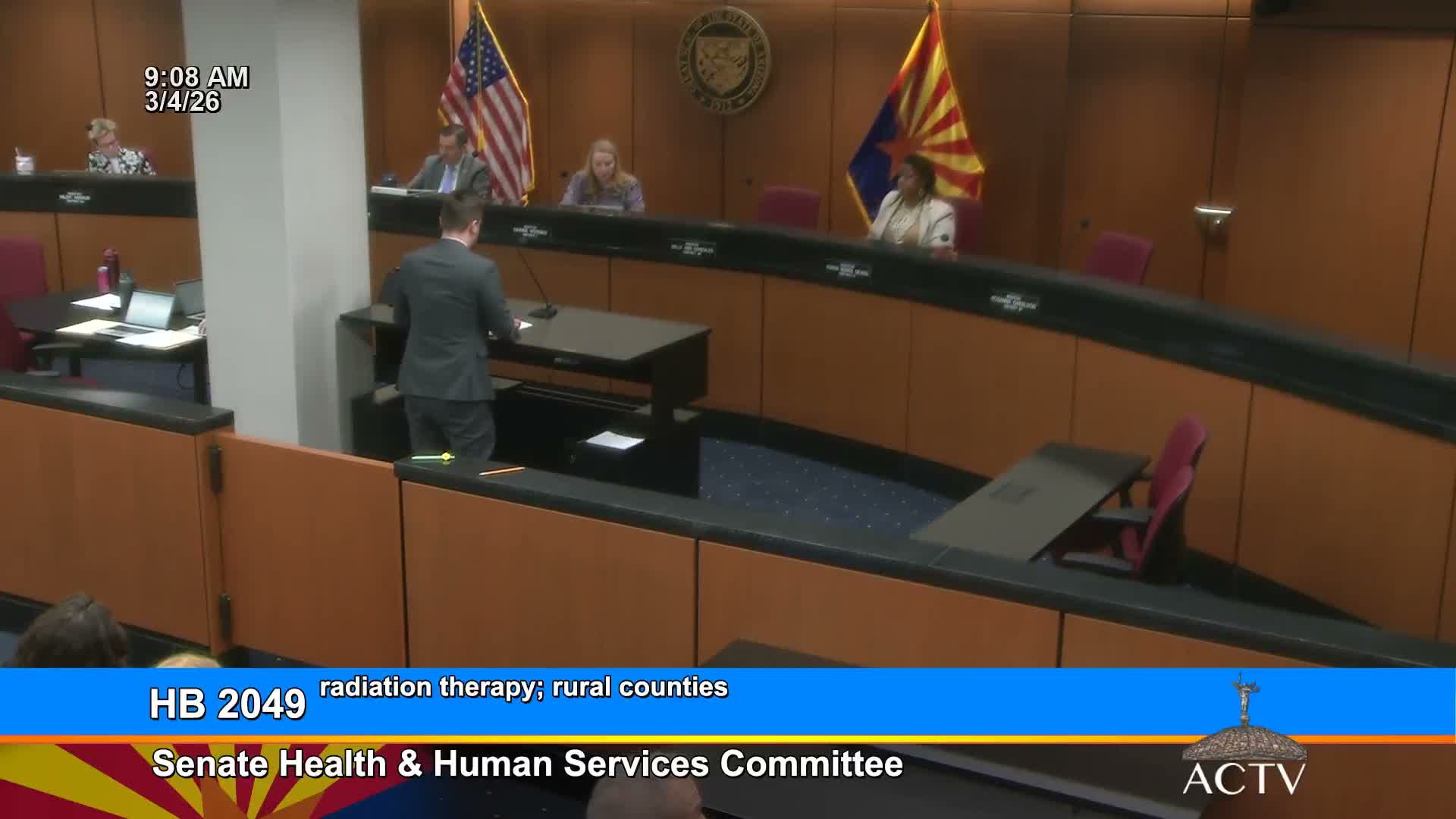
Panel advances bill to let rural hospitals use particle accelerators under defined general supervision
Loading...
Summary
The House Health and Human Services Committee voted 7–0 to give HB 2049 a due-pass recommendation, which would let critical-access and small-county hospitals use particle-accelerator radiation therapy under limited, documented general supervision while keeping safety checks such as periodic physician observation and on-site availability for consultation.
The House Health and Human Services Committee on Feb. 19 voted to advance House Bill 2049, which would allow the Department of Health Services to permit particle-accelerator radiation therapy under general supervision in counties with fewer than 400,000 residents and at critical-access hospitals if safety and documentation requirements are met.
Supporters told the committee the change is aimed at improving access to radiation treatment in rural Arizona, where patients sometimes must travel long distances or temporarily relocate to complete weeklong courses of therapy. "HB 2049 helps address that gap by creating a pathway to expand radiation therapy services in rural communities while maintaining strong safety standards and treatment protocols," said Damien Johnson of the Arizona Hospital and Healthcare Association.
The bill prescribes several safeguards: registrants must meet documentation and review requirements; they must ensure devices are not used during special procedures and that written protocols are followed; a registrant must observe procedures and document assessments of the technologist at least every six months; and an authorized user must be on-site and available for consultation at least once every five working days.
Dr. Steve Rosinski, a medical oncologist in Mohave County, told the committee high-dose treatments would still require direct supervision and a radiation oncologist would continue to see patients at least once a week. "This just further clarifies direct versus general supervision for radiation oncologists," Rosinski said, noting similar approaches exist in other states.
Dr. Winliff Swasson, a radiation oncologist with decades of rural experience, said workforce shortages and long patient travel times make local access fragile and that remote planning and cloud-based access to treatment plans have proven feasible in recent years. "When you have workforce shortages, it threatens closure of cancer care," Swasson said.
A committee member moved the bill with a due-pass recommendation; the secretary recorded 7 ayes, 0 nos and 0 not voting, advancing HB 2049 to the next legislative stage.
The bill as described in committee includes an emergency clause cited by the sponsor to address current access concerns in rural Arizona.