Minnesota Commerce Committee advances a slate of health-insurance mandate bills amid debate over state defrayal and infertility coverage
Get AI-powered insights, summaries, and transcripts
SubscribeSummary
On March 5, 2026 the Senate Commerce & Consumer Protection Committee advanced most health-benefit mandate bills to the Health and Human Services Committee after testimony from the Department of Commerce, insurers, clinicians and patient advocates. Members debated state defrayal of mandate costs and whether the infertility bill could be read to require surrogacy-related coverage.
The Minnesota Senate Commerce and Consumer Protection Committee on March 5 heard an overview of the state’s 62J mandate-review process and advanced a slate of health-insurance mandate bills to the Health and Human Services Committee while rejecting a broad amendment to require state defrayal for all future mandates.
PJ Mitchell, director of regulatory and health policy at the Minnesota Department of Commerce, told the committee the department “determines, or initially determines if a mandate exceeds the coverage required under the state's EHB plan” and outlined how 62J analyses gather stakeholder input, claims analyses and fiscal estimates. Mitchell cautioned that the reviews sometimes produce ranges of estimates because of limited data and that the department contracts technical work to outside vendors such as the American Institutes for Research.
Why it matters: The bills would change what private, fully insured health plans in Minnesota must cover, affecting access to care for people with chronic pain, diabetes, cancer risk, spinal cord injury, childbirth and infertility. Several authors and advocates framed the bills as correcting gaps in coverage; insurers focused on premium impacts if new benefits are added across the market.
Insurers emphasized cost and safeguards. Dan Andreesen of the Minnesota Council of Health Plans said mandates are paid by plan enrollees and warned of cumulative effects: “It’s not our money. It’s our enrollees’ money that they give us to pay for care,” he said, urging caution about removing utilization-management tools and flagging private equity–backed providers as a potential source of fraudulent billing.
Bills advanced and key votes. The committee recommended several bills to pass and be referred to Health and Human Services, usually by voice vote, and recorded a roll-call on one contentious measure:
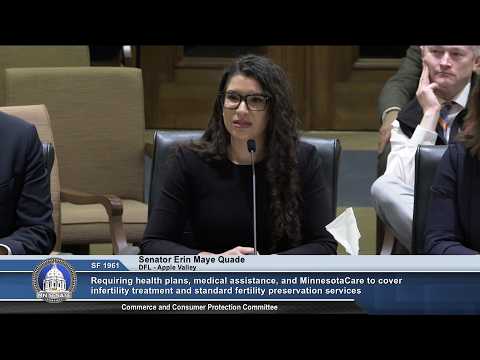
Votes at a glance - SF 1946 (nonopioid pain alternatives): recommended to pass and referred to Health and Human Services. Sponsor: Senator Kupak. - SF 3716 (follow-up diagnostic tests after abnormal Pap): recommended to pass and referred to Health and Human Services. Sponsors: Senator Mann. - SF 2071 (prohibit step therapy for insulin): recommended to pass and referred to Health and Human Services. - SF 1302 (genetic testing and imaging for high-risk patients): recommended to pass and referred to Health and Human Services; Department and MMB 62J materials cited low per-member cost estimates. - SF 970 (bowel and bladder care after spinal-cord injury): recommended to pass and referred to Health and Human Services. - SF 3768 (doula services coverage): heard with multiple witnesses; bill was laid over (no recommendation at this hearing). - SF 1101 (augmentative and alternative communication devices): recommended to pass and referred to Health and Human Services. - SF 1961 (Minnesota Building Families Act — infertility coverage): after debate and adoption of an A6 religious‑exemption amendment, the committee approved the motion to pass and refer to Health and Human Services by roll call, 6–5.
Committee debate: defrayal and scope of mandates. Senator Rasmussen offered an A2 amendment to require the state to defray the fiscal impact of new insurance mandates under federal rules; some members supported the principle of defrayal but questioned whether attaching the language to SF 1946 was procedurally appropriate. Senator France and others said the state should fund mandates that it imposes; Senator Wicklund and others said a stand‑alone bill or referral would be the appropriate vehicle. The A2 amendment was not adopted.
Contentious issues on SF 1961 (infertility). SF 1961 prompted prolonged debate over whether the bill’s language could be read to require coverage tied to third-party services or surrogacy. Supporters — including patients, clinicians and infertility advocates — described financial and health harms from lack of coverage. Dr. Zirak Khan of the Mayo Clinic said infertility is a medical condition and noted improved outcomes and safer practice when coverage is available. Opponents raised ethical concerns and warned the statutory definitions could be interpreted broadly; Rebecca Delahunt of Minnesota Family Council argued the bill “likely mandates insurance coverage of surrogacy” as written. The author accepted a religious‑exemption amendment (A6). The committee recorded a roll‑call and approved the motion to advance the bill 6–5 (roll-call names recorded in the transcript).
Witness testimony highlights. Patients and clinicians described concrete cases: Planned Parenthood volunteer Jessica Klem recounted that follow‑up diagnostic care after an abnormal Pap had saved her life; Eduardo Colon testified about the life‑threatening consequences if insulin is delayed; doulas and maternal‑health advocates detailed how continuous support reduces complications and racial disparities in maternal outcomes; advocates for AAC devices and disability groups described lives harmed by denial of communication technology.
What’s next. Most of the advanced bills move to the Senate Health and Human Services Committee for budgetary and policy consideration; doula coverage was laid over for future consideration. The Department of Commerce’s 62J reports and fiscal notes will be available for the receiving committee as applicable.
Committee adjourned with no further business.