Get Full Government Meeting Transcripts, Videos, & Alerts Forever!
Get email alerts on the Road Safety topic
No spam. Unsubscribe anytime.
Arlington staff present first Safe Streets annual report, cite recent rise in serious crashes and new public dashboard
Summary
Transportation staff presented the first annual Safe Streets Arlington report, detailing a high-injury network, a public safety dashboard with crash data through 2024, 43 recommended action items and a goal of zero fatalities by 2050; staff and APD officials described enforcement and grant-seeking efforts.
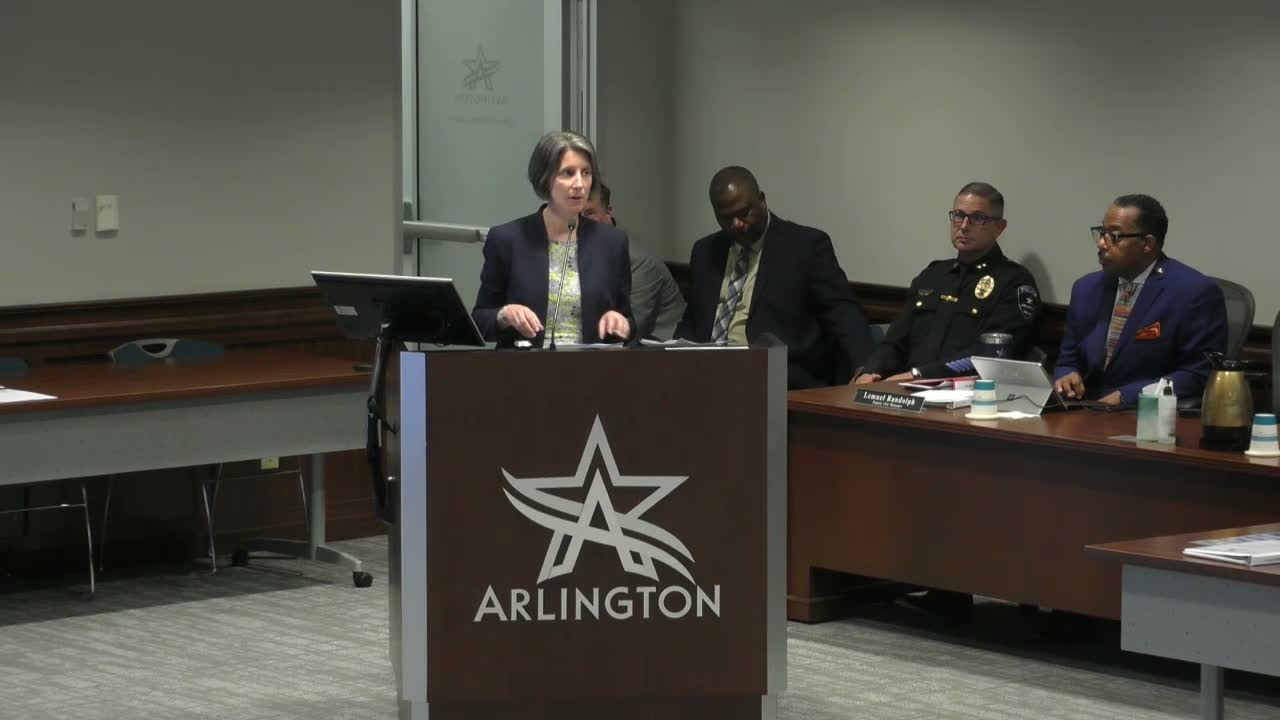
Anne Foss, who identified herself as representing the Transportation Department, presented Arlington's first annual report on the Safe Streets Arlington plan adopted in December 2024, outlining data analysis, stakeholder engagement and next steps to reduce serious crashes.
Foss told the council the plan used five years of crash data (2018'022) to produce a high-injury network highlighting roadway segments with an elevated likelihood of fatal or serious-injury crashes. She said the plan "uses something called the safe systems approach" and focuses on five elements: safe speeds, safe roads, safe road users, safe vehicles and post-crash care. The presentation included an interactive public dashboard that now contains crash data through 2024 and an implementation tracker showing the status of 43 recommended action items divided into short-, mid- and long-term timelines.
"The dashboard is on our city website," Foss said when asked how residents could access the materials, adding that the same tools are available through the city's open-data portal. She described the dashboard's interactive features: "You can click on each dot and get a lot of information about an individual crash" and filter by time, location and conditions.
Foss also provided an updated count of recent fatalities and serious-injury crashes. "Unfortunately I do have an update since these slides were posted last week: we've had two more fatalities reported," she said, reporting that the total to date for 2025 is 29 traffic fatalities. She reiterated the plan's long-range goal "to eliminate fatalities and serious injuries on Arlington roadways by 2050."
Council members pressed staff on enforcement and trends. Assistant Chief Kyle Dushko of the Arlington Police Department said the traffic and patrol units have "increased significantly over the last two years" and reported that the patrol unit has made "over 50,000 traffic stops so far this year," noting the city is "on pace to have over 100,000 traffic stops," returning toward pre-COVID levels. Dushko said the department has seen a decline from a recent peak in fatal crashes ("If you look three years ago, we had 52") and that recent reductions, he said, "have a direct correlation to the amount of traffic stops and the visibility of our officers."
Council members and staff discussed how the Safe Streets recommendations will be integrated into other processes: Foss said the plan's recommendations are being folded into roadway design and rebuild projects and into the city's comprehensive plan update; staff are meeting with Public Works and other departments and have formed an implementation team with representatives from 15 city departments to meet quarterly and guide work.
Foss highlighted grant-seeking and external partnerships: staff have applied for four safety-related grants this calendar year, including a Safe Streets and Roads for All implementation grant to fund a Mansfield-Webb and Silo Road intersection project. She said the city had been unsuccessful in one TxDOT set-aside program but would pursue future opportunities and that a Highway Safety Improvement Program application package would be submitted for TxDOT consideration.
Short-term and midterm actions reported included continuing public outreach and education, incorporating safety language into procurements, pursuing a citywide Safe Routes to School master plan (with federal funding secured for a demonstration project) and launching targeted sidewalk and crossing improvements near Thornton Elementary, Crow Leadership Academy and Webb Elementary. Longer-term items include before-and-after assessments and possible updates to the city's design criteria and consideration of a speed-limit-setting policy.
The presentation concluded with staff noting four high-priority short-term actions that had not yet begun and a plan to convene external stakeholders and school-district outreach in early 2026.
What happens next: staff will continue implementation work, pursue grants, update the dashboard with new crash-year data and return to council with further materials as specific projects are developed.