Get Full Government Meeting Transcripts, Videos, & Alerts Forever!
Get email alerts on the Backflow Ordinance topic
No spam. Unsubscribe anytime.
Denton PUB hears proposed tightening of backflow rules, city staff set March council review
Summary
Denton City staff outlined proposed updates to the cross-connection control and backflow ordinance that would require testable backflow prevention devices on new nonresidential connections, expand inspection authority and eliminate non-testable atmospheric vacuum breakers for new installations.
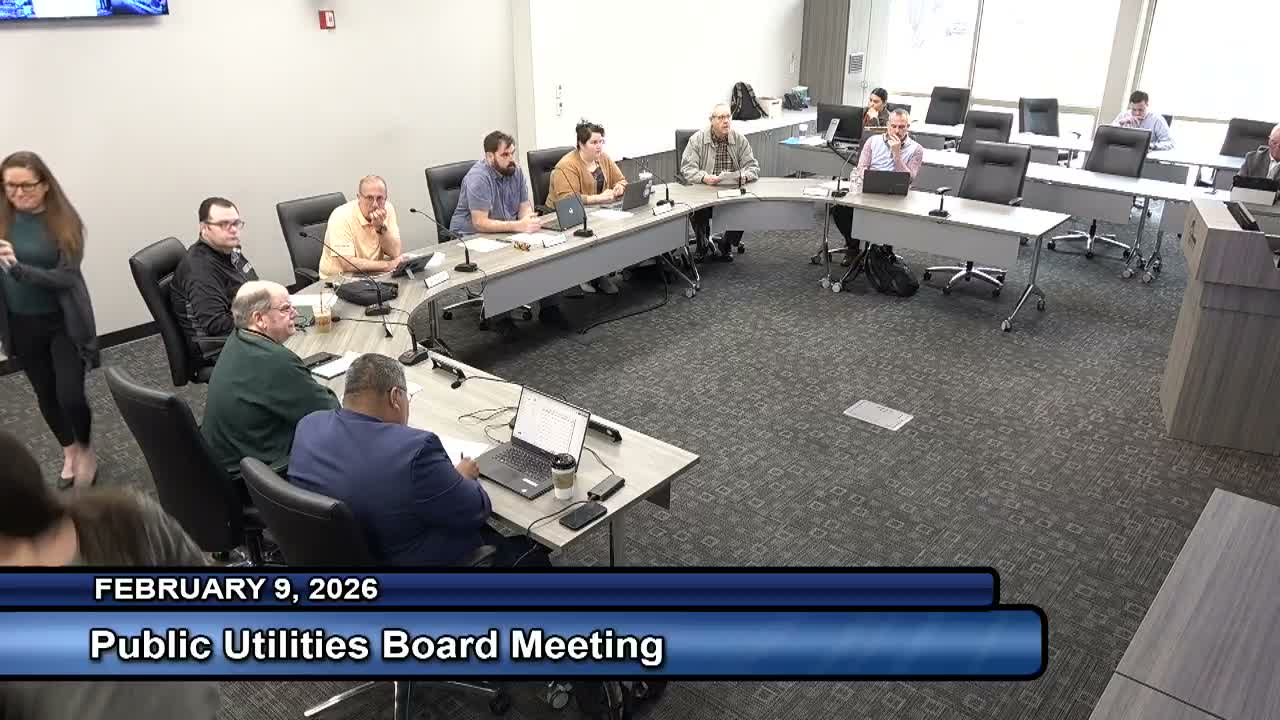
Michael Hunter, reclaimed water and cross-connection control manager for Denton Water Utilities, told the Public Utilities Board on Feb. 9 that the city is proposing updates to its cross-connection control and backflow ordinance to strengthen protections for the drinking water distribution system.
Hunter said Denton currently monitors a little more than 6,000 commercial backflow assemblies and adds about 600 new assemblies each year. He said the changes respond to evolving best practices and enforcement challenges and aim to reduce the risk that contaminated water will flow back into the distribution system. "We monitor a little over 6,000 commercial backflow assemblies all throughout the city," Hunter said.
Under the proposed ordinance, staff would require testable backflow prevention assemblies just past the meter on all new nonresidential construction — including domestic, fire and irrigation systems — and would no longer allow atmospheric vacuum breakers for new installations because they cannot be tested annually. The proposal also includes clearer installation standards, updated tester insurance and training requirements, expanded staff inspection access for cross-connection surveys, and clarified emergency shutoff and service-suspension authority for noncompliance.
Hunter said the ordinance would not force changes at existing nonresidential sites unless a major plumbing modification triggers a permit; single-family residential properties would generally not be affected. "For existing nonresidential, nothing is required unless they are going to undergo large, major plumbing modifications," he said. Stephen Gay, general manager of water utilities and street operations, added that multifamily apartment connections are treated as nonresidential for the ordinance's purposes.
Board members pressed for details on device protection and cost. Hunter said pressure vacuum breakers and reduced-pressure-principle (RPZ) devices are testable replacements for atmospheric vacuum breakers and that above-ground RPZs require weatherproofing. For a typical small commercial 3/4-inch reduced-pressure assembly with weather protection, Hunter estimated materials and installation could range from about $2,000 to $4,000, and he confirmed licensed plumbers must perform installations and that permits are required.
Hunter cited a 2024 Grand Prairie incident in which firefighting foam entered the drinking system, causing a "do not use" advisory, as an example of the risks the ordinance seeks to avoid. "As a result of that, the city had to issue a do not use the water notice," he said, underscoring potential public-health and economic impacts.
Staff said they presented the proposal at a city-council work session on Feb. 3 and plan to take it to council for individual consideration on March 3; staff will publish required notice in the Denton Record-Chronicle and have proposed an effective date of March 17 if council approves the ordinance. The PUB noted the item was provided for information and not posted for direction.
The board did not take a formal vote on the ordinance during the Feb. 9 session; next formal action would occur at the city council meeting on March 3.