Lifetime Citizen Portal Access — AI Briefings, Alerts & Unlimited Follows
DOE opens SEIS scoping for Santa Susana soils, cites implementability limits of original cleanup standard
Loading...
Summary
The Department of Energy opened public scoping March 6, 2025, for a supplemental environmental impact statement on soil cleanup in Area 4 and the Northern Buffer Zone at Santa Susana Field Laboratory, proposing updated lookup-table values, a multiple-lines-of-evidence approach, and a resident-with-garden risk-based alternative; public comments are due March 27, 2025.
The U.S. Department of Energy began public scoping March 6, 2025, for a supplemental environmental impact statement (SEIS) that will analyze options for soil remediation in Area 4 and the Northern Buffer Zone at the Santa Susana Field Laboratory.
Dr. Joshua Mengers, DOE’s Federal Project Director at the Energy Technology Engineering Center, told attendees that DOE published a Notice of Intent in the Federal Register on Dec. 27, 2024, and extended the scoping period so comments will be accepted through March 27, 2025. “We determined that the lookup table values…were not implementable,” Mengers said, explaining why DOE is proposing new alternatives rather than relying solely on the Administrative Order on Consent (AOC) background cleanup described in earlier documents.
Why it matters: the choice of cleanup standard affects how much soil is removed, what backfill is necessary to restore the site, and the environmental impacts of excavation and disposal. The SEIS will guide the next legally binding Record of Decision for soils and shape remediation work at a site that has been the focus of government and community attention for decades.
What DOE presented
DOE said the SEIS will examine three principal alternatives: (1) updated lookup-table (LUT) values intended to align background cleanup goals with current laboratory detection capabilities while retaining other AOC provisions; (2) the Department of Toxic Substances Control’s (DTSC) multiple lines of evidence (MLE) approach, which DOE characterizes as combining background data and risk-based lines of evidence; and (3) a resident-with-garden risk-based scenario — the cleanup standard in Boeing’s 2022 settlement for Boeing-owned areas.
Mengers said the AOC’s original LUT-based background cleanup is difficult to implement for three main reasons: DOE could not identify backfill sources that meet the AOC cleanup standard, laboratory methods in some cases lack the detection limits needed to verify LUT concentrations, and the data collected from so-called pristine sites used to establish LUTs do not pass the LUT detection limits. “Conducting an AOC cleanup to the lookup table values would do more environmental harm than good,” he said, and noted DTSC’s SoilSmarts workshops reached similar technical conclusions.
Progress to date
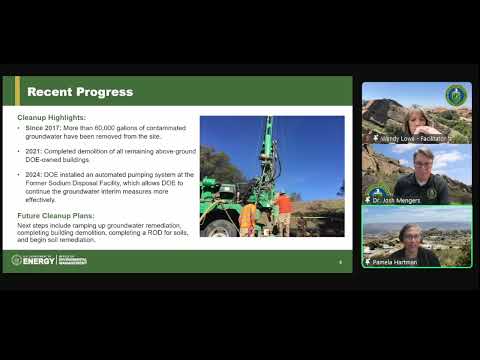
Pamela Hartman, DOE’s Deputy Federal Project Director, described recent cleanup actions: since 2017 the groundwater implementation plan has removed more than 60,000 gallons of contaminated groundwater from the former sodium disposal facility; in 2024 DOE installed a solar-powered automated pumping system and pumped about 2,700 gallons in January and February 2025. Hartman also said DOE completed demolition of all above-ground DOE-owned buildings in 2021, and that remaining work includes below-grade structures, additional soil remediation and completing a soils ROD.
How the SEIS will be done and how to comment
DOE said the SEIS adds to — but does not replace — the 2018 FEIS, and it will incorporate new information (including changes since the Woolsey Fire, updated biological and cultural-resource data, disposal-facility information, laboratory method reporting limits, and backfill availability). Mengers advised commenters to focus on issues relevant to the proposed action (DOE soil removal in Area 4 and the Northern Buffer Zone), identify reasonable alternatives and supporting information, and provide specific examples of community impacts.
Next steps
DOE has not identified a preferred alternative. The public scoping period closes March 27, 2025; DOE anticipates preparing a draft SEIS in 2026 and a final SEIS in 2027, dates the agency said are estimates and subject to change. DOE will summarize scoping comments and explain how it used them when it prepares the draft SEIS. The agency scheduled a second public scoping meeting for March 18, 2025, in Simi Valley.
“We want you to provide comments on the scoping,” Mengers said. “We will analyze the comments, determine if there needs to be a change in the scope of the SEIS, and use that to prepare the draft SEIS.”