Lifetime Citizen Portal Access — AI Briefings, Alerts & Unlimited Follows
Lake County outlines broadband and digital equity plan; Waukegan pilot and BEAD approvals highlighted
Loading...
Summary
Lake County staff reviewed broadband and digital equity strategies including BEAD monitoring, a Dig Once policy draft, a Waukegan downtown public Wi‑Fi pilot IGA approved Jan. 20, 2026, and plans for laptop distributions and digital navigator programming funded through ARPA with sustainability discussions ongoing.
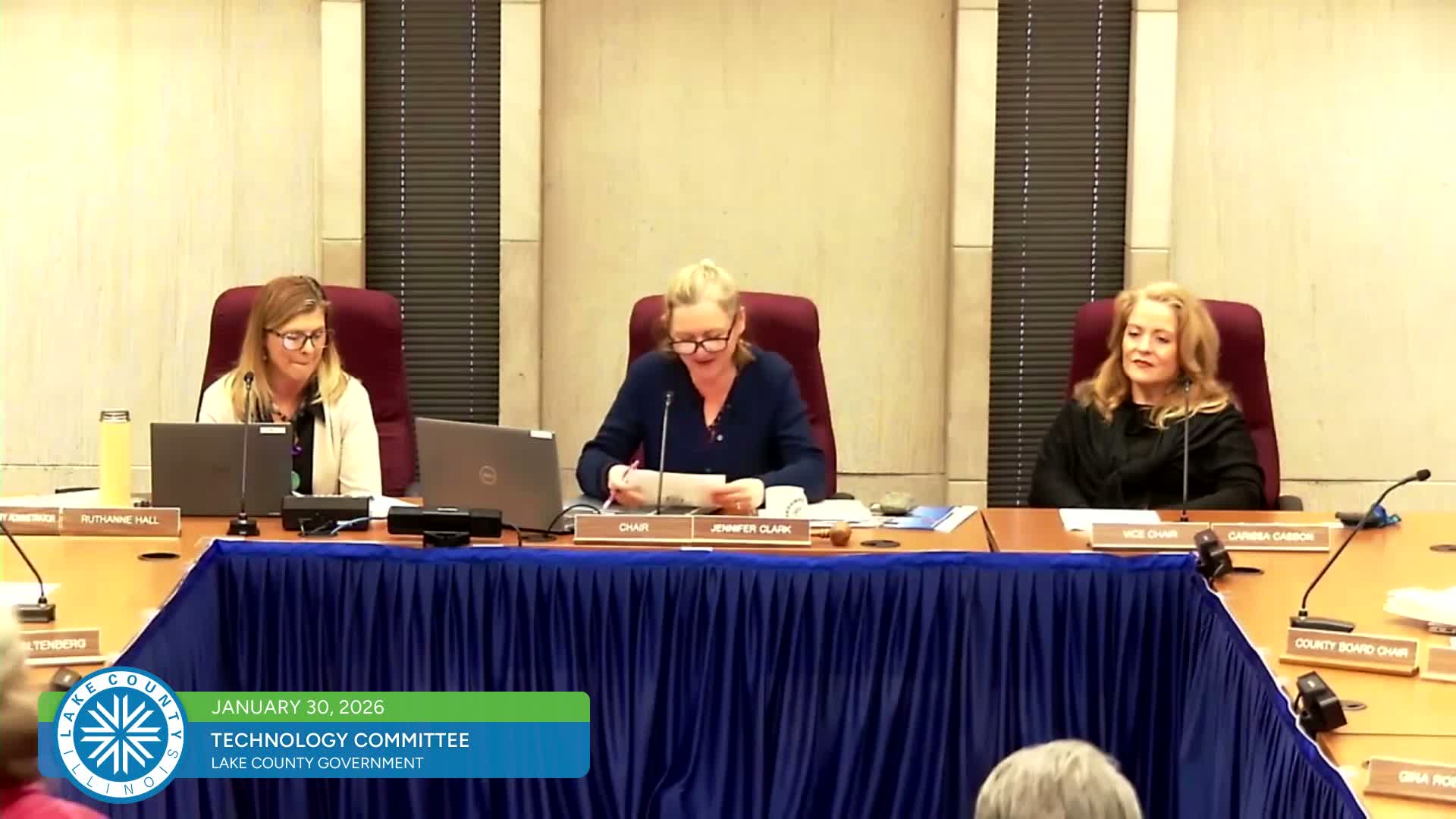
County staff gave the Technology Committee a broad update on broadband and digital equity strategies on Jan. 30, covering federal BEAD timing, local policy work, pilot public Wi‑Fi, device distribution goals and digital literacy efforts.
Betsy Brandon (assistant to the county administrator) and Kim Lundt (digital equity coordinator) outlined seven strategy areas from the county’s broadband and digital equity action plan. They said Lake County will support the BEAD/Connect Illinois process, but that Illinois’s provisional awards remain pending final approval by the National Telecommunications and Information Administration (NTIA). Kaye (county broadband staff) confirmed the state entered a 90‑day review and that the county is still awaiting NTIA approval for implementation of provisional awards.
On local implementation, staff said the county and the city of Waukegan approved an intergovernmental agreement (IGA) on Jan. 20, 2026, to provide free high‑speed municipal Wi‑Fi in Waukegan’s downtown corridor — described as Lake County’s first municipal public Wi‑Fi partnership. Staff also said they will draft a Dig Once policy to coordinate trenching/permitting for broadband projects and will develop outreach materials for safe use of public Wi‑Fi.
Digital inclusion activities: staff reported device distribution and digital navigator metrics: the team said it distributed "10 21 lap laptops through the 2025" (verbatim from transcript) and plans to distribute at least "9 79 devices" in 2026 (transcript phrasing). Staff noted they have engaged around "8 50 users" on Northstar since March 2025 (transcript phrasing), offer Northstar in English and Spanish, and plan three laptop distribution events in March, June and October 2026 tied to required training. Brandon said they will continue coalition meetings (virtual and in‑person) and a redesigned public-facing technology resource map updated quarterly.
Sustainability and funding: committee members pressed for sustainable funding beyond ARPA; staff said they are exploring federal and state grants, private foundations, and partnerships with workforce development, health department and libraries to continue programs after ARPA ends in December. Committee members praised outreach and social‑media engagement; county social analytics firm JT reported strong Facebook reach and engagement in December 2025.
What happens next: staff will draft a Dig Once policy, finalize public Wi‑Fi implementation timelines, schedule Northstar-linked device distribution events, and pursue funding opportunities for program sustainability.