
Medford outlines school HVAC, solar and IT upgrades; National Grid rebates reported
Get AI-powered insights, summaries, and transcripts
Subscribe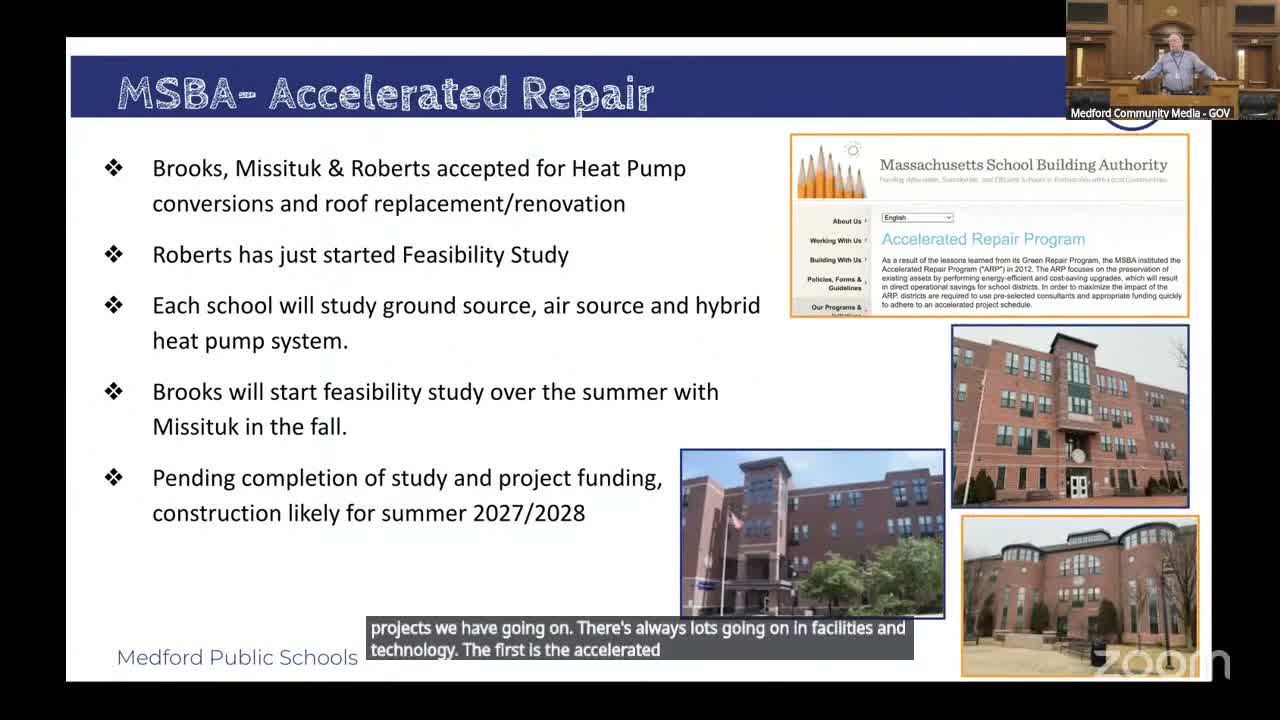
Summary
Chief operations officer Kenneth Lord updated the committee on MSBA Accelerated Repair Program feasibility studies for three elementary schools (Brooks, Misotuck/Mistock, Roberts), timeline for HVAC/roof/solar work, a district network refresh and near-complete security upgrades; he reported National Grid rebates totaling roughly $1.677 million for Andrews and McGlynn projects.
The Medford School Committee received an operations update March 2 detailing feasibility studies, energy upgrades and IT/security work across the district. Kenneth Lord, chief operations officer, said three elementary schools (Brooks, Misotuck/Mistock and Roberts) were invited into the Massachusetts School Building Authority's Accelerated Repair Program (ARP) and that owners' project managers and engineers will begin feasibility work to evaluate ground-source, air-source and hybrid heat pump options, roofs, electrical upgrades and any necessary terminal equipment.
"Tomorrow they're actually gonna come out and do a tour of the school so they can get a better idea of the building and the project to be able to negotiate our contracts with those firms to stop the feasibility study," Lord said, describing a feasibility process that will yield designs and detailed budgets for funding requests. He said work could move to construction in 2027 or 2028 and that the MSBA would like projects substantially complete by 2029.
Lord told the committee the district received National Grid rebates: about $587,000 for the Andrews project and about $1,090,000 for McGlynn, and that additional utility rebates are being pursued for building-management systems. He also said the McGlynn roof rebid came in under budget and that the district will select a contractor after final specification review.
On technology and security, Lord said the district has begun a network refresh (Phase 1: wireless access points and high-school switches) and will work with Extreme Networks for professional services; he also reported that security cameras, keyless entry and vape detectors are roughly 95% installed and that staff training is underway.
Committee members asked where the rebates are applied. Lord said the credits are direct reductions to project cost and were anticipated in bond planning. Members also raised concerns about who will maintain more complex building management systems; Lord said commissioning and retro-commissioning work and training are planned so in-house teams can manage new systems and that the district intends to use 24/7 managed detection services for cybersecurity.
Why it matters: the feasibility studies and rebates aim to lower the district's long-term energy costs and accelerate building repairs without unduly increasing borrowings. Next steps include feasibility study reports, selection of contractors, continuing commission agent procurement and further rebate applications.