Lifetime Citizen Portal Access — AI Briefings, Alerts & Unlimited Follows
Elyria board hears facilities‑rental overview, cautioned on fee changes
Loading...
Summary
District facilities director outlined how Ohio law and district policy govern community use of school buildings, explained fee schedules and insurance requirements, and warned that charging fees could push community groups to other districts; board members asked about specific costs and legal limits.
Brian Cocchi, who presented the district’s facilities usage overview, told the Elyria City School Board on March 4 that state law and district policy set the basic rules for renting school property and that the district already uses a tiered fee system and an online booking tool for community groups. Cocchi cited Ohio statutes he identified as 3313.76 and 3313.77 and noted district policies KG and KGR as the implementing framework.
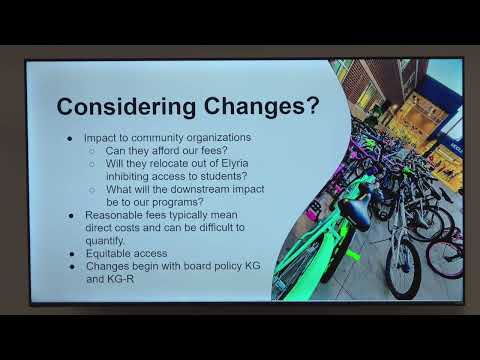
“Ohio law requires community use of district facilities,” Cocchi said, and the board “can adopt a policy to charge reasonable fees.” He emphasized that access must be equitable and that the district must treat similar groups the same, noting potential First Amendment considerations for religious groups.
Cocchi described how the district classifies users into schedules (A–D) and how charges differ for for‑profit groups, partner nonprofits and internal district groups. He said groups generally must carry $1,000,000 in general‑liability insurance unless the board votes to waive that requirement for a specific case. He described operational details: the district uses the FMX scheduling platform; some buildings (for example, Elyria High) remain open and therefore often avoid direct rental charges, while others (for example, smaller elementary schools) incur direct costs for opening, custodial staffing and utilities.
Board members pressed for concrete examples. Cocchi said a typical weekend PAC (performing arts center) rental could run several hundred dollars for a simple rehearsal but climb into the thousands for full productions that require sound, lights and ticketing services; he said PAC rental revenue has historically been held in a repair account used to fund center maintenance.
Questions included whether staff decide when security or an administrator is required and whether the district still hosts elections. Cocchi said his office has discretion to require administrative staff and security based on past behavior and noted the district currently does not host polling in most buildings but must allow it if requested.
Cocchi urged caution before broadening fees. “If we charge, will they relocate to a different district that may not charge them?” he asked, noting groups such as Pioneer Theatre and the Boys and Girls Club serve students and could be affected. He recommended the board consider the operational cost of administering fees and consult OSBA model policy or counsel if it decides to rewrite KG/KGR to remove contradictions.
The board did not take any formal action on facilities policy at the March 4 meeting. The presentation closed with the board agreeing to receive sample policies and further information.