Get Full Government Meeting Transcripts, Videos, & Alerts Forever!
Get email alerts on the Elected Officials Compensation topic
No spam. Unsubscribe anytime.
Salaries commission reviews mayor pay and survey data, sets timeline for recommendations
Summary
Human resources staff reviewed AML survey data and borough code requirements with the Salaries and Emoluments Commission, noting the mayor’s highlighted pay and recommending a COLA range; commissioners agreed to finalize recommendations at the March 4 meeting for a March 25 public hearing.
Michelle, a human resources staff member for the Fairbanks North Star Borough, briefed the Salaries and Emoluments Commission on Feb. 18 about the commission’s statutory duties and a packet of comparative salary data for elected officials.
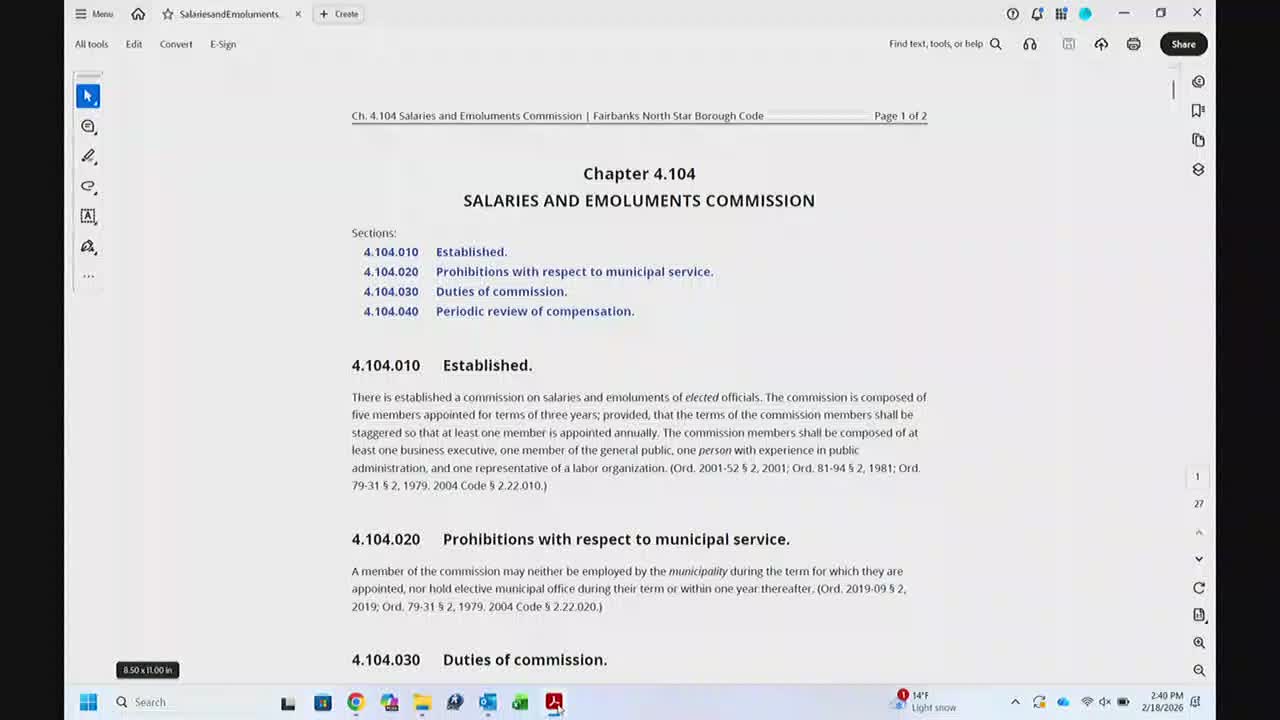
Her presentation summarized Title 29 requirements and the borough’s Salary and Emoluments Commission code (chapter 4.104), which sets the commission’s membership composition and requires periodic reviews. “Section 4.104.020 is the prohibition with respect to municipal service … someone on this commission cannot be employed by the municipality during the term nor can they hold elective municipal office for one year after their term expires,” Michelle said.
Michelle walked commissioners through the Alaska Municipal League survey and the commission’s spreadsheet material, explaining how the packet is color-coded and noting bargaining-unit distinctions used in the analysis. She said the mayor’s salary was highlighted in the packet at $132,860 per year and that, according to staff’s recent actions, the Assembly had adopted an adjustment of the mayor’s salary to $130,000 annually along with a COLA provision of not less than 2% and not more than 4% tied to the Alaska urban CPI.
Commissioners pressed staff for clarifications: one asked whether small compensation figures in early spreadsheet rows were hourly rates and Michelle confirmed they were. Commissioners also asked which membership slot on the commission remained vacant; Michelle said the commission has a union representative and can move members to fill other positions.
The commission did not take a final vote on changes at the Feb. 18 meeting. Staff reminded the group of the timeline: recommendations should be completed at the March 4 meeting to allow scheduling for a public hearing on March 25. “We are going to make our recommendations with respect to salaries no later than 75 days before the end of our fiscal year, which ends on June 30,” Michelle said.
Commissioners asked staff to provide a short history of the last three recommendations sent to the school board and to bring hard copies of the spreadsheets to the March 4 meeting for easier in-person review. The commission left the record open for discussion and scheduled recommendation work for the next meeting.
The commission’s next regular meeting is set for March 4, 2026; the assembly hearing was listed for March 25, 2026.