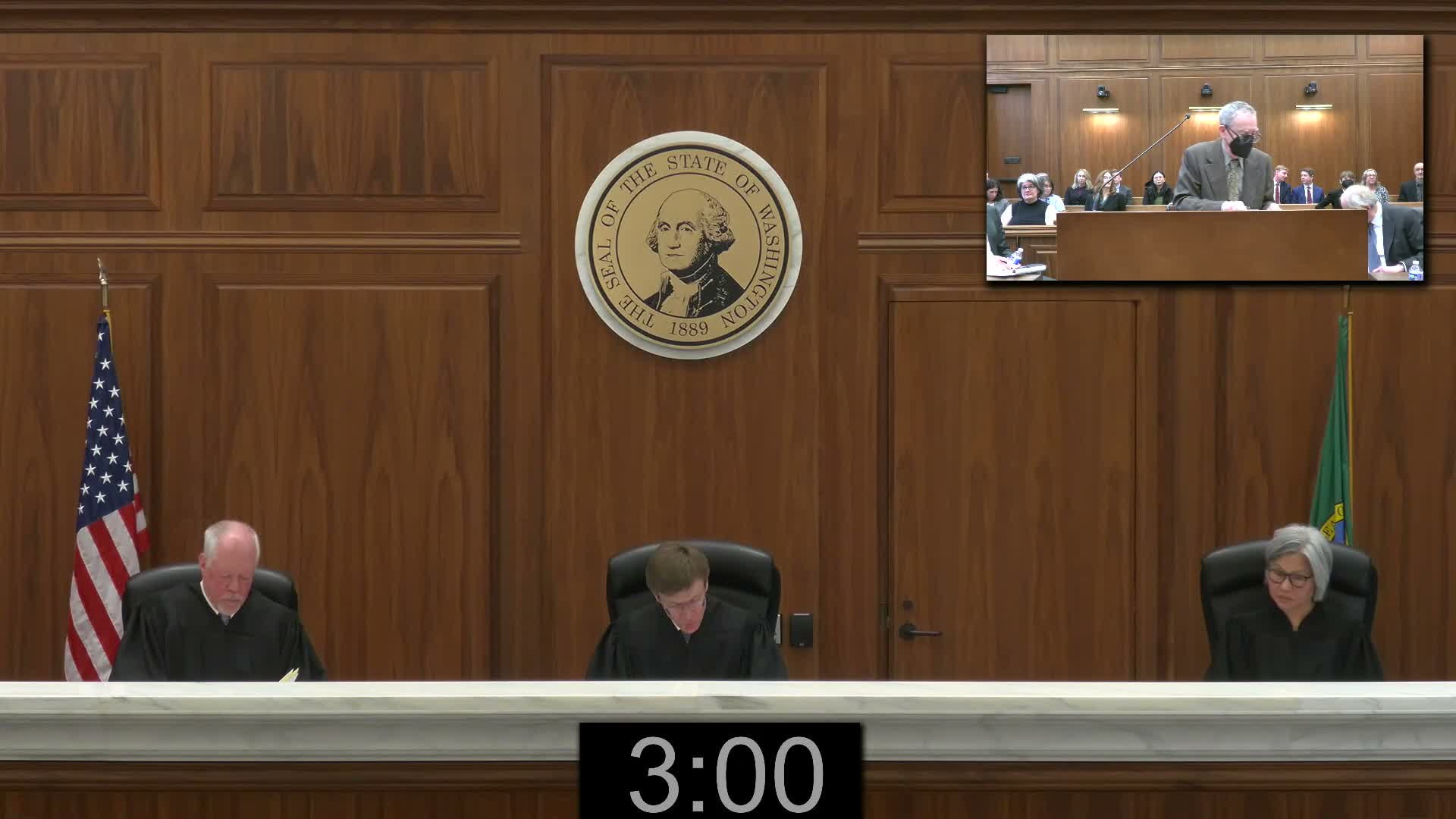
Court hears dispute over whether Shell’s payment to Superior Energy was a lease or a service
Loading...
Summary
In oral argument in Other Court, Superior Energy Services argued Shell acquired control of an Arctic containment system by leasing it, while the Department of Revenue said the contract purchased a package of services; neither side obtained an immediate ruling.
Bridal Durban, counsel for Superior Energy Services, told the court the case “boils down to whether or not Shell paid Superior Energy Services to lease a first‑of‑its‑kind equipment to satisfy its regulatory responsibilities, or whether Shell paid Superior Energy to perform an oil containment service that was never mentioned in a multi‑100 page lease agreement and was never actually performed.” Durban argued Shell exercised control and could acquire the equipment after termination, and that Superior provided equipment, operators and standby capability rather than an immediately payable spill‑response service.
The Department of Revenue, represented by Assistant Attorney General Scott Forbes, countered that the contract required a broad bundle of services—designing, building, maintaining and storing the system; hiring, training and supplying personnel; demonstrating and operating the system; and managing the project—so Superior acted as a consumer and use tax attaches. “This was not a true lease,” Forbes said, and he emphasized the administrative board’s finding that Superior’s testimonial evidence lacked corroborating documentary support.
Why this matters: the court’s characterization — lease versus service — determines whether Superior owes use tax on the goods and services used to construct the Arctic containment system. A finding that the contract was a lease could exempt some transactions from use tax; a finding that it was a service would subject the construction‑related purchases to use tax.
At argument the court focused on two related lines of inquiry: (1) control and dominion—whether Shell had the kind of control over the equipment that typifies a lease, including contractual options to acquire the item after termination; and (2) the role of operators and whether the contract supplied only operators who perform set‑up/maintenance or instead supplied expertise and services beyond operation, which the Department says converts the transaction into a taxable service. The presiding judge repeatedly probed the parties about statutory examples (scaffolding and crane operator) and asked whether the rule language that references “expertise beyond operating” was intended to draw a clear line.
Both sides pointed to factual anchors in the record: Durham (sic) stressed that the response rate for deploying personnel to an actual spill was never paid, and that Shell supplied the barge supervisor; Forbes pointed to multiple deployment tests (including tests conducted in Bellingham) and to contract language requiring deployment capability and ongoing project management, and he noted an on‑standby team was available in Alaska during the 2015 drilling season even though the system was never deployed in response to an emergency.
The court heard extended discussion about whether the analysis should be backward‑looking (actual mobilization and payments) or forward‑looking (the parties’ intent and the contract’s true object at the time it was executed). Forbes urged the court not to apply a retroactive test and to give deference to the administrative board’s factual findings.
The hearing concluded without a ruling. The court thanked counsel and took the case under advisement; no decision was announced at the session.