
Chair LaHood and witnesses press Congress to reclaim nearly $1 billion in frozen pandemic unemployment payments
Get AI-powered insights, summaries, and transcripts
Subscribe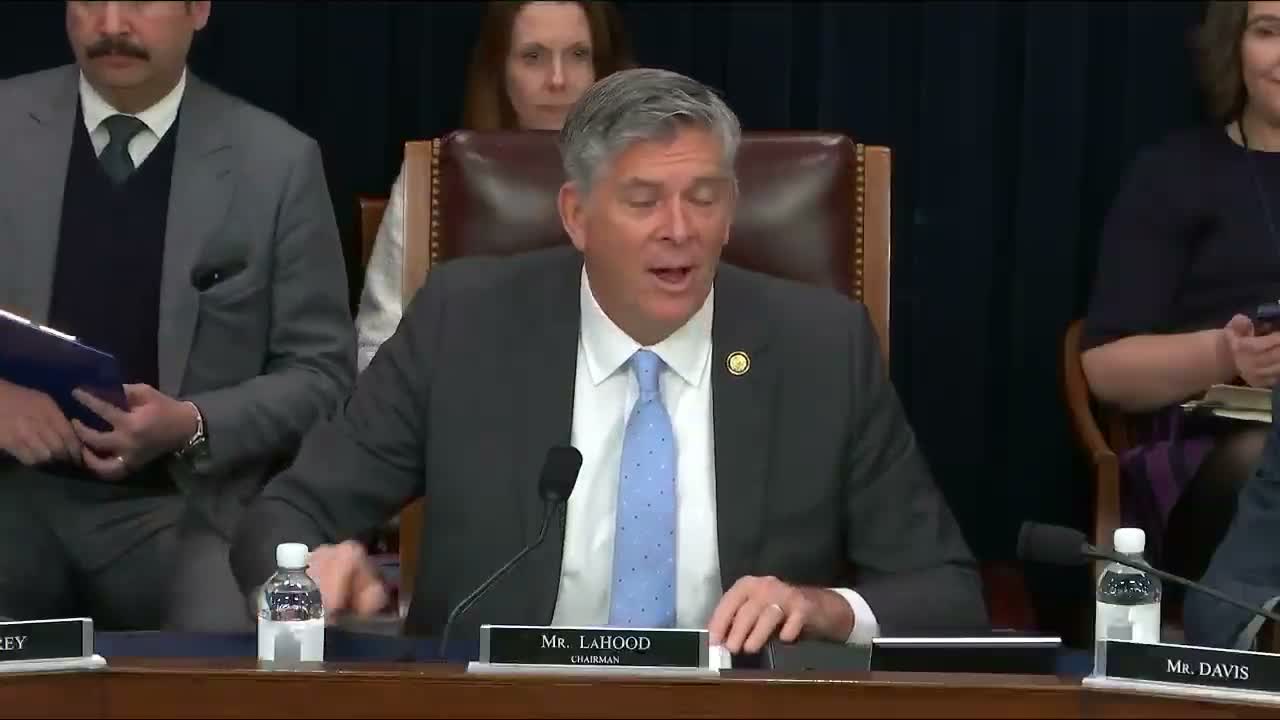
Summary
At a House Ways and Means subcommittee hearing, the DOL inspector general and outside experts said roughly $1 billion in pandemic unemployment funds remain on prepaid cards at banks and urged statutory safe harbors, better data sharing, and a statute-of-limitations extension to enable recovery.
Chairman Darren LaHood opened a Work and Welfare Subcommittee hearing saying investigators have identified nearly $1 billion in pandemic unemployment insurance (UI) funds still sitting on prepaid debit cards and in bank accounts, and urged bipartisan action to recover the money for taxpayers.
The hearing featured testimony from Anthony D'Esposito, inspector general at the U.S. Department of Labor Office of Inspector General (DOL OIG); Linda Miller, president and cofounder of the Grama Integrity Alliance; Dan Williams, founder of Origin Payments; and Michelle Evermore, senior fellow at the National Academy of Social Insurance.
D'Esposito told the panel the OIG's work with financial institutions and data analytics found "more than $1,000,000,000 in taxpayer funded unemployment insurance benefits remain unclaimed or unused in 21 states," and that roughly $720,000,000 is still loaded on unused prepaid debit cards. He warned that $192,000,000 has already been turned over to state unclaimed property offices and said "continued inaction will likely result in states not fulfilling their responsibilities to prevent and detect improper payments and recover potential overpayments, including fraud." (Inspector General Anthony D'Esposito)
Linda Miller described pandemic UI fraud as extensive and fast-moving, saying it "was theft on a scale this country has never seen before" and argued Congress must provide a statutory framework and a "safe harbor" so banks can return suspected fraudulent balances without facing regulatory fines or liability. Miller said banks often froze suspect accounts but lacked a clear federal path to return funds to the government.
Dan Williams, who develops fraud-prevention systems for card programs, described the pool of prepaid-card balances as an unusually concentrated recovery opportunity and urged a tranche-based reconciliation approach. "This is summarized in the multiple OIG alert memorandums issued ahead of this hearing is a potential billion dollar recovery opportunity," he told the committee, and pointed to Maryland's reported $520,000,000 recovery as an example of a successful state effort.
Michelle Evermore urged a balanced approach that pairs recovery efforts with investments in detection and state capacity, noting that fraud patterns vary by state and that better technology and front-line staffing are crucial to preventing future losses. She also urged stronger identity-victim assistance and cautioned about data-security lapses in some agencies.
Committee members pressed witnesses on two recurring points: (1) whether extending the statute of limitations would aid criminal and civil recovery, and (2) how to resolve conflicts that make banks reluctant to return funds (for example, regulatory fines or consumer-protection exposure). D'Esposito said the OIG supports an extension of the statute of limitations and encouraged Congress to consider amendments that would give inspectors general additional tools; witnesses said Congress could provide indemnities and clearer data-sharing authority to give banks the certainty they need.
Members also debated trade-offs between spending investigative resources on reconciling dormant card balances and investing in prevention and state capacity. Witnesses generally agreed recovery of clearly identifiable balances is worthwhile but cautioned that reconciliation is labor intensive and should be paired with investments in state systems and frontline staff.
The chairman referenced previously circulated DOL OIG memoranda identifying the funds and urged passage of the Pandemic Unemployment Fraud Enforcement Act (H.R. 1156) to extend the statute of limitations and support recovery efforts; witnesses said that statutory mechanisms and clearer federal leadership would make recovery more feasible. The hearing concluded with members submitting materials for the record and two weeks allowed for additional written questions.
The committee did not vote on legislation at the hearing; members signaled continued interest in statutory solutions, more funding for detection and state systems, and targeted recovery efforts focused on prepaid-card balances and other clearly identifiable funds.