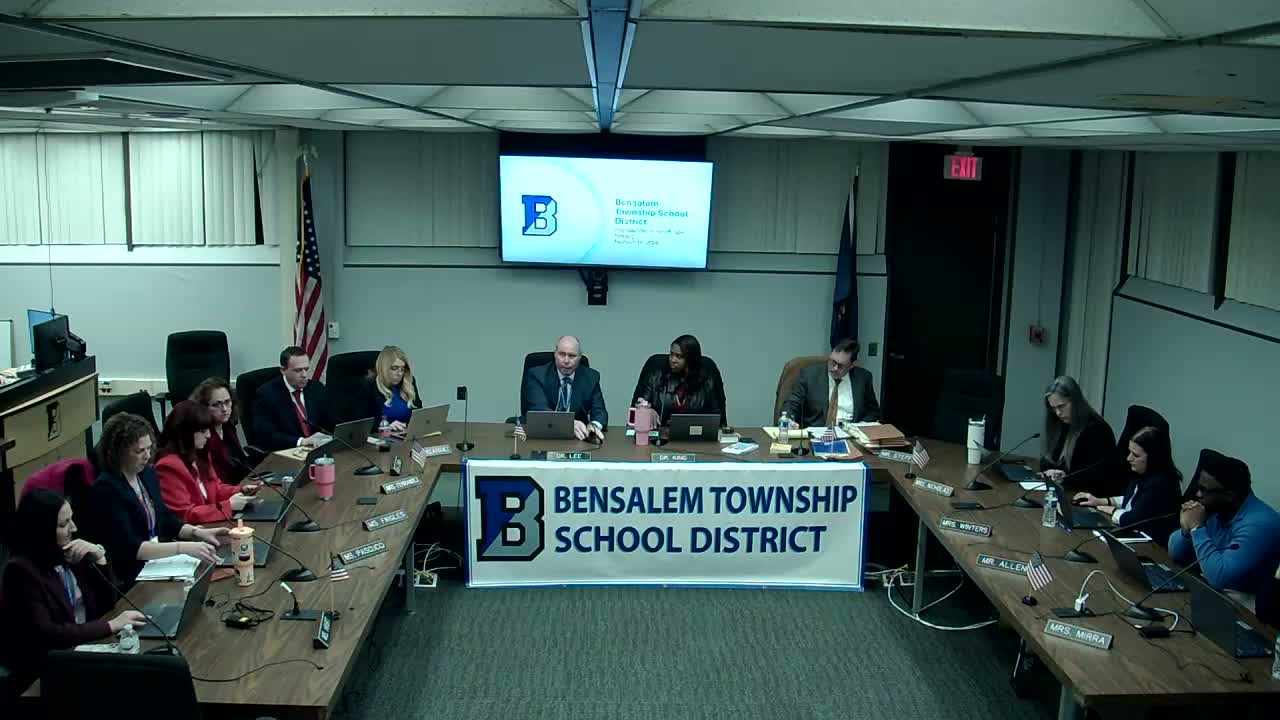
Bensalem Township School District adopts preliminary $204.19 million budget framework; votes to proceed under 4.2% Act 1 ceiling
Loading...
Summary
The Bensalem Township School District board approved a preliminary $204,191,301 spending plan required to start the state budget process, acknowledging a roughly $11–12 million shortfall and presenting options including debt restructuring, staff reductions and program cuts to close the gap.
The Bensalem Township School District board voted on Feb. 18 to approve a preliminary proposed budget of $204,191,301 for fiscal year 2026–27, a procedural step the administration said is required to start the state’s review process even though the district faces an $11 million to nearly $12 million shortfall.
Superintendent Dr. Lee told the board and public that administrators had been operating under the mistaken assumption the district could pursue Act 1 referendum exceptions but confirmed the district is ineligible because it has received and is projected to receive adequacy funding from the Commonwealth. "There was an oversight in our planning process. I take responsibility for that," Dr. Lee said, and pledged tighter vetting of state-funding assumptions.
The board framed the approved preliminary budget around the Act 1 ceiling, which several members said caps any tax increase this year at about 4.2%. A board member told the audience plainly, "we cannot and will not be seeking any tax increases above the Act 1 index."
The shortfall and its drivers drew sustained public comment. Frank Goldstein, speaking as a township homeowner, said the district’s fiscal crisis "had its roots in the past several years" and urged broader legislative fixes in Harrisburg. Brenda McMullen, a long-time resident and union leader, told the board, "You're gonna tax me out of my house" and urged leaders to prioritize affordability for staff and families. Parent John Chick defended his choice to send his son to School Lane Charter School and said the core issue is fiscal accountability rather than individual schools.
Board officials identified charter school tuition and special-education costs as the primary uncontrollable drivers of the deficit. Business manager Mr. Steffey and Dr. Cohen (a district official who handles special-education reporting) described how state reporting (Act 16 reports) and federal privacy rules limit how much student-level information the district can access or publish and explained that charter and special-education payments are categorized into cost "tiers," which can result in widely different per-student charges.
As part of the discussion on ways to close the gap, the board heard a presentation from PFM Financial Advisors on debt restructuring. Brad Remig of PFM said the district currently has about $9.6 million scheduled in municipal-bond payments this fiscal year and about $10.6 million next year; he presented a restructuring option that could lower next year’s net payments to roughly $7.6 million but would increase interest costs over the life of the debt and carry a present-value cost of about $1,359,000. PFM said a bond issue would need to be closed before June 1 for savings to affect next year’s budget and that refunding restrictions would likely prevent refinancing for roughly 7–8 years.
Administrators emphasized that the approved document is a working preliminary budget and does not bind the district to final decisions. Dr. Lee said the administration will recommend a range of cost-reduction options, including position eliminations, staffing-efficiency measures, possible program reductions at the secondary level, restructuring debt service and reassessing nonpublic-school nursing services. The board scheduled additional budget workshops and committee meetings between now and the June 30 finalization deadline and invited the public to participate.
Roll-call votes were recorded when the board approved the preliminary budget; the motion carried. Several board members stressed that the vote was a statutory procedural step required to begin the state submission and that more work would follow to close the remaining budget gap.
The board defeated a subsequent motion to publish notices seeking Act 1 referendum exemptions after members noted the district’s legal ineligibility to pursue those exemptions.