
Committee passes bill granting business civil‑liability protections after violent crimes; members debate scope and 'gross negligence' standard
Get AI-powered insights, summaries, and transcripts
Sign Up Free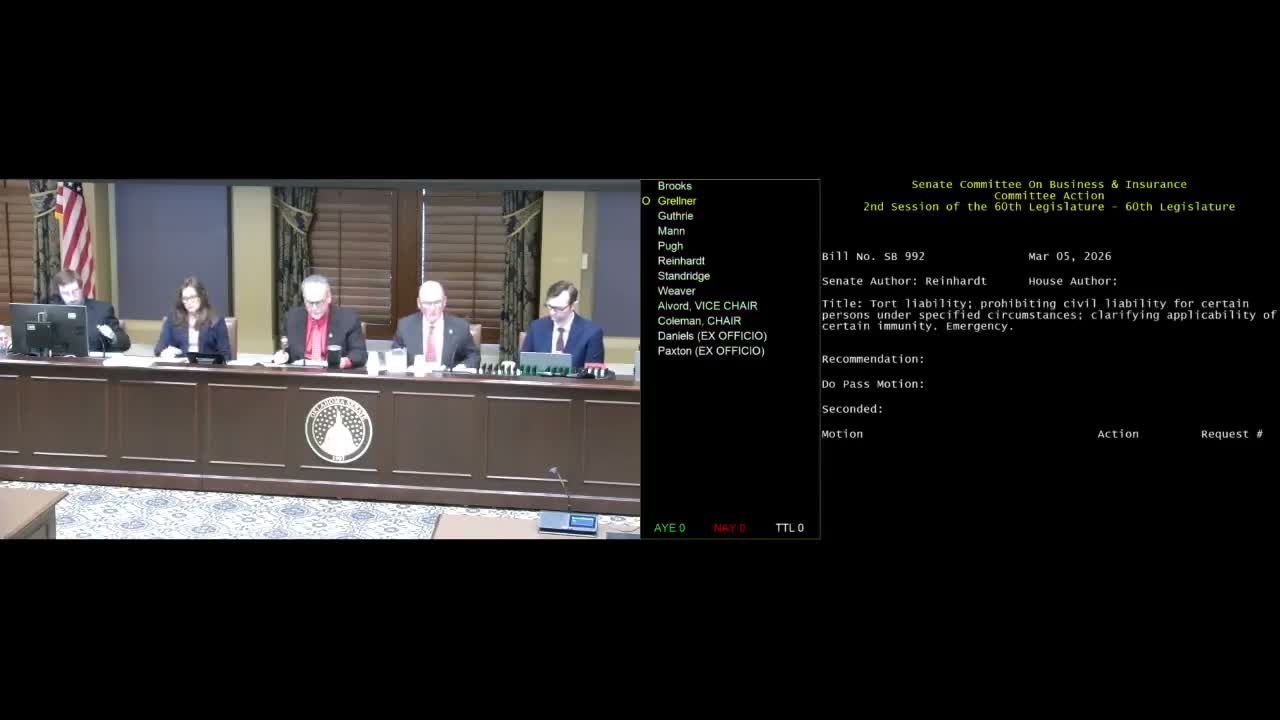
Summary
Senate Bill 992, presented by Sen. Reinhart, passed the committee after lengthy debate about whether the bill would create blanket immunity for businesses after criminal violent acts and how the exclusion for gross negligence would be applied. Opponents warned it may limit accountability and insurers’ incentives; supporters framed it as targeted tort reform.
Senator Reinhart introduced Senate Bill 992 to the Business and Insurance Committee, describing it as a measure to provide civil‑liability protections for businesses and property owners when a criminal commits a violent act on their premises, while preserving liability for gross negligence. "This is a beer bill," the senator prefaced his remarks in an apparent attempt to signal a lighter tone before detailing the proposal; he said the bill addresses litigation that follows violent incidents and seeks to protect small owners from ruinous civil awards.
Committee members pressed on how the bill distinguishes simple negligence from gross negligence and whether the change would remove incentives for businesses to adopt reasonable security. Senator Brooks asked directly whether the bill would “establish immunity ... even if they're negligent,” and warned that the language as drafted could shield owners from liability in situations many members considered troubling. Reinhart responded that the bill excludes gross negligence—defined in the hearing as "a conscious voluntary act or omission that shows a reckless disregard for safety"—and that judges and attorneys would continue to litigate distinctions between negligence and gross negligence in individual cases.
Debate focused heavily on workplace and public‑space safety: members asked whether the measure would produce fewer security guards or more 'gun‑free' zones, and whether large facilities (hospitals, venues) could be insulated from liability. Supporters said the bill targets civil aftermath costs that can devastate small businesses, while opponents said it risks reducing accountability and shifting costs to victims. Several members said the language could be tightened and the author said he was open to revisions.
After extended debate, the committee recorded a Do Pass vote and the bill passed in committee with a recorded tally of 5 ayes and 3 nays. The author said he is willing to work with members and the committee attorney on tighter language to clarify the boundaries between simple negligence and gross negligence and to address public‑safety concerns.
Next steps: The bill advances from committee. Sponsors indicated they will consider drafting amendments to narrow or clarify the immunity language before floor consideration.