Get Full Government Meeting Transcripts, Videos, & Alerts Forever!
Get email alerts on the Mental Health topic
No spam. Unsubscribe anytime.
College Station police outline expanded mental‑health response, council seeks broader community plan
Summary
Police Chief Couch told the council the department now has a full‑time care team and 20 crisis intervention members, boosting tracked mental‑health responses to about 1,300 a year; council directed staff to convene community partners and explore options including mental‑health courts and regional inpatient capacity.
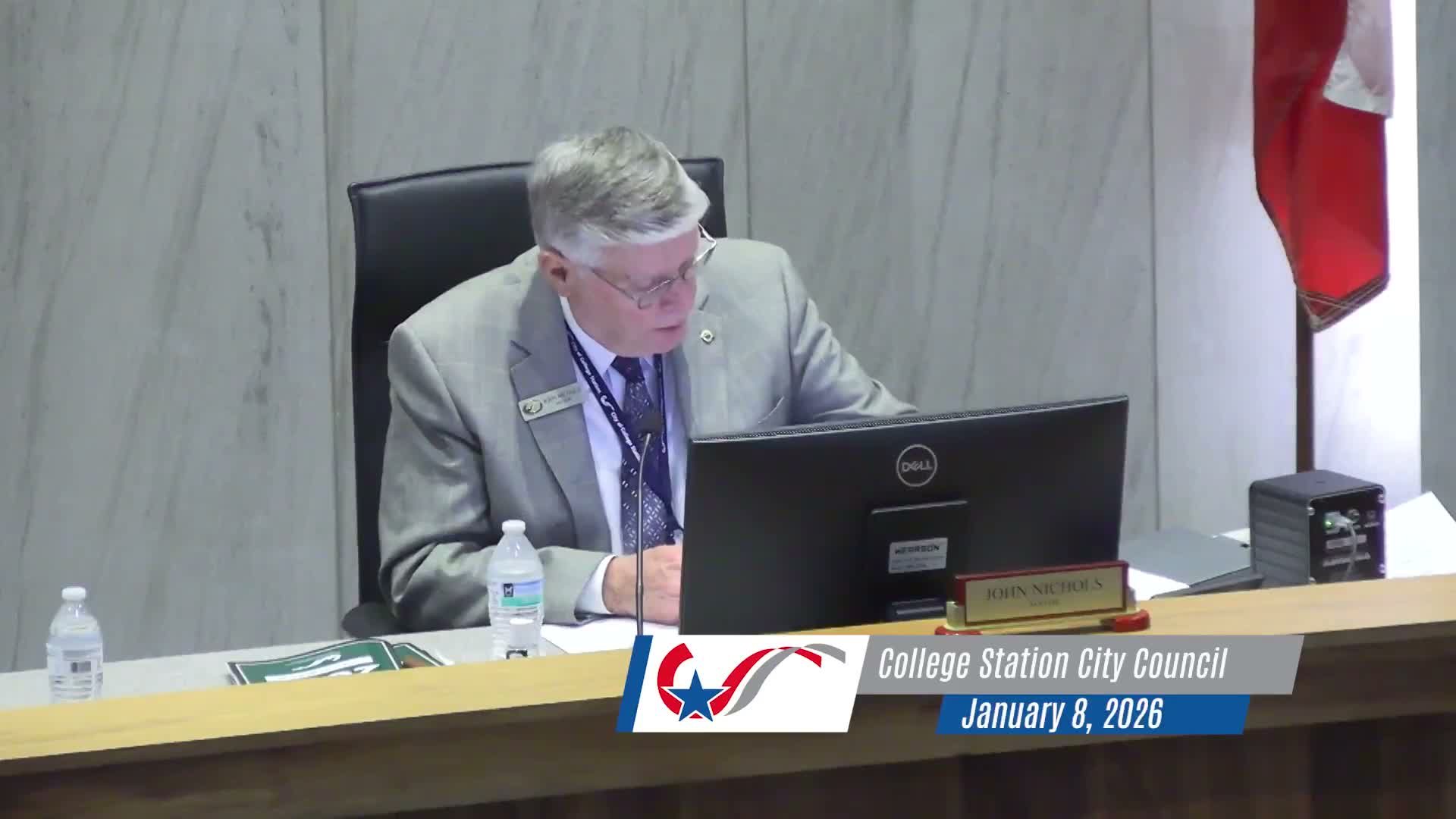
Mayor John P. Nichols invited Chief Couch to brief the City Council on the police department's mental‑health response at the Jan. 8 meeting.
Chief Couch said the department has stood up a Care Team (two full‑time positions funded initially by grants) plus 20 crisis‑intervention officers across patrol and Northgate, and that staff work closely with MHMR of the Brazos Valley and area schools. "These members manage caseloads, proactively reach out, and are responsive to our partners," Chief Couch said. He added that MHMR has an office adjacent to the police care team to enable immediate coordination.
The chief presented data showing an increase in recorded mental‑health consumer incidents to roughly 1,300 per year for the past two years. He attributed much of the rise to improved coding and the department's full‑time tracking: "Prior to going full time in '24, there were some codes missed…now my care team coordinator reads every report, so we don't miss them." Couch also told council the department averages very low uses of force on these calls — "an average of 8 over the last 3 years" — and emphasized training and de‑escalation.
Council members and the mayor pressed for operational and system‑level details: where involuntary holds are taken, the transport burden, and whether local inpatient capacity exists. Chief Couch said the region has had limited local inpatient beds for several years; transports are most often handled by the sheriff for placement outside the county. On grant sustainability, he said the city budget includes funding to maintain the care‑team positions if pass‑through grant money declines.
A resident, Valen Cipack, gave a three‑minute testimony about personal experiences with crisis response and hospital stays, and praised the clarity and compassion of the care‑team officers. "When Chief Couch's guys showed up, it was very clear. This is what we're here to do," Cipack said.
Why it matters: Council members said the discussion showed the city has strengthened frontline response but lacks the full continuum of local treatment capacity. Multiple council members asked staff to return with a community‑level assessment of service gaps and to convene partners, including hospitals, the county, and universities. The council also asked the city manager to gather information about mental‑health court models and other cross‑jurisdictional options; the Brazos County mental‑health court was noted as an existing regional resource.
Next steps: Staff will follow up with a public conversation and technical options for addressing acute inpatient capacity, funding strategies for sustaining positions if grants lapse, and how the city might partner with regional providers and the county on courts and transport burdens.