Muncifa details loans, pipeline and federal funding risks as senators press on transparency and farmland impacts
Loading...
Summary
Kari Gross Swan, executive director of the Minnesota Climate Innovation Finance Authority, told the Senate committee Muncifa has closed $23.1 million in loans, has a $100M+ pipeline and seeks to distribute $50 million more in 2026, while federal grants and tax-credit sunsets and questions about closed credit-committee meetings and solar gardens on prime farmland drew scrutiny.
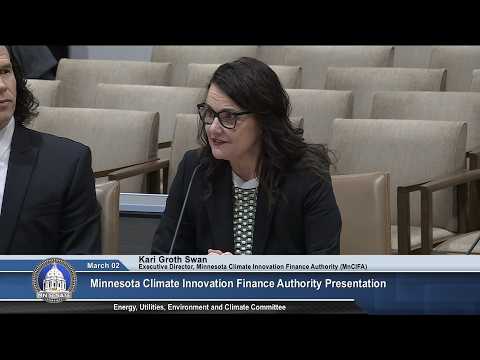
Kari Gross Swan, executive director of the Minnesota Climate Innovation Finance Authority (Muncifa), briefed the Senate Energy, Utilities, Environment and Climate Committee March 2 on the authority’s operations, financing results and plans for 2026.
Swan said Muncifa is a state-created financing authority (enacted in 2023) that provides loans, not grants, to accelerate clean-energy projects and to crowd in private capital. "We are set up to be self sustaining. We are a revolving loan fund," Swan told the committee.
Key figures and portfolio: Swan said Muncifa is operating with about $105,000,000 in financing drawn from state appropriations and transfers, including a one-time $45,000,000 appropriation and a $60,000,000 competitiveness transfer to leverage federal tax credits. She said Muncifa has closed $23,100,000 in loans, approved $14,300,000 pending closure, and is reviewing a pipeline exceeding $100,000,000. Swan reported a roughly 5-to-1 crowd-in of private capital for closed deals ("we have crowded in another $107,000,000 in private capital").
Federal risks and litigation: Swan told senators an EPA $25,000,000 grant (via the Coalition for Green Capital) and a $24,000,000 "solar for all" grant are frozen and in federal litigation; she also said the Department of Energy loan program office is no longer funding renewable energy loans, reducing expected federal capital. Those changes and the scheduled sunsetting of federal ITC/PTC tax credits in 2026, she said, have a direct impact on potential borrowers and the authority’s loan volume.
How loans are approved: Swan described a multi-step underwriting process: a staff investment team conducts financial analysis and statutory compliance checks; a credit committee (which meets in closed session because it generally does not constitute a quorum) reviews proprietary materials, then a public board meeting holds a roll-call vote and publishes redacted credit memos. "So our final process is the board of directors. That final decision is held in an open meeting," Swan said.
Projects and impacts: Swan highlighted several financed projects, including a $1.8 million bundled loan for community and faith-based solar projects (Celtic Junction in Saint Paul), the Sandstone workforce-housing rehabilitation (a roughly $25 million project that included high-efficiency boilers, HVAC and windows), and a $500,000 loan to CARBA Inc. to commercialize woody-biomass-derived biocarbon. Swan said Sandstone’s Muncifa share was a small portion (about 3.6%) of total project financing and that the authority’s loans help make projects viable and crowd in other capital.
Senators pressed on transparency and local impacts. Senator Green asked how closed credit-committee meetings align with open-meeting law; Swan said final approvals are public and that credit memos with proprietary material are redacted before publication. She described the closed committee as a technical review that leads to public board votes. "There is a credit memo that is provided to anyone who wants to come, stripping out some of the proprietary information," Swan said.
Senator Green also asked how much of project capital comes from other state or federal funds; Swan said Muncifa typically participates in a small portion of a project’s capital stack and that the authority’s funding is intended to leverage tax credits, bank lending and philanthropic funds. She cited banks (Midwest, Stearns Bank, Sunrise Bank, Min-Wet Bank) and state agencies (Deed, Commerce, Housing) that have appeared in capital stacks.
Senator Gruenhagen raised concerns about large community solar installations on prime farmland and suggested such projects could damage soil and impose cleanup costs. Swan said site selection depends on landowner consent and local permitting and that the farmer’s decision is central to whether a community solar garden advances. "The first and final decision maker on where a community solar garden is built is the farmer that owns the land," she said.
On biochar, Senator Green asked for data on carbon emissions from producing biochar versus letting woody waste decompose; Swan offered to connect the committee with CARBA’s founder and noted the company’s patented, university-developed technology.
Next steps: Swan said Muncifa published a call for applications and aims to distribute $50,000,000 in new loans in 2026, focusing on projects that reduce energy costs, increase reliability and expand opportunities in rural and tribal communities. She said the authority will continue to publish board minutes and credit memos (with proprietary redactions) and to report annually on progress.
The committee did not take formal action on Muncifa during the hearing; the briefing was informational.