Get Full Government Meeting Transcripts, Videos, & Alerts Forever!
Get email alerts on the Taxes Agriculture topic
No spam. Unsubscribe anytime.
Assembly restores farm-structure property tax exemption, delays effective date to 2027
Summary
After public testimony and discussion about eligibility language, the Fairbanks North Star Borough Assembly voted 9–0 to reinstate a property tax exemption for qualifying farm structures, amending the ordinance to take effect Jan. 1, 2027 to give assessors time to implement rules.
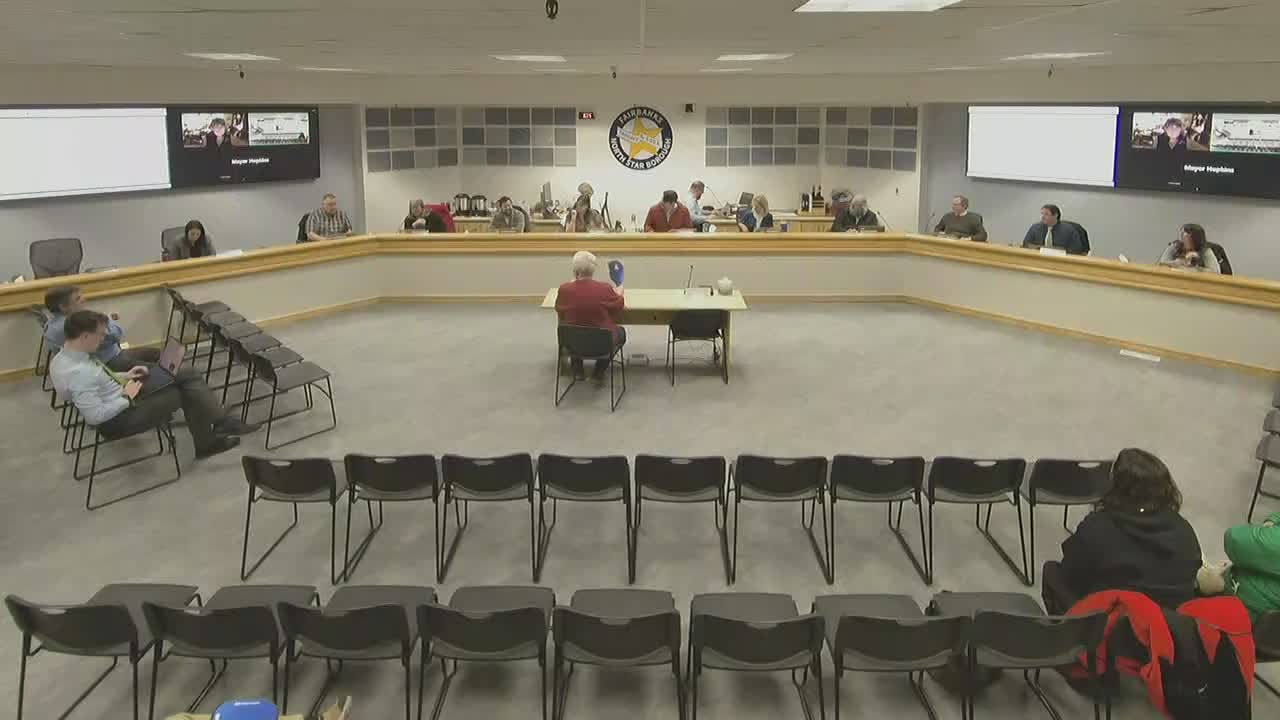
The Fairbanks North Star Borough Assembly on Feb. 26 adopted ordinance 20-26-06, restoring a property-tax exemption for qualifying farm structures and setting an effective date of Jan. 1, 2027.
Assemblymember Trista Crass presented the staff report explaining the ordinance would reestablish an exemption authorized by Alaska Statute 29.45.050(T), restore the policy voters approved in 2023 and align borough code with changes in state law. Crass said the change aims to support local agriculture, food security and infrastructure investment while noting the state law includes a deferred-tax penalty if land stops being used for farming.
During public comment, Heather Koponnen urged refinements to the draft ordinance’s eligibility language so small or starting farmers are not locked out by thresholds such as minimum sales. Sam Knapp, who farms in Cripple Creek, said a climate‑controlled storage building used to keep winter produce viable had increased his tax burden and that an exemption would lower overhead for similar operations.
Assemblymembers debated definitional language, asking how the term “exclusively” would apply to structures that house tractors or equipment used for both farm and nonfarm tasks. Borough staff said structures used exclusively for farming activity — including buildings that house tractors used for agricultural work — are meant to qualify under the ordinance’s definitions.
Assemblymember Crass moved an amendment to change the ordinance’s effective date to Jan. 1, 2027 to give the assessor’s office time to prepare application and implementation procedures; the amendment passed unanimously. The amended ordinance later passed on final vote, 9–0.
The ordinance restores a voter-approved policy intended to reduce operating costs for farming infrastructure; the board and staff said the measure removes a barrier for entrepreneurs building farm storage and processing space. The staff report and public testimony noted a state‑level deferment provision that could require repayment of deferred taxes if land use changes, a point some speakers said they found concerning.
Next steps: staff will finalize implementation guidance for landowners seeking the exemption and publicize the application process ahead of the Jan. 1, 2027 effective date.
Quotation examples from the meeting: “This is exactly what we voted on in the election,” said Assemblymember Wilson, supporting reinstatement and emphasizing voter intent. Sam Knapp, a local farmer, described storing “about 32,000 pounds of veggies” and said the building’s added tax burden was a conservative estimate of about $500 annually.