
MassDEP inspection finds gaps in vapor‑intrusion mitigation; proposes stricter operating‑regimen requirements
Get AI-powered insights, summaries, and transcripts
Subscribe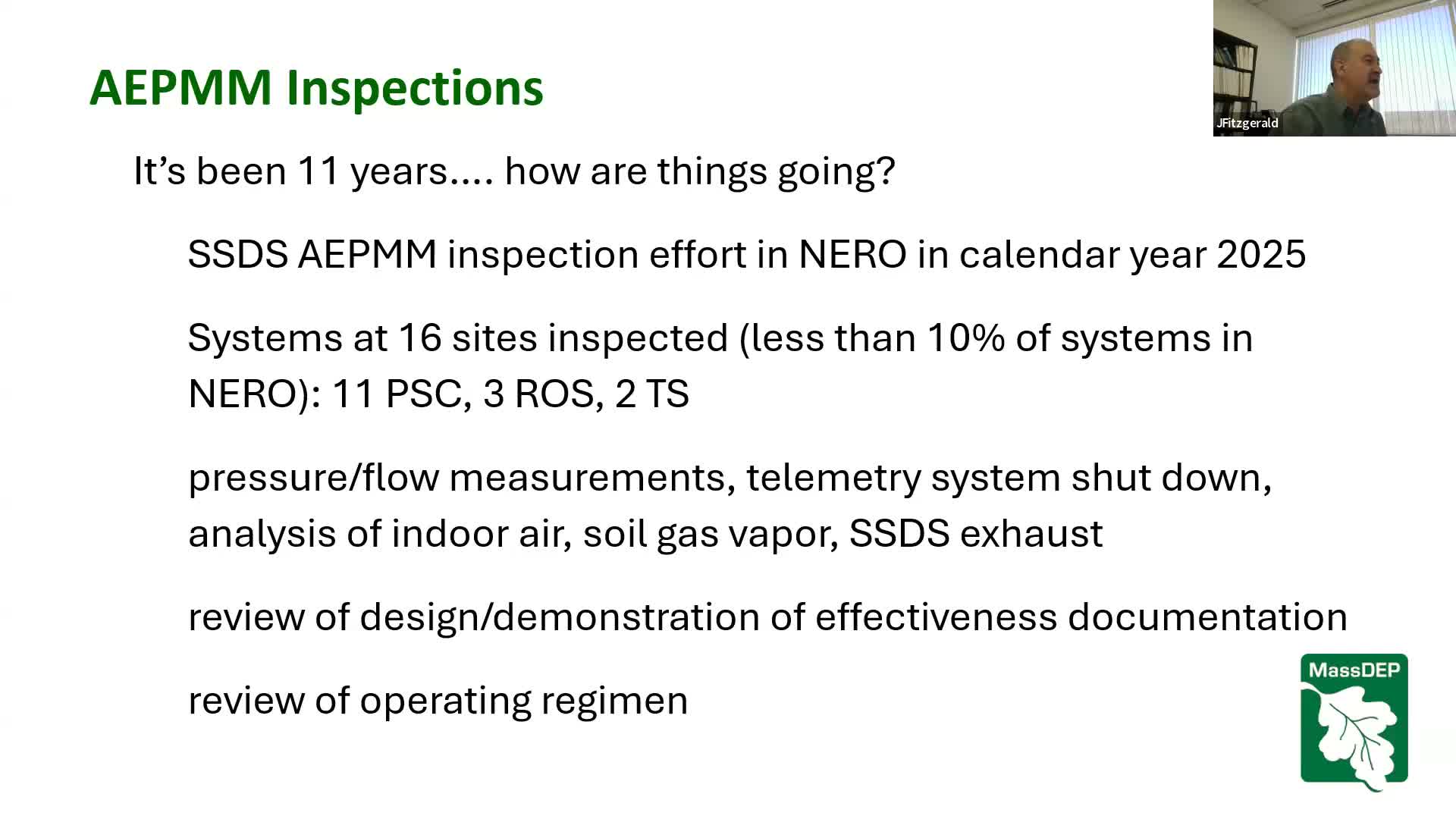
Summary
MassDEP presented 2025 inspections of active exposure pathway mitigation (APM) systems and found many sites lacked clear operating regimens, monitoring, or functioning instruments. Staff proposed requiring demonstrable correlation between extraction vacuum, sub‑slab pressure fields and indoor air, plus telemetry and defined vacuum ranges.
John Fitzgerald, who led a recent inspection initiative, told the advisory committee MassDEP inspected 16 APM sites in calendar year 2025 (a small subset of systems statewide) and found widespread deficiencies in documentation, monitoring and records.
Fitzgerald said department staff performed pressure and flow measurements, telemetry checks, indoor‑air and soil‑gas sampling, and reviews of design demonstrations. He said no imminent hazards were identified but the audits showed that six of 15 permanent‑solution sites had no operating regimen or O&M requirements, and six of nine sites with regimens had deficient provisions.
Common problems included as‑built plans that did not reflect installed systems, a lack of correlation data tying extraction vacuum to sub‑slab negative pressure fields and indoor‑air results, missing manometer gauges or nonfunctional gauges at extraction points, and absent monitoring records that the operating regimen required. Fitzgerald said these gaps undermine confidence that systems operating ‘‘as designed’’ actually maintain a condition of no significant risk.
Fitzgerald outlined elements MassDEP intends to include in forthcoming guidance: a discrete, public operating‑regimen document for each APM; as‑built plans and a demonstration of effectiveness; tabulated acceptable vacuum ranges (lower and upper limits) at extraction and monitoring points; demonstration of correlation between extraction vacuum, sub‑slab vacuum and indoor air concentrations; a telemetry strategy for continuous vacuum measurement at key extraction points; complementing on‑site inspections tied to telemetry certainty; and clear recordkeeping and maintenance schedules.
Staff and advisors discussed telemetry limits and the technical challenge of low‑level transducers; advisor Matt suggested continuous telemetry at representative extreme locations to ensure vacuum field coverage, and Sarah recommended specifying upper vacuum limits as well as lower. MassDEP said it will convene a focused session with practitioners to work through technical details before issuing formal guidance.
Next steps: MassDEP plans a stakeholder walkthrough of the APM concepts, formation of a focused practitioner group, and publication of standalone guidance on operating regimens prior to broader vapor‑intrusion guidance updates.